
Reviewed · ATHENS BIKE TOURS
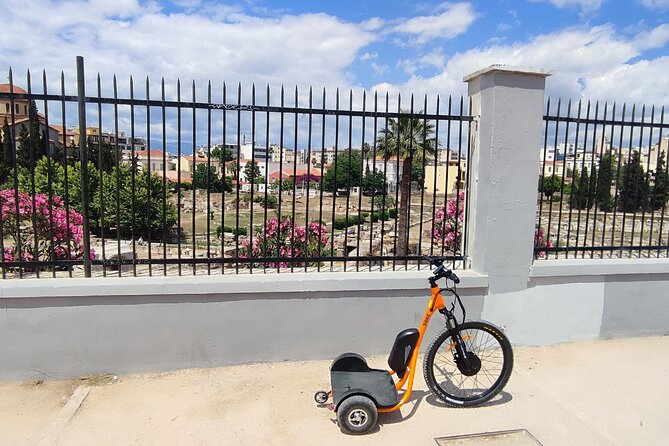
Ancient Athens E-Bike Tour
Two hours can change how you see Athens. This Ancient Athens e-bike tour uses a standing electric trike that keeps you moving while still taking in the big monuments up close. I like that you get a small-group feel (max 12) and a guide who helps you connect the dots—so the sites don’t feel like random stops. One thing to plan for: archaeological entry tickets aren’t included, so you’ll likely add a few euros on top.
What I love most is the efficiency without feeling rushed. You cover the Acropolis area, the ancient civic core, and the old neighborhood streets (Plaka and Monastiraki) in one smooth loop, then you can head back out later on your own time to linger where you want. Guides like Dimitris and Kevin (from past groups) also seem to adapt based on what you already saw, which helps a lot if you’re on a tight schedule.
In This Review
- Key things to know before you ride
- Why a standing e-bike makes sense for Athens highlights
- Meeting point on Leof. Andrea Siggrou 22: start strong, not stressed
- Two hours, nine-plus historic stops: how the rhythm works
- Theatre of Dionysus and the Odeon of Herodes Atticus: where Greek drama began
- Acropolis Hill: close-side views that save your legs
- Pnyx: stepping into the birthplace of democracy
- National Observatory of Athens: Hill of the Nymphs and a calmer pace
- Ancient Agora + Kerameikos: markets, ceramics, and civic life
- Monastiraki and Roman Agora: the Tower of the Winds moment
- Plaka: finish where the city looks like a postcard
- Price and value: $72.09 for the ride, plus your likely entry adds
- Guides, small-group energy, and what to expect from the commentary
- Safety and comfort: helmet on, pedaling off
- Weather and timing: build your day around the Athens forecast
- Should you book this Ancient Athens e-bike tour?
- FAQ
- Is the tour duration really about two hours?
- Do I need to pedal on the standing e-bike?
- Are archaeological tickets included in the price?
- What’s included with the tour?
- Where does the tour start and end?
- What language is the tour offered in?
- How big is the group?
- What happens if the weather is poor?
- What if I cancel close to the start time?
Key things to know before you ride
- Standing Trikke e-bikes are designed for comfort and easy control, and you don’t pedal.
- Small group size (up to 12) keeps the pace friendly and the commentary more personal.
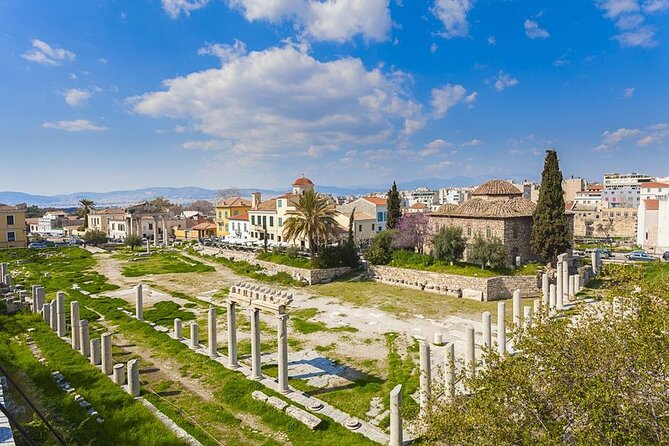
- Two hours, big coverage: Acropolis Hill, Pnyx, Ancient Agora, Keramikos, Monastiraki, Roman Agora, Plaka.
- Tickets are extra: the tour covers the riding and guidance, but archaeological admissions may cost 20€, 4€, or be free depending on the stop.
- Helmet + activity insurance are included, which matters when you’re zipping around crowded areas.
- Mobile ticket + English guide make this a straightforward buy-and-go plan.
Athens by pedal, a couple more routes
- Athens Scenic Electric Bike Tour with optional Acropolis visit
★ 5.0 · 3,350 reviews - Athens: City Electric Bike Tour with Acropolis Visit Option
★ 4.9 · 1,017 reviews - Athens Small Group E-Bike Tour
★ 5.0 · 1,013 reviews - Historic Athens: Small Group Electric Bike Tour
★ 4.9 · 966 reviews
Why a standing e-bike makes sense for Athens highlights

Athens rewards slow travel, but most trips don’t give you that luxury. This tour is built for the reality that you want the big-picture sights without spending your entire day walking up and down hills.
The standing electric trike is the secret. Instead of dismounting, folding your feet into shoe-shredding distances, and then trying to “catch up” with your group, you stay on board and keep gliding. That changes the tone of the experience. You can actually look around while moving—toward the Parthenon, down into valleys, and across neighborhood squares—without turning every moment into a workout.
And because it’s motor-assisted, it’s a nice fit for people who can walk but don’t want steep stairs to be the main activity. You also get a helmet, plus included safety support via the tour’s insurance.
One more practical point: you’re not just seeing monuments from far away. The route is designed around short stops with good sightlines, so you get close enough to understand why people obsessed over these places in the first place.
Meeting point on Leof. Andrea Siggrou 22: start strong, not stressed
You’ll meet at Leof. Andrea Siggrou 22, Athina 117 42 and finish back at the same spot. The central meeting end-point matters more than it sounds. After the ride, you can decide immediately: do you want a snack in Monastiraki, explore Plaka lanes on foot, or head to a museum nearby?
The tour runs Monday–Saturday, 10:00 AM to 4:00 PM during the stated operating period. If your sightseeing plan has you bouncing between neighborhoods, this midday window can be a good “spine” day: you knock out the major anchors first, then fill in the details later.
You’ll also have a mobile ticket, which means fewer head-scrambles with paper vouchers.
Two hours, nine-plus historic stops: how the rhythm works
This is a short tour, so the best way to think about it is like a guided “highlights reel” with built-in pause moments. You’ll ride between areas, then spend just enough time at each stop to orient yourself, learn what matters, and snap mental notes for later.
Here’s what that looks like in real life.
More of Athens by bike

Theatre of Dionysus and the Odeon of Herodes Atticus: where Greek drama began
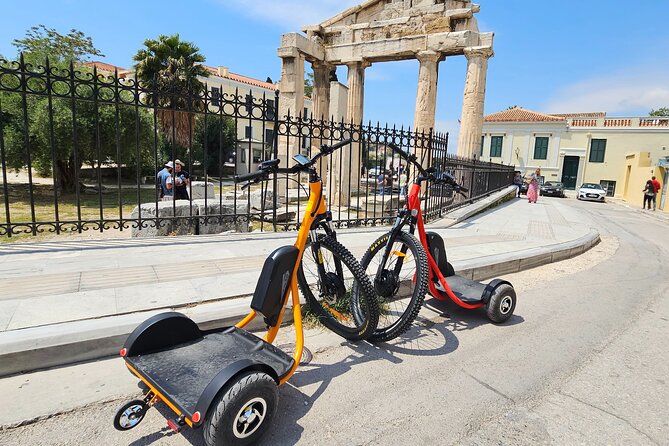
One of the first stops is the Theatre of Dionysus, described as the first theatre of the world and the starting point of theatre. Even if you know almost nothing about ancient drama, you’ll leave with a clearer feeling for the cultural importance of performance in Athens.
Right after that, you’ll also see the Odeon of Herodes Atticus, a Roman-era theatre still used for shows. It was built in the 2nd century A.D. as a memorial gift connected to Herod Atticus’ wife.
Practical note on tickets: the tour notes say the Acropolis Hill ticket includes the Theatre of Dionysus, and it also states the Acropolis Hill ticket includes the Odeon of Herodes Atticus too. At the same time, the information lists an entry price for the Odeon stop as 20€. That’s a cue to check how the admissions are handled when you arrive or in your booking details—don’t assume you’ll pay the same way for both. Either way, budgeting for an extra site-ticket line is smart.
Why this stop matters: these theatres aren’t just architecture. They explain how public life worked—religion, politics, storytelling, and community gathered in one physical place.
Acropolis Hill: close-side views that save your legs
The tour then turns toward the Acropolis, framed as the key hill in Athens with the Parthenon up top. The big value here isn’t just the monument itself—it’s the way you get to watch the hill from a very close side.
If you’ve ever tried to “do the Acropolis quickly” on foot, you know how the day can evaporate into stairs and queues. Here, you spend less time transporting yourself and more time getting oriented: where the Parthenon sits, how the slopes connect, and what views open up.
Tickets: Acropolis entry is listed at 20€, and archaeological admissions aren’t included in the tour price. Plan to add that if you want to go inside during your time there.
If you’re sensitive to heat or you’re arriving from a long travel day, this style of approach helps. You can still appreciate the scale and story without burning your energy before the main viewing moments.
Pnyx: stepping into the birthplace of democracy

Next up is Pnyx, described as the place where democracy started. You also get the bonus of context because it’s inside an archaeological area that’s also a park.
Why I like this stop: it’s not as “iconic-photo-only” as the Parthenon area. Instead, it feels more like a place where ideas played out in public space. When your guide explains what happened there, you start noticing how the geography supports the politics—sightlines, assembly space, and the sense of open gathering.
Entry here is listed as free. That’s a nice win on a tour where other stops may cost extra.
National Observatory of Athens: Hill of the Nymphs and a calmer pace
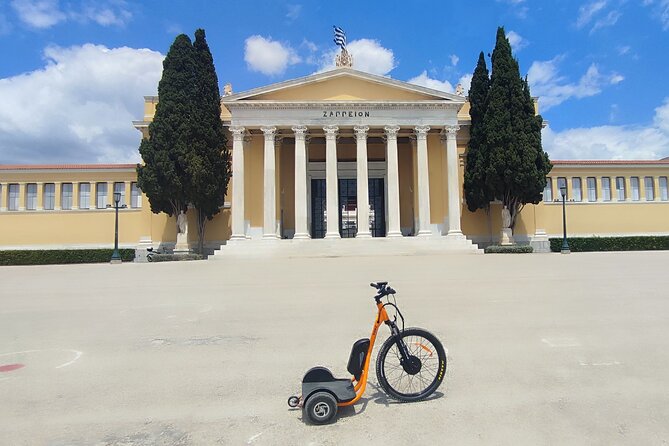
You’ll also visit the National Observatory of Athens, described as the first observatory of Athens. It’s located on the Hill of Nymphs, again inside an archaeological area and park.
This is one of those stops that often becomes “just a viewpoint” on many tours, but it can be more than that if the guide ties it to Athens’ relationship with knowledge and observation. The observatory angle gives you a different lens on the city beyond temples and markets.
The tour data says admission is included for this stop. That’s another plus for value because it’s one less paid stop in your day.
Ancient Agora + Kerameikos: markets, ceramics, and civic life
Now you shift into the ancient daily-world zone: Ancient Agora of Athens, described as the most important side of Ancient Greece and the main market in ancient society. You’ll spend about 20 minutes here, which is enough time to learn what the Agora represented and how it functioned as a social and economic hub.
Entry is listed at 4€, and it’s also indicated as included for that stop. So again, your real-world cost may depend on how the tour handles site admissions on the day. The safest planning approach is: assume some archaeological costs may apply, and keep a few euros ready.
Keramikos is the neighboring piece: an archaeological area tied to ceramics production, which is why the area’s name relates to pottery. The stop here is shorter (around 10 minutes) and is marked as free.
Why this pair works: Agora without Kerameikos can feel like theory. Kerameikos adds the “how everyday life was made” layer—materials, craft, and the economic rhythm behind the public squares.
Monastiraki and Roman Agora: the Tower of the Winds moment
Then you head into modern Athens with a deep ancient backbone: Monastiraki, described as the heart of Athens with bars, restaurants, and lots of options around it. It’s also noted as one of the city’s most crowded squares, so expect energy.
From there, you continue to the Roman Agora, described as the Roman version of the Greek Agora, built in the 2nd century A.D. It includes the Tower of the Winds.
Tickets here are listed in a couple different ways in the provided information: the Roman Agora stop shows 4€ and is also marked free. Because the tour doesn’t include archaeological tickets overall, I’d treat this as “may be paid or may be included depending on what’s required at the time.” Keep a little cash/card buffer so you don’t stall your day at the entrance.
Why this stop is worth your attention: Tower of the Winds is a visual anchor that connects ancient measurement and daily life. Even if you only catch it briefly, you’ll understand why Athens cared about time, weather, and planning.
Plaka: finish where the city looks like a postcard
Finally, you end in Plaka, the traditional neighborhood described as picturesque and “like a Greek island” in the heart of Athens. The stop is short (about 10 minutes) and marked free.
This is a smart ending because Plaka is where you naturally want to keep wandering. After two hours on the trike, you’re not exhausted enough to call it quits. You have enough context to know what you’re looking at—and enough energy to explore at your own tempo.
Price and value: $72.09 for the ride, plus your likely entry adds
The tour price is $72.09 per person, for around two hours. That includes the trike use, helmet, and insurance.
So what are you paying for, exactly?
- Time efficiency: you cover multiple major zones in one go. For a city built on hills and layers of ruins, cutting down on transit and walking adds real value.
- Guided interpretation: the stops aren’t just photo ops. The theatre + democracy + Agora flow helps you feel connections across ancient Athens.
- Reduced friction: standing electric trikes help you avoid the “I’m too tired to enjoy it” problem.
Now the add-on reality: archaeological tickets aren’t included. Some entries are listed as 20€ (Acropolis, and also Odeon of Herodes Atticus is noted with a 20€ figure), while others are listed as 4€ (Ancient Agora and Roman Agora), and a few are marked free (like Pnyx, Keramikos, and Plaka; Monastiraki is marked as included).
Because the notes also say the Acropolis Hill ticket may cover the Theatre of Dionysus and Odeon of Herodes Atticus, you might not pay for every charged item separately. Still, budget for at least the Acropolis Hill entry if you want full value from the day.
My advice for planning: treat the $72.09 as the cost of the experience and direction, then add a separate line for site admissions. That keeps you from making the day too tight.
Guides, small-group energy, and what to expect from the commentary
With a maximum of 12 travelers, you’re not swallowed by a crowd. That matters when you’re moving from spot to spot—your guide can adjust pace, and you can ask follow-up questions without waiting for the whole line.
The reviews mention guides like Dimitris, who tailored the route if you already visited certain areas, and Kevin in another group. I also like that the tour can give you “why it matters” explanations, not just dates and names.
If you’re the type who enjoys learning the story behind a building, this style fits. If you want pure sightseeing with minimal talk, you might still appreciate the guidance because it helps you notice things you’d otherwise walk past.
Safety and comfort: helmet on, pedaling off
You don’t need to pedal. That’s a big practical difference. You’ll still steer and balance, but the motor assist keeps the ride friendly in hilly areas and crowded streets.
The tour includes a helmet and activity insurance. That combination is reassuring. It’s not just “we gave you a bike,” it’s “you have basic protection and coverage for the activity.”
If you’ve never ridden a trike before, give yourself a minute at the start to get comfortable. Once you do, you’ll likely find the pace feels natural—and you’ll have more attention left for the viewpoints.
Weather and timing: build your day around the Athens forecast
This experience depends on good weather. If poor conditions cancel the tour, you’re offered a different date or a full refund.
That matters in Athens because heat, wind, and rain can change how comfortable it feels on any outdoor route. If your trip includes more than one day with a “safe weather window,” it can be worth scheduling this tour on the most reliable day you have.
Also, with the listed hours running from 10:00 AM to 4:00 PM, you’re mostly doing this in the daylight stretch. That’s perfect for seeing monuments clearly, but pack sun protection and water if you’re traveling in warmer months.
Should you book this Ancient Athens e-bike tour?
Book it if:
- You want the major ancient Athens highlights in a tight timeframe.
- You’d rather spend your energy on looking and learning than on walking steep stretches.
- You like a small-group guide who helps you connect the monuments to what Athens became later.
- You’re curious about multiple layers: theatre, democracy, marketplaces, and neighborhood life.
Skip it (or pair it with a different plan) if:
- You already know you want a long, slow Acropolis-day with lots of time inside museums and galleries.
- You hate the idea of paying extra entry tickets on top of the tour price.
If you’re trying to get a first hit of Athens—then roam on your own afterward—this is a strong way to do it. You’ll ride out with a mental map, not just a camera roll.
FAQ
Is the tour duration really about two hours?
Yes. The experience is listed as approximately 2 hours, with stops designed to keep things moving while still giving you time at key sights.
Do I need to pedal on the standing e-bike?
No. The standing electric trike is described as no pedaling required, so you can focus on steering and enjoying the views.
Are archaeological tickets included in the price?
No. Tickets to archaeological areas are not included, and the tour notes list entry prices for several stops (including 20€ and 4€) along with some stops marked free or included.
What’s included with the tour?
The tour includes use of the trikke (standing e-bike), a helmet, and costumer insurance as listed.
Where does the tour start and end?
It starts at Leof. Andrea Siggrou 22, Athina 117 42, Greece and ends back at the same meeting point.
What language is the tour offered in?
The tour is offered in English.
How big is the group?
This tour has a maximum group size of 12 travelers.
What happens if the weather is poor?
The experience requires good weather. If it’s canceled due to poor weather, you’ll be offered a different date or a full refund.
What if I cancel close to the start time?
You can cancel for a full refund if you cancel at least 24 hours in advance. If you cancel less than 24 hours before the experience starts, it won’t be refunded (changes within 24 hours aren’t accepted).
More Tours in Athens
- Athens: Acropolis, Parthenon & Acropolis Museum Guided Tour★ 4.8 · 9,316 reviews
- The Acropolis, Parthenon & Acropolis Museum Guided Tour★ 4.7 · 8,493 reviews
- Acropolis: Premium Acropolis and Parthenon Guided Tour★ 4.8 · 5,208 reviews
- Athens: Mythology of Delphi, Museum and Arachova Guided Tour★ 4.7 · 5,102 reviews
- Acropolis and Parthenon Guided Walking Tour★ 5.0 · 4,755 reviews
- Greek Food Walking Tour in Athens★ 5.0 · 4,740 reviews
More Tour Reviews in Athens
- Athens: Acropolis & up to 5 Archaeological Sites Combo Pass★ 4.2 · 13,904 reviews
- Athens: Acropolis, Parthenon & Acropolis Museum Guided Tour★ 4.8 · 9,316 reviews
- The Acropolis, Parthenon & Acropolis Museum Guided Tour★ 4.7 · 8,493 reviews
- Athens: Cape Sounion & Poseidon Temple Sunset Half-Day Trip★ 4.8 · 8,241 reviews
- Acropolis: Premium Acropolis and Parthenon Guided Tour★ 4.8 · 5,208 reviews
- Athens: Mythology of Delphi, Museum and Arachova Guided Tour★ 4.7 · 5,102 reviews
Two Wheels Through Athens
- Athens Scenic Electric Bike Tour with optional Acropolis visit★ 5.0 · 3,350 reviews
- Athens: City Electric Bike Tour with Acropolis Visit Option★ 4.9 · 1,017 reviews
- Athens Small Group E-Bike Tour★ 5.0 · 1,013 reviews
- Historic Athens: Small Group Electric Bike Tour★ 4.9 · 966 reviews
- Highlights of Athens biketour★ 5.0 · 840 reviews
- Athens Electric Bike Tour★ 5.0 · 836 reviews
Fresh Off the Boat: New Athens Reviews





Athens Bike Tours, compared.
 ★ 5.0Athens Scenic Electric Bike Tour with optional Acropolis visitFrom $353,350 reviews
 ★ 4.9City Electric Bike Tour with Acropolis Visit OptionFrom $531,017 reviews
 ★ 5.0Athens Small Group E-Bike TourFrom $351,013 reviews
 ★ 4.9Historic Athens: Small Group Electric Bike TourFrom $41966 reviews
 ★ 5.0Highlights of Athens biketourFrom $47840 reviews
 ★ 5.0Athens Electric Bike TourFrom $58836 reviews
 ★ 4.9City Bike tour with Acropolis Visit Option665 reviews
 ★ 4.9Discover the City Electric Bike TourFrom $54544 reviews
Browse the lists this tour appears in