

Reviewed · ACROPOLIS & PARTHENON TOURS
Athens: Acropolis Entry Ticket & VR Audio Guided Tour
An app-led walk through Athens oldest stones. This timed Acropolis entry keeps you moving past the worst crowd moments, and I like the fact that the experience comes with 9-language audio plus a VR layer so you understand what you are seeing instead of just snapping photos. You also get a built-in route focus around the Theater of Dionysus and the Parthenon area.
The main thing to weigh is that this is self-guided on your phone. If your screen is hard to read in strong sun or your battery is low, you’ll feel it, because the audio and VR experience depend on having a charged device and (ideally) headphones.
In This Review
- Key things I’d pay attention to before you go
- Timed Acropolis Entry That Actually Changes Your Day
- Getting the Ticket and Starting the VR Audio Guide
- Theater of Dionysus: The Best Place to Start for Meaning
- Parthenon and Propylaea: Where You’ll Actually Use the Audio
- Temple of Athena Nike, Erechtheion, and the Odeon of Herodes Atticus
- The VR App Factor: Worth It, But Use It Intelligently
- Views Over Athens: Timing, Sun, and Phone Battery Reality
- Price and Value: What You’re Really Paying For at $53
- When This Works Best (and When It Might Not)
- Should You Book This Acropolis VR Audio Tour?
- FAQ
- How long is the Acropolis entry and audio tour?
- What’s included with the ticket?
- How many languages are available for the audio guide?
- Do I need headphones?
- Where do I enter the Acropolis?
- Can I change the date or time slot after booking?
- Is it wheelchair accessible, and are strollers allowed?
Key things I’d pay attention to before you go

- Timed entry + separate access: you enter in your window instead of fighting the general lines
- VR audio format: you get ancient-scene context right where you stand
- Multiple stops built into the flow: Theater of Dionysus → Parthenon → key temples and monuments
- Nine language options: audio is available in English and many others, not just the usual two
- Smartphone power matters: plan for battery life and screen visibility in daylight
More ways up the sacred rock, set side by side
- Athens: Acropolis & up to 5 Archaeological Sites Combo Pass
★ 4.2 · 13,904 reviews - Athens: Acropolis, Parthenon & Acropolis Museum Guided Tour
★ 4.8 · 9,316 reviews - The Acropolis, Parthenon & Acropolis Museum Guided Tour
★ 4.7 · 8,493 reviews - Acropolis: Premium Acropolis and Parthenon Guided Tour
★ 4.8 · 5,208 reviews
Timed Acropolis Entry That Actually Changes Your Day

The biggest practical win here is the pre-reserved time slot. The Acropolis is famous for crowds, and a timed ticket turns the visit from chaos into a schedule. You still walk at your own pace, but you are not stuck waiting with everyone else for an open gate.
This ticket also gives you skip-the-line style access via a separate entrance. That matters because the Acropolis bottleneck is usually at the start—getting in, then getting your bearings. Once you’re through, the hill opens up and you can focus on monuments instead of crowds.
One more plus: your 2-hour window is realistic. You can see the major highlights without running. If you like slow looking—surface details, alignment, and viewpoints—you’ll appreciate that the time frame is long enough to do it calmly.
Getting the Ticket and Starting the VR Audio Guide
After booking, your ticket is sent to your email or WhatsApp. The day before, you should also receive the instructions for the VR audio guide through WhatsApp messenger or email (including spam, if you’re unlucky). On the day of your visit, you bring the PDF ticket on your phone or printed paper and show it at the Main or South entrance.
Here’s what I’d do to make the start painless:
- Charge your smartphone fully the night before.
- Bring headphones (earphones are not included).
- Download whatever the instructions require before you get to the entrance area, if that’s possible for your device.
Your first job is to get going—no long meeting, no group wrangling, no waiting for a live guide to arrive. Once you’re in, you follow the audio/VR prompts at each monument.
It’s also wheelchair accessible, and since this is a self-guided route, you can pause when you need to. One caution: baby strollers are not allowed, and pets are also not allowed, so plan your logistics accordingly.
Theater of Dionysus: The Best Place to Start for Meaning
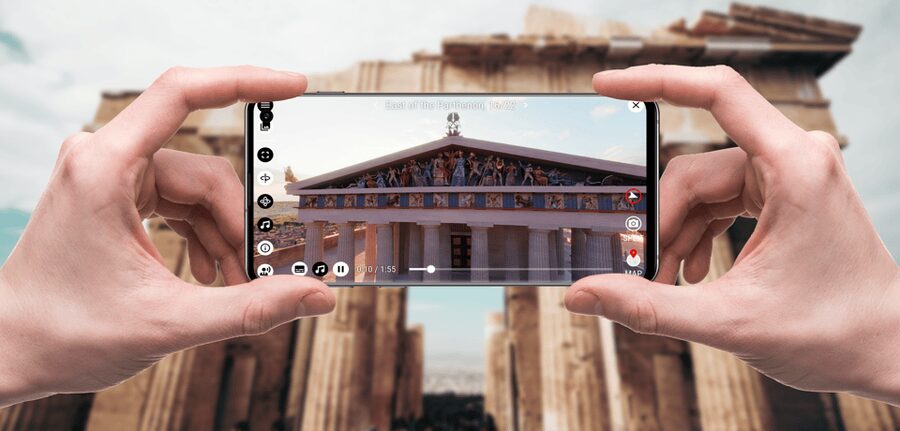
Your visit begins at the Theater of Dionysus. Starting here is smart because it gives you the culture context before you reach the biggest temple icons.
Even if you already know the Parthenon is the star, the Theater of Dionysus frames what the Acropolis meant to people in ancient Athens. This was a place tied to civic life and performance—an early reminder that these buildings were part of daily identity, not just a museum setting.
As you listen through the app, you’re not just hearing dates and names. You’re getting cues to connect shapes and functions to what you see around you. This is where the self-guided format can feel surprisingly effective: you control the tempo, so you can stop and read the angles and stonework instead of being rushed along.
Worth comparing before you book this Athens tour:



Parthenon and Propylaea: Where You’ll Actually Use the Audio
Next in the flow is the Parthenon, a UNESCO World Heritage Site dedicated to Athena. The app’s role here is to help you look. The Parthenon can feel like a single huge photo moment, but audio context encourages you to notice how the space works—how lines guide the eye, how the site’s layout supports movement, and why the Parthenon sits where it does.
From there, you move to the Propylaea. This is one of those areas where people slow down naturally because it feels like a gateway. With the audio playing, you’ll get more out of that feeling—you’ll understand you’re moving through a designed approach, not just walking uphill.
Two small realities to keep in mind:
- You will be outside, and the sun can be intense.
- Your phone screen can be harder to see in glare, which can make it tempting to keep the audio on and stop checking the visual instructions.
The goal is to use your eyes for the monuments and use the app as your background narrator, not as something you have to constantly babysit.
Temple of Athena Nike, Erechtheion, and the Odeon of Herodes Atticus
After the main temple zones, you continue through the highlights that many people skim past too quickly. The app helps you avoid that by treating each site as its own stop.
You’ll reach the Temple of Athena Nike. This is a great pause point because it’s close enough to feel part of the same complex, yet different enough to feel like a distinct piece of architecture. Listening while you look can help you notice how smaller temples fit into the broader sacred landscape.
Then comes the Erechtheion. This area often draws visitors because of its unique features and layout, and the audio guide is useful for putting that uniqueness into language. The monument becomes more than a landmark—it becomes a clue to how Athena and other stories shaped the place.
Finally, you have the Odeon of Herodes Atticus. This stop is a reminder that the Acropolis wasn’t only about temples. It also included major cultural venues. When the app shifts from religion to performance and civic life, the hill starts to feel more like an ancient city center and less like a set of ruins.
The VR App Factor: Worth It, But Use It Intelligently
The VR portion is designed to give you a glimpse of how the Acropolis Hill and surroundings might have looked in ancient times. Even without perfect VR immersion, that kind of reconstruction can change what you think you are seeing.
I like using VR audio in two steps:
- Listen first while you identify what you’re looking at now.
- Then use the VR layer to compare past vs. present.
If you jump to VR too early, you can end up chasing effects instead of understanding the real structure. But if you let the normal views set the stage, the VR moments feel like helpful captions rather than distractions.
One more tip: don’t plan to rely on VR as the only way to understand the site. The audio narration is the backbone. VR is the add-on that can make the stones feel less flat.
Views Over Athens: Timing, Sun, and Phone Battery Reality
The Acropolis viewpoints are part of why people travel here. You’ll see Athens, surrounding mountains, and the Aegean Sea in the distance on clear days.
But here’s the real-world factor you should plan for: your phone battery and your ability to read the screen. A couple of issues can pop up in bright sun:
- The screen can become hard to read due to glare.
- Audio downloads or playback can drain battery if your phone is working hard.
So if you’re going on a hot, sunny day, bring a charging plan. If you don’t have one, keep your expectations realistic. You may find yourself wanting to glance less at the phone and lean more on the audio, or use the audio-only portions when possible.
Also remember you’re outdoors. You are allowed to take your time, but you should also take breaks strategically—especially if you’re traveling with anyone who gets tired in heat.
Price and Value: What You’re Really Paying For at $53
At about $53 per person for a 2-hour, timed ticket plus VR and a multilingual audio guide, you’re buying three things:
- Skip-the-line style access that reduces waiting
- A structured route that targets the main monuments
- Audio context in multiple languages, without needing a live guide
This is good value if you want independence. You can stop, start, and linger near the views without worrying about holding up a group.
If you’re the type who learns best from a person talking in real time, you might feel this doesn’t replace a live guide. The tour explicitly does not include a live guide or live instructor, and that can matter if you want deeper explanations on demand.
Still, the self-guided approach can be more relaxing. With the audio playing, you control the pacing and you don’t have to do the awkward thing where everyone pretends they’re listening while you’re walking too fast.
When This Works Best (and When It Might Not)

This experience is a strong fit for:
- People who want autonomy on a timed entry ticket
- Visitors who like audio guidance in their chosen language
- Anyone who wants VR-style reconstruction without booking a separate guided package
It may be less ideal if:
- You don’t want to manage a phone during key parts of the visit
- Your device battery is unreliable
- You prefer a live guide for deeper storytelling and on-the-spot answers
Even though you can enter from either the south or north entrance, you should still come ready to walk. This is a monument circuit on uneven outdoor ground, and the 2-hour length works best when you’re moving steadily with occasional pauses.
Should You Book This Acropolis VR Audio Tour?
Yes, I’d book it if your priority is practical value: timed access plus a guided-by-audio structure that keeps you oriented. The Audio + VR setup helps you make sense of the Acropolis faster than wandering without context, and the 2-hour duration keeps it from dragging.
I’d think twice if you want a conversation with a human guide or if you know you struggle with phone-dependent experiences in sun and crowds. In that case, consider a live-guided option where the narration doesn’t rely on your screen.
If you do book, do yourself a favor: arrive with a charged phone, use headphones, and let the audio do the teaching while you do the looking.
FAQ
How long is the Acropolis entry and audio tour?
The activity is listed as 2 hours.
What’s included with the ticket?
Included are the entry ticket for the Acropolis and Parthenon, a virtual reality application, and a multilingual self-guided audio tour.
How many languages are available for the audio guide?
The audio guide is available in English, Spanish, German, Italian, Polish, Russian, Chinese, French, Portuguese, Arabic, and Japanese.
Do I need headphones?
Headphones are recommended/required. Earphones are not included, so you should bring your own.
Where do I enter the Acropolis?
You can enter from the Main or South entrance of the Acropolis. The meeting point notes you can enter from either the south or north entrance.
Can I change the date or time slot after booking?
No. Once you select the date and entry time, it cannot be changed.
Is it wheelchair accessible, and are strollers allowed?
Yes, it is wheelchair accessible. Pets are not allowed, and baby strollers are not allowed.
More Tours in Athens
- Athens: Acropolis, Parthenon & Acropolis Museum Guided Tour★ 4.8 · 9,316 reviews
- The Acropolis, Parthenon & Acropolis Museum Guided Tour★ 4.7 · 8,493 reviews
- Acropolis: Premium Acropolis and Parthenon Guided Tour★ 4.8 · 5,208 reviews
- Athens: Mythology of Delphi, Museum and Arachova Guided Tour★ 4.7 · 5,102 reviews
- Acropolis and Parthenon Guided Walking Tour★ 5.0 · 4,755 reviews
- Greek Food Walking Tour in Athens★ 5.0 · 4,740 reviews
More Tour Reviews in Athens
- Athens: Acropolis & up to 5 Archaeological Sites Combo Pass★ 4.2 · 13,904 reviews
- Athens: Acropolis, Parthenon & Acropolis Museum Guided Tour★ 4.8 · 9,316 reviews
- The Acropolis, Parthenon & Acropolis Museum Guided Tour★ 4.7 · 8,493 reviews
- Athens: Cape Sounion & Poseidon Temple Sunset Half-Day Trip★ 4.8 · 8,241 reviews
- Acropolis: Premium Acropolis and Parthenon Guided Tour★ 4.8 · 5,208 reviews
- Athens: Mythology of Delphi, Museum and Arachova Guided Tour★ 4.7 · 5,102 reviews
The Acropolis, a Few More Ways Up
- Athens: Acropolis & up to 5 Archaeological Sites Combo Pass★ 4.2 · 13,904 reviews
- Athens: Acropolis, Parthenon & Acropolis Museum Guided Tour★ 4.8 · 9,316 reviews
- The Acropolis, Parthenon & Acropolis Museum Guided Tour★ 4.7 · 8,493 reviews
- Acropolis: Premium Acropolis and Parthenon Guided Tour★ 4.8 · 5,208 reviews
- Acropolis and Parthenon Guided Walking Tour★ 5.0 · 4,755 reviews
- Athens: Acropolis, Parthenon & Acropolis Museum Guided Tour★ 4.8 · 3,579 reviews
Fresh Off the Boat: New Athens Reviews





Acropolis & Parthenon Tours, compared.
 ★ 4.2Acropolis & up to 5 Archaeological Sites Combo PassFrom $4213,904 reviews
 ★ 4.8Acropolis, Parthenon & Acropolis Museum Guided TourFrom $409,316 reviews
 ★ 4.7The Acropolis, Parthenon & Acropolis Museum Guided TourFrom $408,493 reviews
 ★ 4.8Acropolis: Premium Acropolis and Parthenon Guided TourFrom $405,208 reviews
 ★ 5.0Acropolis and Parthenon Guided Walking TourFrom $414,755 reviews
★ 4.8Acropolis, Parthenon & Acropolis Museum Guided TourFrom $413,579 reviews
★ 5.0Acropolis and Parthenon Guided Walking TourFrom $414,755 reviews
★ 4.8Acropolis, Parthenon & Acropolis Museum Guided TourFrom $413,579 reviews
 ★ 4.0Acropolis Ticket with Audio GuideFrom $473,575 reviews
 ★ 5.0Athens Scenic Electric Bike Tour with optional Acropolis visitFrom $353,350 reviews
Browse the lists this tour appears in