
Reviewed · DELPHI DAY TRIPS
Delphi: Archaeological Site & Museum Ticket with Audio Tour
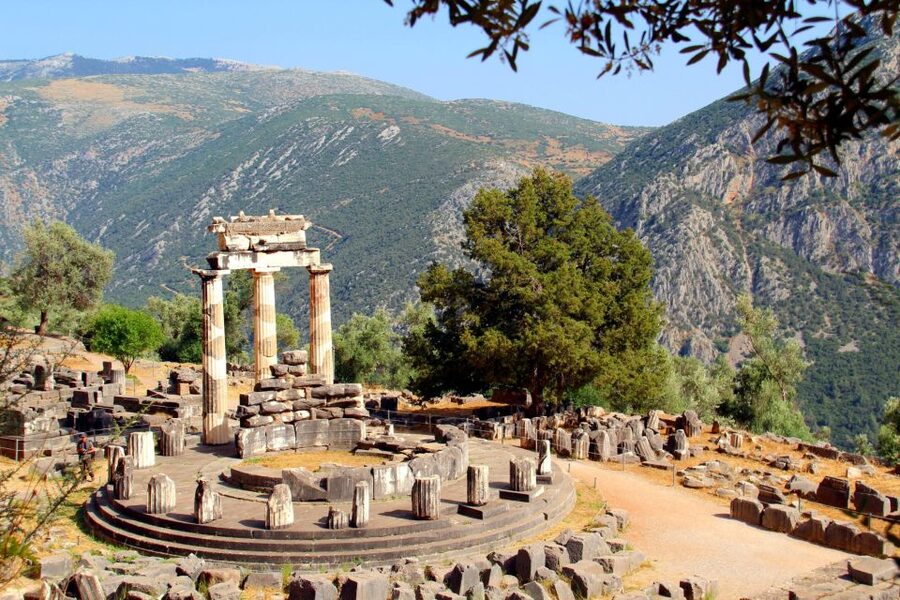
Delphi hits you with instant scale, and this ticket lets you walk the Temple of Apollo area plus the Treasury of the Athenians on your own timing, not a bus schedule. I love that the visit is museum-first, then you move straight into the hilltop archaeological site with an offline smartphone guide that keeps you oriented. One catch: if you bounce between audio sections, it can get tricky to keep the listening order on track.
For $41, you’re paying for entry plus a multilingual self-guided audio experience that you can replay later. If you get cranky about hills, note the ruins run up and down a mountainside—plan for real walking and bring good shoes.
In This Review
- Key points before you go
- Pre-booked Delphi entry and museum-first flow
- Your smartphone audio guide: offline, multilingual, and map-led
- Entering the Delphi site at the right start point
- Roman Agora: the calm warm-up before the big monuments
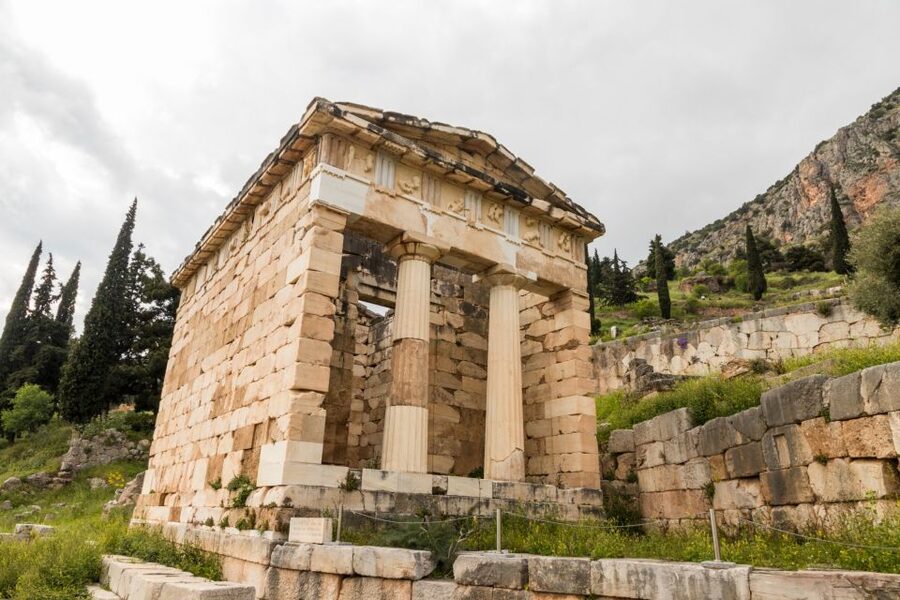
- Treasury of the Athenians: power, pride, and stone details
- Temple of Apollo: the sacred center and its visual drama
- The amphitheater and theater zone: views plus the human scale
- Timing, pacing, and the real-world walking math
- Price and value: is $41 a good deal?
- Who this Delphi ticket fits best
- Should you book this Delphi audio ticket?
- FAQ
- What’s included in the Delphi ticket?
- Where does the audio guide start?
- Which languages are available?
- Do I need to bring headphones?
- Can I download the audio for offline use?
- What kind of phone do I need?
- Is wheelchair access possible?
Key points before you go
- Pre-booked entry helps you avoid long ticket-line waits at Delphi
- Offline audio on your phone means you don’t have to worry about signal
- Museum + ruins in one day keeps the story clear as you move locations
- Temple, treasuries, Roman Agora, and theater cover the big Delphi hits
- Audio pacing is flexible, but you’ll want to use headphones you supply
North to the oracle, more Delphi runs
- Delphi: Archaeological Site & Museum Ticket with Audio Tours
★ 4.3 · 721 reviews - Delphi: Archaeological Site & Museum Ticket with Audio Tour
★ 4.4 · 275 reviews - Delphi Guided Walking Tour and Admission Ticket
★ 4.4 · 226 reviews - Delphi Self-Guided Tour with 3D Models & Audio (No Ticket)
★ 4.1 · 69 reviews
Pre-booked Delphi entry and museum-first flow
This ticket is built for a smooth day. You start at the Delphi Archaeological Museum with a selected time slot, then you head out to the archaeological site itself. That “museum first” choice matters. In the museum you see objects and context that make the outdoor ruins easier to read. Then, when you’re standing amid the stones on the hillside, you’re not just looking at shapes—you’re matching what you just learned to what you’re seeing.
The overall plan is self-paced. You’re not stuck following a group through each room. You can pause for views over the valley, catch your breath when the stairs start to feel personal, and take longer where you care. The duration listed is 1 day, and the ticket is valid for one day, so you can decide how deep you want to go without feeling time-boxed.
Price-wise, you are paying for the combination of admission + smartphone audio. That’s usually a smart deal in places like Delphi where the site is spread out and it’s easy to lose the thread. You’ll still need to do the walking, though. The big payoff is that your brain gets a storyline instead of a random walk through ruins.
Your smartphone audio guide: offline, multilingual, and map-led
The audio guide is the core of the experience. You receive ticket instructions by email, then you download the audio guide and app before you arrive. The content is available offline, so you’re not dependent on cell service once you’re on site. The guide uses a mix of narration, text, and maps, which is exactly what you want at Delphi, where monuments appear in pieces along a slope.
You get languages: English, Italian, French, German, and Spanish. That’s a nice feature if you’re traveling with someone who wants a different language than yours. It also means you’re not relying on whoever else in the group speaks best.
Two practical realities to plan for:
- You must bring headphones. Smartphone or headphones are not included, so pack your own. If your headphones are bulky, keep it simple—solid audio beats fancy gear here.
- You need phone compatibility and storage. You’ll need an Android (version 5.0 and later) or iOS smartphone. The guide isn’t compatible with Windows Phones, older iPhones/iPods, and some older iPads. You also need about 100–150 MB of storage space for downloads.
There’s also a small “know before you go” detail that can affect your experience: the guide can be harder to follow if you accidentally jump to a different section. My advice is simple—start at the beginning, let it run, and only skip intentionally.
Entering the Delphi site at the right start point
The audio guide is designed to begin at the entrance of the archaeological site of Delphi (33054, Delphi, Prefecture of Fokida). That makes life easier. You don’t have to figure out where the “tour” officially starts while your feet are already tired.
Once you’re at the ruins, put on your headphones and start listening. Try not to multitask—Delphi is best when you connect each story to the stones in front of you. A quick tip: take a minute to look at your surroundings before you start the next audio segment. Even a small glance helps your brain link the map to the real path.
Also note what’s not allowed: oversize luggage and large bags are a problem. So travel light. At Delphi, that’s not just for rules; it keeps you from feeling like your bag is chasing you uphill.
Worth comparing before you book this Delphi tour:
Roman Agora: the calm warm-up before the big monuments
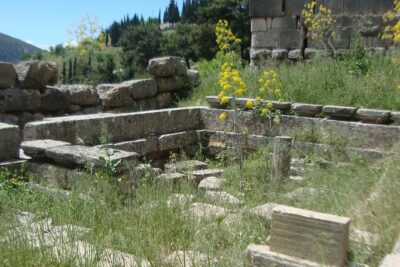
Your route includes the Roman Agora area. Think of it as a settling-in point before the major religious and ceremonial structures. The Agora setting gives you a sense of how Delphi functioned beyond myth—people gathered, moved through spaces, and used the site as part of everyday life during different eras.
Why I like starting here (and why you might too): it slows the day down. After that, when you hit the treasuries and the Temple zone, everything feels more meaningful because you’ve already seen how the site had public rhythm.
One caution: since this is a self-guided route, your timing is fully up to you. If you rush, you might miss the “how the space works” feeling that makes the later stops click. If you’re a fast walker, schedule extra pauses, especially around areas where you might want to read the audio’s map cues.
Treasury of the Athenians: power, pride, and stone details
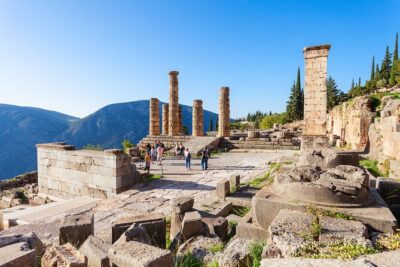
The Treasury of the Athenians is one of Delphi’s standout stops, and it’s the kind of place where an audio guide earns its keep. The structure may look like a single monument at first glance, but the storytelling helps you see why these treasuries mattered: they weren’t just decorative. They were statements—about identity, wealth, and prestige tied to the sacred center.
I love that this stop is built for understanding as much as sightseeing. You get historical facts and anecdotes through the audio, plus map support to keep you oriented. The result is less guesswork and more, Oh, that’s what I’m looking at.
If you’re the type who likes to capture photos, this is also a good location for it. But don’t treat it like a quick photo stop. Take a minute and listen long enough that you can point out what the narration is referencing. That’s how you turn a nice picture into real memory.
Temple of Apollo: the sacred center and its visual drama
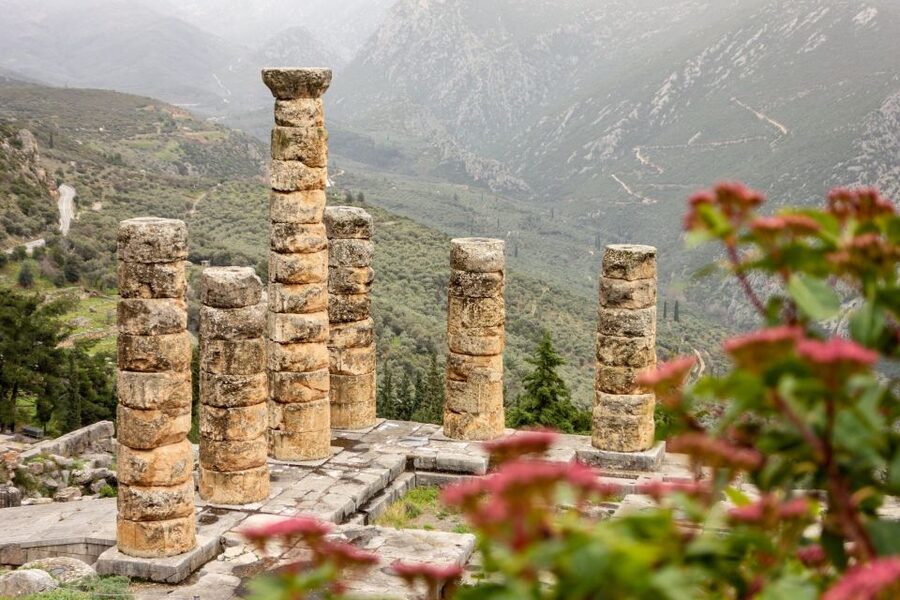
The audio highlights the Temple of Apollo, and it’s the moment many people come for. Even if you know the myths, the experience becomes more satisfying when you understand what you’re seeing in physical terms—how the sacred space was designed and why the area kept pulling attention across generations.
This is where the museum-first setup really shines. After you’ve seen related artifacts indoors, the outdoor temple zone feels less like a famous postcard and more like a place with logic and purpose.
Practical note: the Temple area is on a hillside, so you’ll feel the slope in your legs. Plan to stop more often than you think you need. And if you wear shoes that are fine on flat streets but questionable on uneven ground, switch before you go.
The amphitheater and theater zone: views plus the human scale
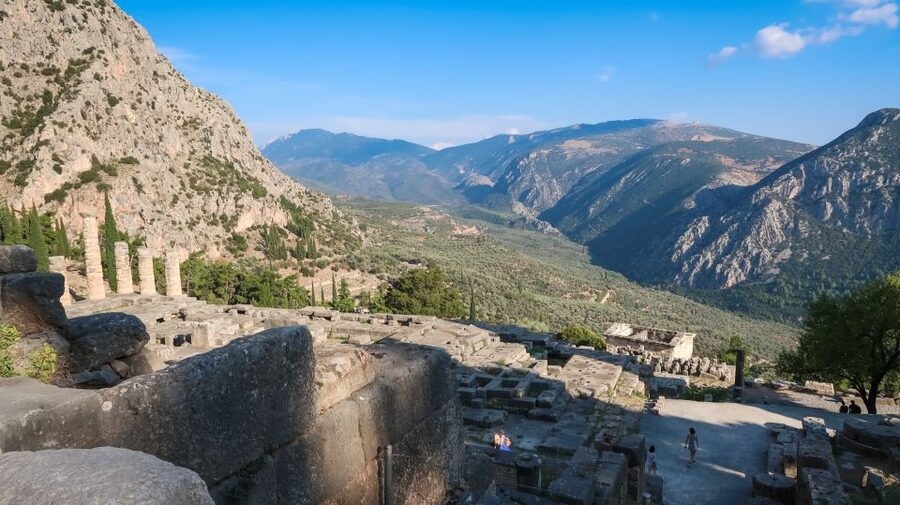
Delphi’s amphitheater/theater setting gives you a different kind of connection. Instead of temples and treasuries, you’re looking at a space built for gatherings, performance, and sound. The audio guide frames this area through storytelling, so you’re not just staring at seats.
Then you get the bonus: the location on Mount Parnassus means dramatic views. Those mountain panoramas can be breathtaking, and they work as a reset between intense history listening. Take advantage of that. Let your eyes rest on the landscape after you finish a longer audio segment.
My favorite way to do this stop is simple: after one or two audio sections, pause silently for a few minutes and just take in the view. It’s a small trick that makes Delphi feel bigger than a list of monuments.
Timing, pacing, and the real-world walking math
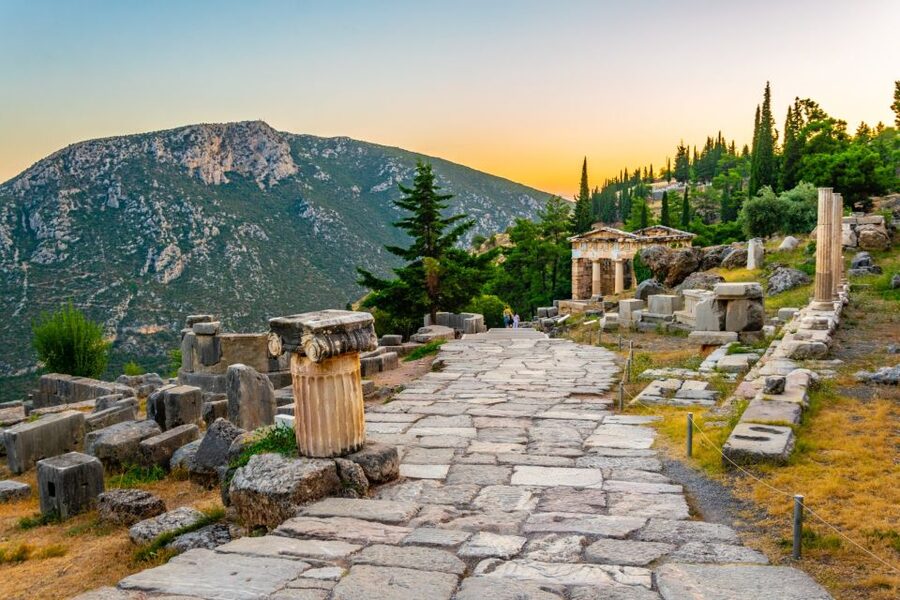
This is a full “one day” outing, but it’s not a sprint. The ruins are spread up the side of a mountain, so it’s less about a single long hike and more about nonstop gentle to not-so-gentle climbing and descending.
Here’s what I think you should plan for:
- Comfortable shoes are essential (this is not the time for fashion sneakers)
- Bring a hat and sunscreen. Sun can bite at elevation.
- Keep your phone charged. You’ll use it for audio and likely maps.
- If you want headphones that don’t slip, test them the day before.
Also, you’re not stuck in a rigid group schedule. That’s a major reason people enjoy self-guided experiences at sites like this. You can pause at viewpoints, linger at a treasury, and skip ahead if you need a mental break. Just keep an eye on the audio order so you don’t end up listening to a later segment too early.
Price and value: is $41 a good deal?

At $41 per person, this ticket is competitive if you compare it to paying for separate museum admission plus an audio guide on top. Here, your value comes from three things working together:
- Museum admission with a time slot, so you start with context.
- Entry to the archaeological site, where the walking and interpretation matter.
- A multilingual offline audio experience designed specifically for the Delphi stops.
What’s not included is just as important. You’ll pay extra if you need headphones, and transport is on you. Smartphone hardware is also on you. But since you’d likely need some form of device anyway, the audio guide is the main cost-saver.
If you’re traveling as a pair or small group, audio guides can be pricey. In this case, you’re buying admission plus guided structure for one ticket, which tends to keep the math reasonable.
One more detail: the activity is non-refundable, so book with confidence only if your day in Central Greece is firm.
Who this Delphi ticket fits best
This works best if you want control. If you like wandering at your own rhythm—stopping for views, taking photos when a spot feels right, spending longer where your interest kicks in—this format will feel freeing.
It’s also a good choice if you don’t want to manage a live guide’s pace. Delphi is the kind of site where you can get lost in the stones if you don’t have interpretation, but you can also get frustrated if someone rushes you through what you want to understand. The audio bridge solves that.
It’s less ideal if you hate using your phone for navigation and storytelling. You’ll want your batteries ready and your headphones comfortable. And if you’re someone who depends on mobility supports, keep in mind: the museum has wheelchair access, but the ruins are spread out along a mountain slope with rough tracks, and pushing a wheelchair up that kind of route isn’t realistic.
Should you book this Delphi audio ticket?
Yes—if you want a flexible, story-driven day at one of Greece’s most famous archaeological sites, this is a solid booking. The museum-first flow plus an offline smartphone guide is a practical combo, and it helps you turn Delphi from a sightseeing stop into something you actually understand as you walk.
Skip it only if you’re expecting a guided group experience with a live expert. This is interpretation on your terms, not a lecturer walking alongside you. And if you don’t like hills or you’re worried about using your phone on uneven terrain, plan accordingly.
If you’re ready for good shoes, headphones, and a phone with battery left to spare, you’ll be able to pace Delphi your way—and enjoy those Mount Parnassus views without feeling rushed.
FAQ
What’s included in the Delphi ticket?
You get admission that starts at the Delphi Archaeological Museum with your selected time slot, then admission to the Delphi archaeological site. You also get a multilingual audio tour for the museum and site, with offline content.
Where does the audio guide start?
The audio guide is designed to start at the entrance of the archaeological site of Delphi at 33054, Delphi, Prefecture of Fokida.
Which languages are available?
The audio guide is available in English, Italian, French, German, and Spanish.
Do I need to bring headphones?
Yes. Smartphone or headphones are not included, so you’ll need your own headphones to listen.
Can I download the audio for offline use?
Yes. The package includes offline content, and you’ll download the audio guide and instructions before you visit.
What kind of phone do I need?
You need an Android (version 5.0 and later) or iOS smartphone. It’s not compatible with Windows Phones, older iPhone models (including iPhone 5/5C and older), older iPod Touch models, or older iPads (including iPad 4th generation and older, or iPad Mini 1st generation).
Is wheelchair access possible?
The museum has wheelchair access, but the ruins are spread up the side of a mountain with rough tracks, so pushing a wheelchair up the paths would not be possible.
More Tours in Delphi
- Delphi: Archaeological Site & Museum Ticket with Audio Tours★ 4.3 · 721 reviews
- Delphi Guided Walking Tour and Admission Ticket★ 4.4 · 226 reviews
- Delphi Self-Guided Tour with 3D Models & Audio (No Ticket)★ 4.1 · 69 reviews
- Delphi Skip-The-Line Private Tour with Licensed Guide & Admission★ 5.0 · 31 reviews
- Delphi Site & Museum with Multilingual 3D Audiovisual Tour★ 3.7 · 25 reviews
- Delphi Self-guided Audio Tour on Your Phone (no ticket)★ 3.5 · 10 reviews
More Tour Reviews in Delphi
- Delphi: Archaeological Site & Museum Ticket with Audio Tours★ 4.3 · 721 reviews
- Delphi Guided Walking Tour and Admission Ticket★ 4.4 · 226 reviews
- Delphi Self-Guided Tour with 3D Models & Audio (No Ticket)★ 4.1 · 69 reviews
- Delphi Skip-The-Line Private Tour with Licensed Guide & Admission★ 5.0 · 31 reviews
- Delphi Site & Museum with Multilingual 3D Audiovisual Tour★ 3.7 · 25 reviews
- Delphi: Archaeological Site & Museum Ticket with Audio★ 3.5 · 24 reviews
North to Delphi: More Day Trips
- Delphi: Archaeological Site & Museum Ticket with Audio Tours★ 4.3 · 721 reviews
- Delphi Guided Walking Tour and Admission Ticket★ 4.4 · 226 reviews
- Delphi Self-Guided Tour with 3D Models & Audio (No Ticket)★ 4.1 · 69 reviews
- Delphi Skip-The-Line Private Tour with Licensed Guide & Admission★ 5.0 · 31 reviews
- Delphi Site & Museum with Multilingual 3D Audiovisual Tour★ 3.7 · 25 reviews
- Delphi: Archaeological Site & Museum Ticket with Audio★ 3.5 · 24 reviews
Fresh Off the Boat: New Delphi Reviews


Delphi Day Trips, compared.
 ★ 4.7Mythology of Delphi, Museum and Arachova Guided TourFrom $305,102 reviews
 ★ 4.6From Athens: Delphi Full Day V.R. Audio Guided TourFrom $303,028 reviews
 ★ 4.8From Athens: Small-Group Delphi, Museum & Arachova Day TripFrom $342,476 reviews
 ★ 4.5Delphi English Day Trip from Athens with Official GuideFrom $782,199 reviews
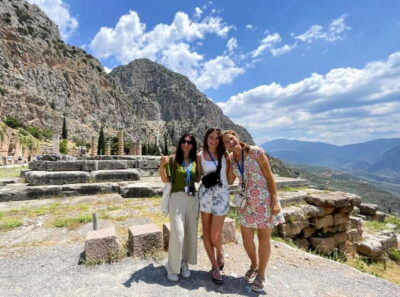 ★ 4.8Delphi Oracle & Museum Tour with a Licensed GuideFrom $362,121 reviews
 ★ 4.5Historical Delphi One Day Tour with Arachova Stop & Expert GuideFrom $341,247 reviews
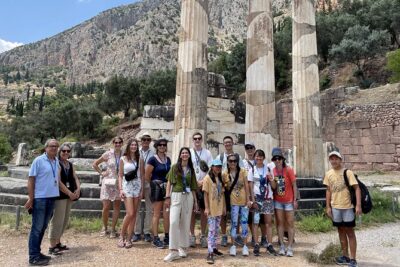 ★ 4.5Premium Delphi Day Trip with an Expert Guide, Museum & LunchFrom $381,100 reviews
 ★ 4.5From Athens: Delphi and Meteora 2-Day Guided TourFrom $271825 reviews
Browse the lists this tour appears in