
Reviewed · PRIVATE
Fast Private Athens Tour
A one-hour Athens sprint, with a driver in charge. I like the hotel pickup and the fact you can relax while your driver handles traffic and tight city timing. I also like the private, up-to-4 setup for a more personal route, which is ideal when you only have a short window. The only real drawback: this is fast by design, so each stop is more of an orientation than a long, deep visit.
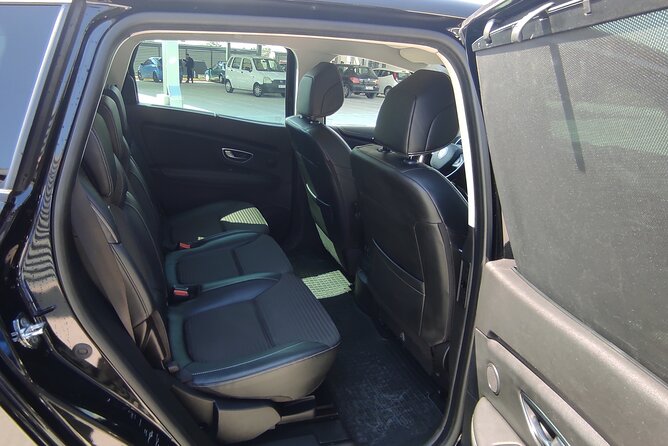
This is a strong choice for an Athens shore excursion or a quick city primer before you go back on your own. If you’re traveling with kids, infant seats are available on request, which makes the whole thing less stressful. You’ll get the tour in English, and the mobile ticket keeps things simple for check-in.
In This Review
- Key takeaways before you go
- Why this fast private Athens loop works so well
- Price and value: what $118.35 per group gets you
- Timing, pickup, and how the route feels in real life
- Acropolis Museum: the 2009 centerpiece for artifacts
- Pnyx: where Athenian assemblies shaped democracy
- Hadrian’s Gate and the road to Olympian Zeus
- Temple of Olympian Zeus: construction that took centuries
- Panathinaiko Stadium: the marble stadium that still matters
- Hellenic Parliament and the ceremony vibe near Syntagma
- Education landmarks: Academy, University, and the National Library
- Squares that anchor the city: Omonia and Klafthmonos
- Old Parliament House and the National Historical Museum site
- Finishing strong at Syntagma Square
- Who this tour suits best (and who should pick something else)
- Should you book the Fast Private Athens Tour?
- FAQ
- How long is the Fast Private Athens Tour?
- What’s the group size for this private tour?
- Is pickup available?
- What language is the tour offered in?
- What stops are included?
- Is the tour family-friendly?
- What happens if weather is bad?
Key takeaways before you go
- Private up-to-4 pace: your group stays together and you’re not stuck waiting on other tours.
- Driver handles traffic: you spend energy on sights, not stop-and-go logistics.
- A free-entry focused route: the stops listed are marked as admission ticket free.
- Democracy to modern Athens in one loop: Acropolis-area sites connect to Syntagma Square and Parliament.
- Great for shore days: it’s timed for a short outing, not a half-day commitment.
- Family-friendly on request: infant seats are available.
More private options, your group only
- Best of Athens Half Day Private Tour
★ 5.0 · 3,714 reviews - Athens Full Day Private Tour
★ 5.0 · 2,903 reviews - Athens Airport Private Arrival Transfer with Meet & Greet
★ 4.5 · 1,495 reviews - Athens Airport to Athens Hotels Private Arrival Transfer
★ 5.0 · 947 reviews
Why this fast private Athens loop works so well
Athens has a lot going on—traffic, crowds near the center, and streets that can feel like a puzzle when you’re on your own. This tour is built around one practical idea: let someone local manage the routing while you get a clean highlights sweep.
For me, the best value in a short city visit is not trying to “do everything.” It’s making sure you see the right things in the right order, without losing half your time to getting from A to B. This route clusters major landmarks so you can build a mental map fast—especially useful if you’re arriving for a shore excursion or you already have plans later in the day.
Because it’s private (up to four people) you’ll also feel the difference in pace. You’re not waiting for the slowest person, and you’re not being herded. That matters in Athens, where the best moments often happen when you’re standing still long enough to look closely.
Price and value: what $118.35 per group gets you
The price is $118.35 per group for up to four people, with a duration of about 45 minutes to 1 hour 10 minutes. Put that in real terms: if you’re traveling as a couple, it’s still a straightforward cost to buy back time and stress. If you have four people in your group, the per-person cost becomes very reasonable for a private, guided-drive experience.
Also, the tour is designed around stops listed as admission ticket free. That can help you avoid the “small ticket fees add up” problem that happens when you try to stitch attractions together on your own.
Where this pricing shines is short-stay planning. When you only have a limited window—like a cruise day, a late arrival, or a quick interlude between hotel check-in and dinner—you’re paying for efficient sightseeing, not for a multi-hour museum deep dive.
Timing, pickup, and how the route feels in real life
Pickup is available from your hotel or apartment, which is a big deal if you don’t want to coordinate taxis or figure out where to meet. The tour runs Monday through Thursday, from 8:00 AM to 6:00 PM, during the overall operating window shown by the provider.
The schedule is fast, with each stop clocked at about five minutes. That means you’ll typically get:
- a quick arrival and orientation
- a short walk-and-look moment
- enough time to take photos and understand what you’re seeing
If you’re the type who wants to sit and read every panel, you may feel a bit rushed. But if you want to get your bearings fast and then come back later with a longer plan, this format is a clever way to start.
One more practical note: the experience requires good weather. If weather cancels it, you should expect a different date or a full refund, not a scramble.

Acropolis Museum: the 2009 centerpiece for artifacts
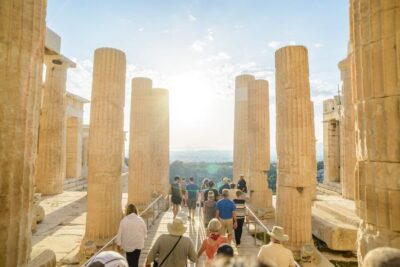
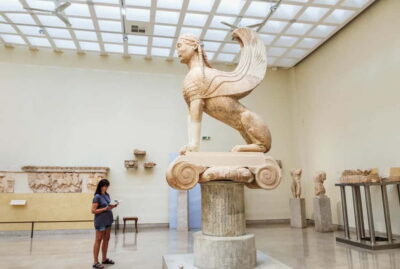
The first stop is the Acropolis Museum, the archaeological museum built to display findings from the Acropolis of Athens and surrounding slopes. It was founded in 2003, with the organization established in 2008, and it opened to the public on 20 June 2009. The museum covers about 14,000 square meters and exhibits more than 4,250 objects.
In a short tour like this, you shouldn’t treat the museum as a full-day assignment. Instead, think of it as a high-impact “what you’ll see outside” connection. When you later stand on the Acropolis slopes (or revisit the area), the objects you saw inside give context to what the stones used to mean.
What I like about starting here is simple: it sets a baseline. You move from the art and artifacts into the outdoors and suddenly the landscape isn’t just dramatic—it’s historically legible.
Pnyx: where Athenian assemblies shaped democracy

Next is Pnyx, the hill where Athenians held assemblies beginning as early as 507 BC in the Fifth-century era. It’s less than one kilometer west of the Acropolis, and about 1.6 kilometers southwest of Syntagma Square.
This stop works because it links ancient civic life to a physical location you can actually stand on. Even if you only get a few minutes, you’ll come away with a clearer idea of where public decision-making happened in ancient Athens.
A quick consideration: because the time is short, you won’t get deep interpretation. But you do get the important part—recognition of the site and how it fits into the bigger democracy story.
Hadrian’s Gate and the road to Olympian Zeus
Then you’re at Arch of Hadrian, also known as Hadrian’s Gate. It’s a monumental gateway that once spanned an ancient road linking central Athens to the eastern complex that included the Temple of Olympian Zeus.
The arch is commonly tied to the Roman emperor Hadrian. One idea proposed is that it celebrated his arrival to Athens and honored him for benefits given to the city around the dedication of the nearby temple complex in 131 or 132 AD. Another argument notes that the inscriptions may honor Hadrian as an Athenian citizen rather than purely as a Roman emperor.
Why this matters on a fast tour: it’s a quick way to shift your lens from Greece to Rome without losing the plot. Athens didn’t switch identities overnight. The architecture tells a layered story.
Temple of Olympian Zeus: construction that took centuries
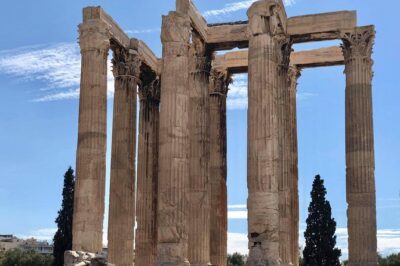
After Hadrian’s Gate, you’ll reach the Temple of Olympian Zeus—also known as the Olympieion, or the famous columns of Olympian Zeus. Construction began in the 6th century BC under Athenian tyrants who wanted the greatest temple in the ancient world. It wasn’t completed until the 2nd century AD, during Hadrian’s reign—about 638 years after the project began.
During the Roman period, the temple was renowned as the largest in Greece and housed one of the largest cult statues in the ancient world, with 104 colossal columns as part of the complex.
The short-stop format here can feel a little different than the Acropolis Museum. You’re seeing more scale and atmosphere than you are reading details. But if you want to understand Athens as a city where major projects spanned generations, this stop delivers fast.
Panathinaiko Stadium: the marble stadium that still matters
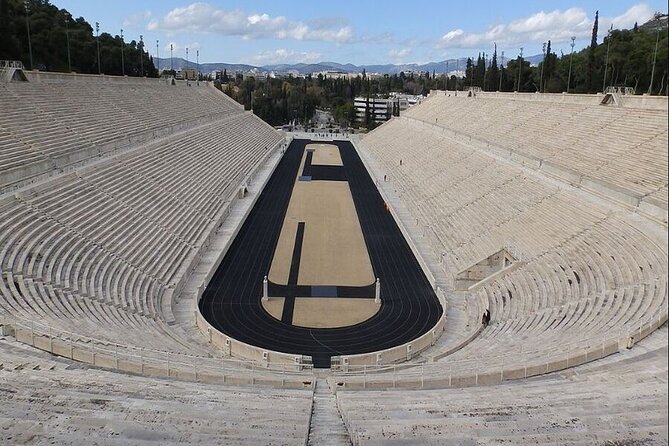
Next up: Panathinaiko Stadio, also called Kallimarmaro, meaning beautiful marble. It’s one of Athens’s main historic attractions and is the only stadium in the world built entirely of marble.
A stadium existed on the site for the Panathenaic Games, with an earlier racecourse structure associated with Lykourgos around 330 BC. Later, Herodes Atticus rebuilt it in marble, and by 144 AD it could hold about 50,000 seats. After Christianity rose in the 4th century, it was largely abandoned. It was excavated in 1869, hosted the Zappas Olympics in 1870 and 1875, and then became a centerpiece for the first modern Olympics in 1896.
It later hosted some events during the 2004 Olympics and remains the finishing point for the annual Athens Classic Marathon.
On a quick tour, you’re not doing a full athletics lesson. But you do get to see a place where ancient and modern Athens overlap in a very physical way. Marble stadiums are rare. This one is famous for a reason.
Hellenic Parliament and the ceremony vibe near Syntagma
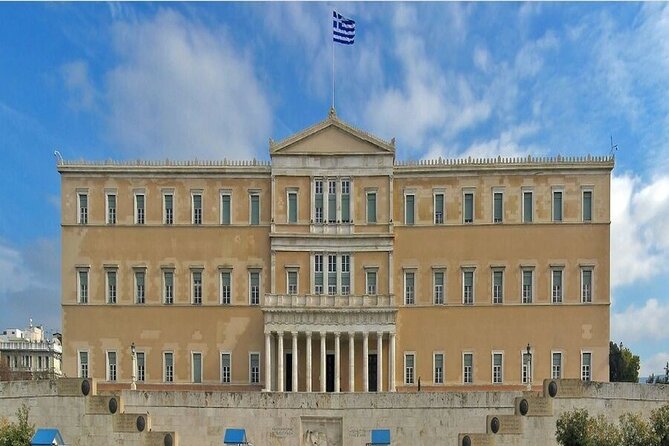
The tour then moves into modern civic Athens with the Hellenic Parliament building, located in the Old Royal Palace overlooking Syntagma Square. It’s Greece’s unicameral legislature and represents citizens through elected Members of Parliament.
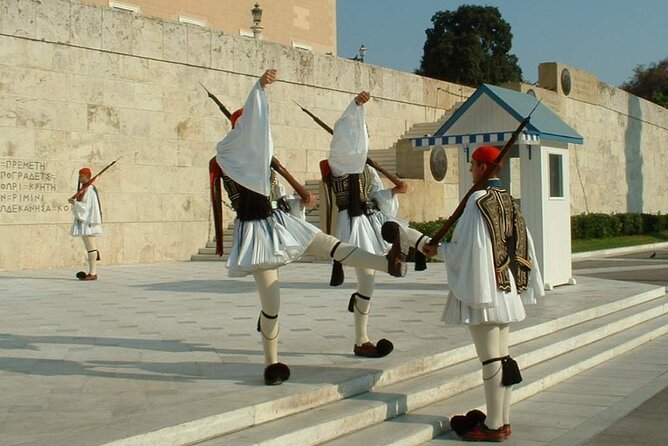
From there, you’ll stop at the Evzones area. The Evzones (or Evzonoi) were elite light infantry units historically. Today, the Evzones are the Presidential Guard, guarding the Tomb of the Unknown Soldier and the Presidential Mansion.
Their uniform evolved from clothing worn by klephts who fought during the Ottoman occupation. The fustanella is the most recognizable element—a kilt-like garment—so you’ll see a style that’s visually tied to Greek resistance and identity.
Important practical reality: the tour timing is tight, so you’re likely to view and photograph from close by rather than settle in for long ceremonies. Still, this section is a great cultural contrast after the ancient and Roman stops.
Education landmarks: Academy, University, and the National Library
After the ceremonial guard stops, the route shifts to major Greek education institutions: the Academy of Athens, the National and Kapodistrian University of Athens, and the National Library of Greece.
Here’s what you’re seeing in plain terms:
- The Academy of Athens is Greece’s national academy and top research institution, established in 1926, operating under the Ministry of Education.
- The University of Athens (EKPA) is the largest university in Greece after Aristotle University of Thessaloniki, with more than 40,000 undergrads and over 2,000 teaching and research staff. It’s been operating since May 3, 1837.
- The National Library of Greece was founded in 1832 with a mission to locate, collect, organize, describe, and preserve evidence of Greek culture and human intellectual production.
On a tour this short, these stops are best treated as big-photo architecture and location markers. You won’t likely get a campus tour, but you’ll come away knowing where modern Greece’s research and scholarship ecosystem lives.
Squares that anchor the city: Omonia and Klafthmonos
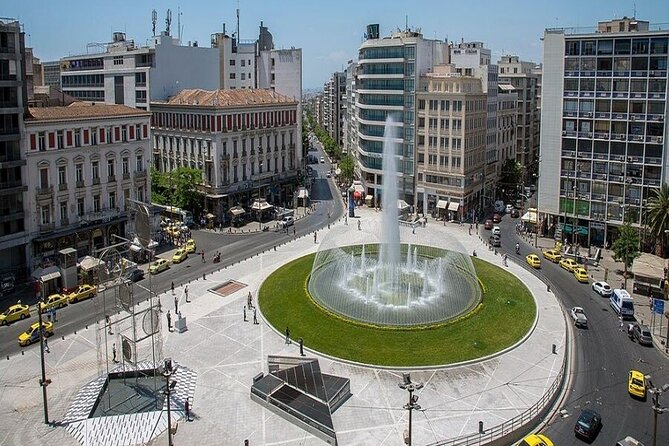
Next: Omonia Square, also known as Concord Square. It’s a central square and one of Athens’s principal traffic hubs, served by Omonia metro station. It’s also described as an important shopping center and a key intersection of six main streets.
Then you’ll pass through Klafthmonos Square—literally meaning crying square. The name comes from a vignette in the magazine Hestia. After elections, dismissed civil servants protested in front of the Ministry of Finance (later demolished), and the area earned its emotional nickname.
I like including these squares because they show Athens isn’t only a museum city. Even if your trip is focused on antiquity, these everyday public spaces are where people live, shop, commute, and argue.
A consideration: since squares can be active traffic and crowds change moment to moment, your time on each stop can feel a little more “watch and orient” than “wander.”
Old Parliament House and the National Historical Museum site
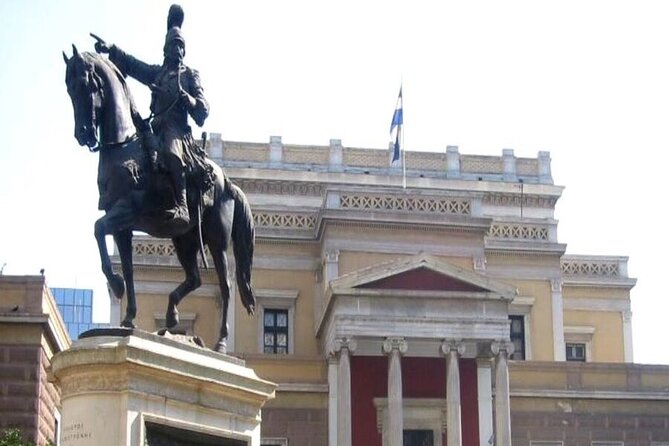
Then you reach the Old Parliament House at Stadiou Street, which used to house the Greek Parliament from 1875 to 1935. Today, it houses the National Historical Museum.
The building story is dramatic. It started as the residence of Athenian magnate and politician Alexandros Kontostavlos. After Athens became the capital in 1833, King Otto chose it as a temporary residence until the Royal Palace was ready. In 1835, a large dance and banquet hall was added. After the 1843 Revolution forced King Otto to grant a constitution, the National Assembly convened here.
In October 1854, however, the house burned down. A new building then began construction in August 1858, with foundations laid by Queen Amalia based on plans by French architect Francois Boulanger.
Even if you only get a brief look, this stop gives you a tangible thread through Greek political history—how governance spaces moved, changed, burned, and rebuilt.
Finishing strong at Syntagma Square
The final stop is Syntagma Square, Constitution Square, named after the constitution Otto was obliged to grant after the popular and military uprising on 3 September 1843. The square sits in front of the Old Royal Palace, which has housed the Greek Parliament since 1934.
Syntagma is Athens’s most important square socially and historically, and it’s also the heart of commercial activity. It’s also a major transport hub with the metro station underneath connecting lines 2 and 3, plus tram and bus terminals.
This is a smart ending point. You finish where it’s easiest to continue your day: hop on the metro, grab food, or start a self-guided walk into other neighborhoods.
Who this tour suits best (and who should pick something else)
This tour is a great fit if you want:
- a fast Athens orientation with minimal planning
- a private experience without jumping through logistics
- something shore-day friendly that won’t eat your whole schedule
- a family option with infant seats available on request
- a route that includes both ancient landmarks and modern civic Athens
You might want a different format if you:
- love long museum time and detailed galleries
- want to read every sign and take frequent breaks inside major sites
- prefer a slow, wandering pace over quick stops
Think of this as a “first pass.” It helps you decide what to revisit once you’ve mapped the city in your head.
Should you book the Fast Private Athens Tour?
Yes, I’d book it if you’re short on time and want a smart, efficient highlights sweep. The biggest reasons are the private up-to-4 setup, hotel/apartment pickup, and a route designed around key stops that connect ancient Athens to the modern capital.
If you do book it, I’d also plan to treat it as orientation. Use it to learn what each place is and where it sits, then follow up with a longer visit later if something hooks you.
If your travel timing is fixed and weather can be uncertain, keep an eye on conditions. The experience depends on good weather, and you’ll be offered a different date or a full refund if it’s canceled.
FAQ
How long is the Fast Private Athens Tour?
It runs for about 45 minutes to 1 hour 10 minutes.
What’s the group size for this private tour?
It’s private for your group, with a maximum of up to 4 people.
Is pickup available?
Yes. You can be picked up from your hotel or apartment.
What language is the tour offered in?
It’s offered in English.
What stops are included?
The route includes the Acropolis Museum, Pnyx, Arch of Hadrian, Temple of Olympian Zeus, Panathinaiko Stadio, Hellenic Parliament, Evzonoi, the Academy of Athens, National and Kapodistrian University of Athens, the National Library of Greece, Omonia Square, Klafthmonos Square, National History Museum (Old Parliament), and Syntagma Square.
Is the tour family-friendly?
It’s child-friendly, and infant seats are available on request.
What happens if weather is bad?
This experience requires good weather. If it’s canceled due to poor weather, you’ll be offered a different date or a full refund.
Private Days, Your Group Only
- Best of Athens Half Day Private Tour★ 5.0 · 3,714 reviews
- Athens Full Day Private Tour★ 5.0 · 2,903 reviews
- Athens Airport Private Arrival Transfer with Meet & Greet★ 4.5 · 1,495 reviews
- Athens Airport to Athens Hotels Private Arrival Transfer★ 5.0 · 947 reviews
- Athens Greece Full Day private tour★ 5.0 · 785 reviews
- Private Biblical Tour Ancient Corinth & Isthmus Canal from Athens★ 5.0 · 762 reviews
More Tours in Athens
- Athens: Acropolis, Parthenon & Acropolis Museum Guided Tour★ 4.8 · 9,316 reviews
- The Acropolis, Parthenon & Acropolis Museum Guided Tour★ 4.7 · 8,493 reviews
- Acropolis: Premium Acropolis and Parthenon Guided Tour★ 4.8 · 5,208 reviews
- Athens: Mythology of Delphi, Museum and Arachova Guided Tour★ 4.7 · 5,102 reviews
- Acropolis and Parthenon Guided Walking Tour★ 5.0 · 4,755 reviews
- Greek Food Walking Tour in Athens★ 5.0 · 4,740 reviews
More Tour Reviews in Athens
- Athens: Acropolis & up to 5 Archaeological Sites Combo Pass★ 4.2 · 13,904 reviews
- Athens: Acropolis, Parthenon & Acropolis Museum Guided Tour★ 4.8 · 9,316 reviews
- The Acropolis, Parthenon & Acropolis Museum Guided Tour★ 4.7 · 8,493 reviews
- Athens: Cape Sounion & Poseidon Temple Sunset Half-Day Trip★ 4.8 · 8,241 reviews
- Acropolis: Premium Acropolis and Parthenon Guided Tour★ 4.8 · 5,208 reviews
- Athens: Mythology of Delphi, Museum and Arachova Guided Tour★ 4.7 · 5,102 reviews
Fresh Off the Boat: New Athens Reviews





Private, compared.
 ★ 5.0Best of Athens Half Day Private TourFrom $913,714 reviews
 ★ 5.0Athens Full Day Private TourFrom $2442,903 reviews
 ★ 4.5Athens Airport Private Arrival Transfer with Meet & GreetFrom $491,495 reviews
 ★ 5.0Athens Airport to Athens Hotels Private Arrival TransferFrom $42947 reviews
 ★ 5.0Athens Greece Full Day private tourFrom $683785 reviews
 ★ 5.0Private Biblical Tour Ancient Corinth & Isthmus Canal from AthensFrom $301762 reviews
 ★ 5.04 Hours – Athens & Acropolis Highlights Private TourFrom $181681 reviews
★ 5.0Athens Full Day Private TourFrom $205667 reviews