
Reviewed · ATHENS
The Best Way to See and Learn about Athens in 6 hours
Six hours can still change how you see Athens. This is a private, driver-guide day that gets you above ground in comfort while the sights roll by, and it pairs big-ticket landmarks with real explanations about Greek myth and daily life. I like that you get a calm pace with smart timing (not a frantic line-jump day), plus extra little touches when your driver has the habit of going the extra mile. One heads-up: entrance fees and licensed museum/site guiding are not included, and in Greece the driver can’t lead you inside archaeological sites.
What really makes this work is the balance between “wow” stops and “learn” stops. You’ll start with the Acropolis top view, then hit the Acropolis Museum, then spend time in the Ancient Agora and under-the-hill neighborhoods like Plaka. The only possible drawback is that you’ll still need to plan your day around opening times and ticket lines, because most entrances are extra and the driver can’t do the indoor guiding.
If you’re visiting for a first taste of Athens, or you’re working with a tight schedule (including cruise days or a layover), this style of tour is built for you. You get the big hits—Parthenon views, Erechtheion’s Caryatids, the Agora, Monastiraki—without relying on maps or figuring out parking.
In This Review
- Key highlights to look for on this 6-hour Athens tour
- Why this 6-hour Athens plan works (and why it feels easy)
- Acropolis at human speed: Parthenon views, Caryatids, Propylaea, and Nike
- Acropolis Museum: why an hour here changes everything you saw outside
- Zeus Olympios and the big ideas behind Athens’ stadiums
- Syntagma, Omonia, and Monastiraki: Athens in public squares
- Ancient Agora and Hephaestus Temple: where philosophers and markets overlapped
- Plaka under the Acropolis: slow down for the streets, not just the photos
- Neoclassical Athens: the Academy of Athens and the trilogy of culture
- Petralona and the central open food market: where locals actually shop
- Price and logistics: what $505.23 buys, and what you should budget
- What to expect from your driver-guide (and how to get the most from them)
- Who this Athens tour suits best
- Should you book this 6-hour Athens highlights tour?
- FAQ
- How long is the Athens tour?
- Is pickup included, and where can you be picked up?
- What’s included in the price?
- What’s not included?
- Will the driver-guide take you inside the archaeological sites?
- Is the tour offered in English?
- How much are entrance fees?
- Are there any free stops during the tour?
- Is this a private tour?
Key highlights to look for on this 6-hour Athens tour
- Hotel, apartment, port, or cruise pickup so you start without stress
- Acropolis viewpoints first, including the Parthenon area and key landmarks from above
- Acropolis Museum time (a full hour) so you’re not just looking at stones
- Ancient Agora + Hephaestus Temple for one of Athens’ best-preserved ancient experiences
- Squares tour stops (Syntagma, Omonia, Monastiraki) that show how modern Athens breathes
- Optional lunch in Petralona plus a stop at the city’s open food market area
Weighing this one up? Set it beside a few Athens favourites first.
- Athens: Acropolis & up to 5 Archaeological Sites Combo Pass
★ 4.2 · 13,904 reviews - Athens: Acropolis, Parthenon & Acropolis Museum Guided Tour
★ 4.8 · 9,316 reviews - The Acropolis, Parthenon & Acropolis Museum Guided Tour
★ 4.7 · 8,493 reviews - Athens: Cape Sounion & Poseidon Temple Sunset Half-Day Trip
★ 4.8 · 8,241 reviews
Why this 6-hour Athens plan works (and why it feels easy)
The big win here is private transport. Athens has traffic, parking quirks, and heat that can drain you fast. By the time you reach the Acropolis area, you’re not already tired from transit or wandering “just to find the entrance.”
This is also a tour that respects attention span. You’re not trying to do everything on foot. Instead, you get a structured day where each stop has a reason: ancient monuments for context, then museums and markets so the story doesn’t stop at “ancient rubble.”
The operator highlights that the driver is experienced and friendly, with English. Guides in this system also often bring extra flourishes—one guide (Markos) has been described as using a time-lapse style explanation to make the sites feel more real, while other guides have focused on myth and Greek life. If you’re the type who asks questions, this setup usually rewards you.
One more practical point: the tour uses a mobile ticket. That saves time compared with rummaging for printed passes at multiple locations.
Acropolis at human speed: Parthenon views, Caryatids, Propylaea, and Nike

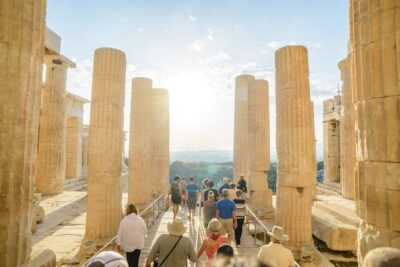
Most Athens itineraries treat the Acropolis like a sprint. This one starts with the big hill and gives it room: about 1 hour 30 minutes at the Parthenon/Acropolis area.
From the Acropolis height, you’re not just looking at the Parthenon. You’re getting the surrounding map of ancient Athens in one glance—places like the Odeon of Herodus Atticus and the Theatre of Dionysus. Even if you don’t go deep into every ruin, that wider view helps your brain organize what you’re seeing.
On the “top” side, the highlight details matter:
- Erechtheion with its six Karyatides (the female statues) is a one-of-a-kind moment. You’ll be right there for it.
- Temple of Athena Nike—the Wingless Nike—sits near the approach area, with its placement making it feel part of the ceremonial route.
- Propylaea is the main entrance to the Acropolis hill area, and it helps you understand how movement and power worked in ancient design.
A quick consideration: entrance fees are not included, and the indoor guiding rules apply. So your driver-guide can explain a lot from the outside viewpoints, but you may need a licensed guide for the deep indoor narration inside archaeological sites and museums. If you want every interpretive layer, budget for that extra service.
Acropolis Museum: why an hour here changes everything you saw outside
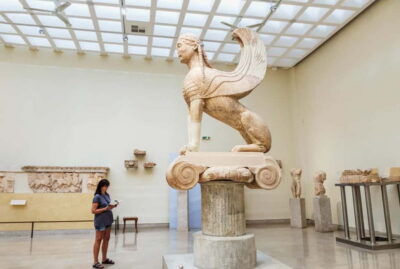
After the hill, the day shifts from “architecture you can see” to “artifacts you can understand.” The Acropolis Museum stop is about 1 hour.
This museum is a huge value add because it gives you the why behind the what. When you see statues, friezes, and reconstructions, the Acropolis stops being a photo destination and turns into a civilization snapshot.
One practical advantage: with your transport handled, you can focus on the museum itself rather than crossing town again. If you’re thinking “Can I handle another museum?”—yes, because the museum is directly connected to what you just climbed.
Tickets are extra, and the licensed guide note still applies. Your driver can set context, but if you want someone licensed to guide inside, that’s an additional option.

Zeus Olympios and the big ideas behind Athens’ stadiums

Next comes a short temple visit: the Temple of Zeus Olympios (Tempio Di Zeus Olimpio), around 20 minutes. It’s described as the biggest temple ever built in Athens—so even a short stop can feel meaningful if you pay attention to scale.
After that, you’ll hit the Panathenaic Stadium for about 20 minutes. This is where the first modern Olympics played out—and the stop also ties to the legend of Pheidippides announcing victory after Marathon. Even if you know the story already, the stadium format gives it a physical sense.
Both stops are fast, but that’s the point. Athens’ best ancient day often works when you mix big monuments with brief “place-based” history so you don’t get museum fatigue.
Syntagma, Omonia, and Monastiraki: Athens in public squares
This part of the tour is where modern Athens shows up. The itinerary includes the key center squares:
- Syntagma (the central square)
- Omonia (one of the three main squares)
- Monastiraki (historic triangle and flea market area)
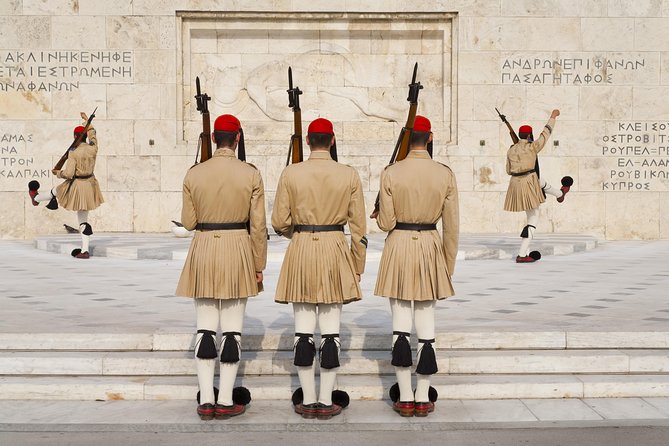
The most memorable “ceremony” moment here is the Tomb of the Unknown Soldier. You’ll stand nearby the Parliament building area and watch the Evzones in traditional uniform during the 10-minute stop.
Even if ceremonies aren’t your thing, this is a useful Athens check-in. It shows you the city’s rhythm—locals moving through, tourists snapping photos, and the uniforms acting like a living “this is Greece” cue.
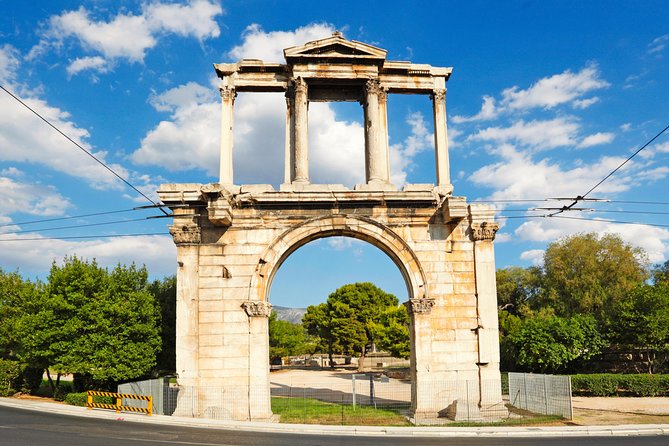
Monastiraki is also the kind of place where your feet naturally slow down. It’s linked with the flea market zone and archaeological-site viewing in the same area, so you get a taste of “old city + everyday shopping” together. Expect souvenirs and food smells. That’s the point.
Ancient Agora and Hephaestus Temple: where philosophers and markets overlapped
The heart of the ancient-city walk is the Ancient Agora of Athens, with about 40 minutes. This is the marketplace area where philosophers spoke—so it’s not just temples on a hill. It’s the civic brain of the city.
The stop focuses on the Agora layout plus one star: the Temple of Hephaestus. The Temple of Hephaestus is mentioned as the best preserved temple in Athens today, and you’ll have a short 10-minute time window there.
One more bonus: there’s also time set aside for the Museum of the Ancient Agora (about 20 minutes, free admission stated for this tour). That museum component helps bridge gaps between what you see outdoors and how the space functioned.
A small reality check: Agora sites involve uneven ground and lots of sun. The tour’s comfort breaks and private transport mean you can focus on the most important areas without turning the day into a full-on hike.
Plaka under the Acropolis: slow down for the streets, not just the photos
After ancient Athens, the day shifts to old-street Athens. Plaka gets about 30 minutes, described as the oldest neighborhood, with its streets running under the Acropolis hill.
This stop is about mood and walking. You’ll pass through areas with souvenir shops and places to grab food or a drink, but it’s also a chance to understand why people end up lingering here: the architecture works well for casual strolling, and you can feel the old city’s layering.
Plaka is typically easiest when you stop thinking of it as a checklist. Treat it like a short wandering break. Look up, catch a view angle, and let the streets do the rest.
Neoclassical Athens: the Academy of Athens and the trilogy of culture
For a different side of the city, you’ll go to the Academy of Athens area—three neoclassical buildings referred to as the Athenian Trilogy:
- the Academy of Arts and Sciences
- the University
- the National Library
This stop is short (around 10 minutes) but it’s a good contrast after the ancient sites. Neoclassical Athens isn’t just decorative. It’s Athens showing how it wanted to present itself as a modern heir to its own past.
The tour also calls out a newer “brand new National Library building” as part of this cultural corridor on Panepistimiou street. If you like architecture beyond the ancient stuff, this is a nice palate cleanser.
Petralona and the central open food market: where locals actually shop
Toward the later part of the tour, you’ll head into Petralona, outside the main tourist corridor. The tour description frames this as a place where you can find an amazing local taverna, with lunch optional (lunch isn’t included in the tour price).
Then there’s a stop at the central, open food market of Athens, described as where Athenians go for quality meat and fresh fish at good prices.
I like this ending portion because it makes your Athens day feel less like a museum-and-backpack marathon. Markets ground the day. You see the everyday Athens that runs alongside the monuments.
If you’re hungry, this is the time to be. If you’re not, it still works as a walk-through experience because you’re in the city, not behind ropes.
Price and logistics: what $505.23 buys, and what you should budget
The price listed is $505.23 per group (up to 3 people) for about 6 hours, which is a key value detail. In other words, you’re not paying a per-person guide fee. You’re buying a private day with transport and a driver-guide service.
What’s included:
- Private driver-guide service (plus parking fees and baggage charges)
- Pickup from your hotel, apartment, or a port/cruise pickup point
- Mobile ticket access
What’s not included:
- Licensed guide for museums and archaeological site interiors (extra service)
- Entrance fees (the tour notes about 30 euros per person as an estimate)
- drinks, meals, accommodation
- gratuities
So is it good value? Usually, yes—especially if you’re traveling as a couple or small family and want to avoid the hassle of lining up, managing transit, and doing multiple ticket purchases across the city. If you’re traveling solo or you’re the type who loves slow, independent wandering, you might find cheaper ways to see Athens. But you’ll trade comfort and planning time for it.
The most important cost consideration is the entrance fees plus any licensed-guide add-on you want for deeper indoor explanations. If you’re aiming for “I want every artifact and story,” budget a bit more.
What to expect from your driver-guide (and how to get the most from them)
This tour is designed around the driver-guide doing the outside explanations while you experience the sights yourself.
The key rule to know: in Greece, the driver-guide cannot guide inside archaeological sites. Only licensed guides can do that, and it’s offered as an extra service. Your driver can still help you understand what matters most, where to look, and how to connect sites together.
You’ll also likely notice a comfort pattern. In the best versions of this tour, guides provide chilled water and keep things moving without rushing you. One guide (Makis) has been described as using a comfortable, clean air-conditioned Mercedes and adding thoughtful extras like pastries and coffee stops. Another guide (John) has been noted for extensive area knowledge and recommendations for authentic lunch.
If you want a smoother experience, come with a couple of interests ready:
- Greek mythology vs. everyday Athenian life
- “best photo angles” vs. “most important facts”
- architecture focus vs. philosophy/Agora focus
Your day gets better when your questions are specific.
Who this Athens tour suits best
This is a strong match for:
- First-time Athens visitors who want the big hits without planning chaos
- Cruise ship passengers or anyone with a timed stay
- People who want private comfort and a guided context, but don’t need a full-time licensed museum guide everywhere
- Small groups up to 3 who want value without splitting into multiple taxis
It may not be ideal if:
- You only want to spend time inside museums and archaeological sites and don’t care about squares, neighborhoods, and outside viewpoints
- You’re happy doing everything independently with public transit and self-guided audio tours
Should you book this 6-hour Athens highlights tour?
I’d book it if your priority is smart, low-stress coverage of Athens in a short window. The combination of Acropolis hill time, museum context, Ancient Agora, and neighborhood texture is exactly what makes a first Athens day click.
Don’t book it blindly if you already know you want deep indoor guiding. Since entrance fees and licensed guiding inside sites aren’t included, you may end up paying extra anyway. If that’s your style, plan for the extra guided component from the start.
If you want the simplest answer: book this when you want Athens to feel organized, comfortable, and meaningful—without you sweating the logistics.
FAQ
How long is the Athens tour?
The tour runs about 6 hours.
Is pickup included, and where can you be picked up?
Yes. Pickup is offered from any hotel, apartment, Piraeus port, cruise ship, or a specific meeting place in Athens.
What’s included in the price?
The rates include a private driver-guide service, all parking fees, and baggage charges.
What’s not included?
Entrance fees are not included (the tour estimates about 30 euros per person). Also not included are a licensed guide for archaeological sites/museums, drinks, meals, accommodation, and gratuities.
Will the driver-guide take you inside the archaeological sites?
No. The driver can’t provide guide services inside archaeological sites or museums; licensed guides are needed for indoor guiding, and that’s an extra service.
Is the tour offered in English?
Yes, it’s offered in English.
How much are entrance fees?
The tour notes entrance fees are approximately 30 euros per person.
Are there any free stops during the tour?
Yes. Stops such as Panathenaic Stadium, the Tomb of the Unknown Soldier, the Academy of Athens area, Plaka, Temple of Hephaestus, and the Museum of the Ancient Agora are listed as free for this tour.
Is this a private tour?
Yes. It’s a private tour/activity, and only your group participates.
More Tour Reviews in Athens
- Athens: Acropolis & up to 5 Archaeological Sites Combo Pass★ 4.2 · 13,904 reviews
- Athens: Acropolis, Parthenon & Acropolis Museum Guided Tour★ 4.8 · 9,316 reviews
- The Acropolis, Parthenon & Acropolis Museum Guided Tour★ 4.7 · 8,493 reviews
- Athens: Cape Sounion & Poseidon Temple Sunset Half-Day Trip★ 4.8 · 8,241 reviews
- Acropolis: Premium Acropolis and Parthenon Guided Tour★ 4.8 · 5,208 reviews
- Athens: Mythology of Delphi, Museum and Arachova Guided Tour★ 4.7 · 5,102 reviews