
Reviewed · DELPHI DAY TRIPS
3 Days private tour- Meteora Rocks & Monasteries, Delphi/ Apollo Oracle, Thebes
A three-day route like this feels like a choose-your-own-Greece adventure. You’ll move from Thermopylae to the Meteora monasteries, then down to Delphi and on to Thebes, with a driver who stops when you want—so you’re not rushed into bad photo angles or forced snack breaks. I especially like the mix of spiritual sites and big-thought history, plus the fact that you get time to breathe and actually look. The one thing to consider is that most museum and site tickets are not included, so your final spending depends on what you choose and the season.
On this kind of private tour, the “best” part is often the pacing. I like that the schedule is flexible, and you’ll have photo stops built in around real views rather than just checkmarks. One note: if you want a licensed archaeologist guide inside sites, you’ll need to arrange that separately, since the driver provides history during travel and in stops, not on-walk expert interpreting.
In This Review
- Key highlights worth planning around
- Road-trip freedom from Athens: pickup, private pacing, photo stops
- Day 1 Meteora Rocks: Thermopylae battle ground to monasteries on pillars
- Battlefield of Thermopylae and the Leonidas area
- Trikala’s old city area: a calm break from headline history
- Great Meteoron Monastery and the Meteora UNESCO core
- Natural History Museum of Meteora and Mushroom Museum
- Kastraki at sunset: when the rocks look unreal
- Day 2 early light at Meteora plus caves and Parnassus-to-Delphi mythology
- Second Meteora visit: photos before the crowds
- Trikala Fort: a slow walk with real structure
- Mount Parnassus option: Vagonetto mine tour or Corycian Cave
- Delphi and the Apollo Oracle sites: the big name with context
- Delphi Museum first: what to see so the ruins make sense
- Delphi Archaeological Museum (included)
- Tholos of Athena Pronaia: the quick iconic photo you can identify
- Arachova stop: a mountain reset
- Day 3 Thebes and the oracle-route vibe: from Levadia springs to museum time
- Kryas Livadeia Springs and the oracle stage concept
- Archaeological Museum of Thebes (timing matters)
- Price and what you actually get for $1,163.56
- Who this tour suits best (and who should think twice)
- Should you book this Meteora–Delphi–Thebes private tour?
- FAQ
- Is this a private tour with only my group?
- Where do you pick up and drop you off?
- What time does the tour start?
- Are tickets for the monasteries and museums included?
- Will I be able to choose what to do on Mount Parnassus?
- Is the Delphi Museum ticket included?
- Can the driver act as a guide inside archaeological sites and museums?
- Can you arrange hotel stays for me?
Key highlights worth planning around
- Private door-to-door pickup in Athens or Piraeus, plus parking and tolls handled so you can focus on the route
- Meteora drive-by photo time and at least two Orthodox monasteries, with simple per-monastery ticket pricing
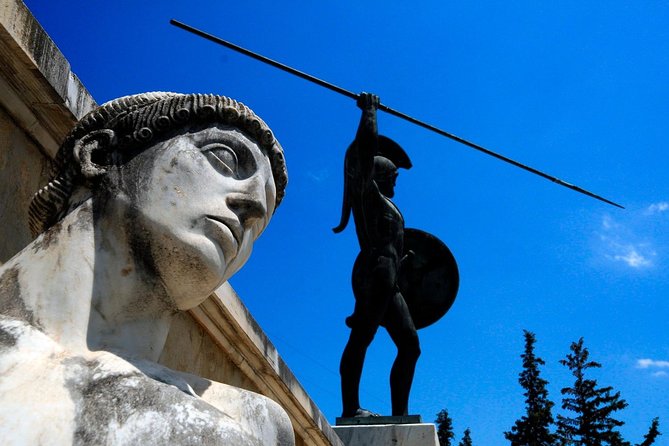
- Thermopylae plus an interactive museum option near Leonidas’ monument (low-cost add-on)
- A real choice on Mount Parnassus: Vagonetto mine visit or Corycian Cave for myth fans
- Delphi Museum included, then the Tholos of Athena Pronaia for fast, iconic context
- Thebes museum timing matters, since it has set weekly closures
North to the oracle, more Delphi runs
- Athens: Mythology of Delphi, Museum and Arachova Guided Tour
★ 4.7 · 5,102 reviews - From Athens: Delphi Full Day V.R. Audio Guided Tour
★ 4.6 · 3,028 reviews - From Athens: Small-Group Delphi, Museum & Arachova Day Trip
★ 4.8 · 2,476 reviews - Delphi English Day Trip from Athens with Official Guide
★ 4.5 · 2,199 reviews
Road-trip freedom from Athens: pickup, private pacing, photo stops
This is a private tour, so it runs on your group’s rhythm, not a herd schedule. You get air-conditioned transport with a clean, comfortable sedan, minivan, or minibus depending on your group size, and you’re picked up in Athens or Piraeus (or you can request another pickup spot).
What makes the experience feel different is the way stops work. The driver is the kind of person who’s been on the road in Greece, so you’re not stuck waiting for things you missed or apologizing for being late. If you want a quick viewpoint pull-off for photos, you’ll usually get it. If you want to stretch your legs before a long drive, you’ll usually get that too.
Price-wise, this tour is positioned as “you pay for the driving and the flexibility.” The trade-off is that sites and museum tickets are mostly on you, and those costs add up fast if you want every option. Budget time and money for tickets, and the value story becomes much clearer.
Day 1 Meteora Rocks: Thermopylae battle ground to monasteries on pillars
You start early (around 8:00 am) and Day 1 sets the tone: history with big scenery, then spiritual architecture that looks impossible.
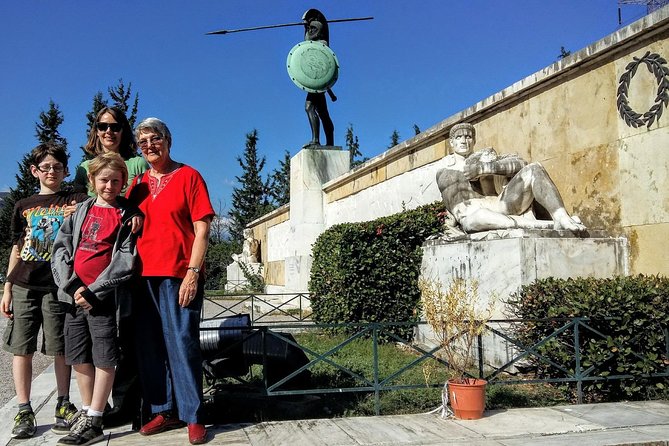
Battlefield of Thermopylae and the Leonidas area
You’ll visit Thermopylae, famous for the 480 BC stand between the Greek forces and the Persians. This is one of those places where the terrain itself explains the story, since the pass mattered then and still matters now.
Two practical stops make this more than a monument photo:
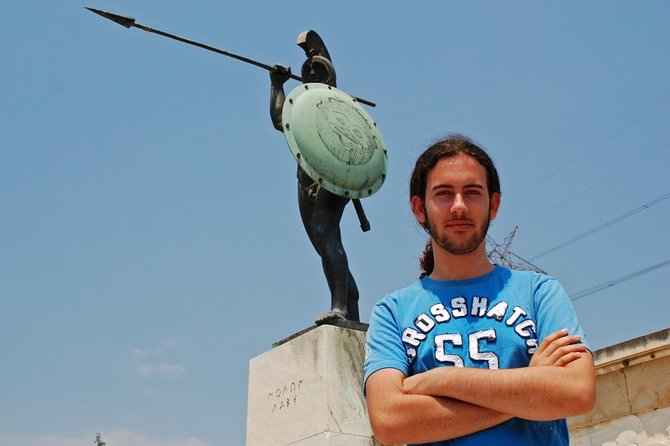
- The Leonidas monument area gives you the emotional anchor.
- Next to it, you can add the Kainotomiko Kentro Istorikis Enimerosis Thermopylon interactive museum. It’s short, and the ticket is low-cost, so it’s a good way to get context without spending your whole morning indoors.
A possible drawback: Thermopylae is a stop you’ll want to do carefully, not quickly. If you rush through, you’ll miss why the battle mattered and why this pass keeps showing up in Greek history.
Monasteries in the sky, more Meteora trips


Trikala’s old city area: a calm break from headline history
After Thermopylae, you’ll head toward Trikala (about 330 km north of Athens). The tour includes time in the Old City of Trikala, a place with settlement traces going back tens of thousands of years and a downtown built on an older city layout.
The practical value here is simple: it’s a breather stop. You’ll be out of “museum-only mode,” and it helps the day feel like a road trip rather than a checklist.
Great Meteoron Monastery and the Meteora UNESCO core
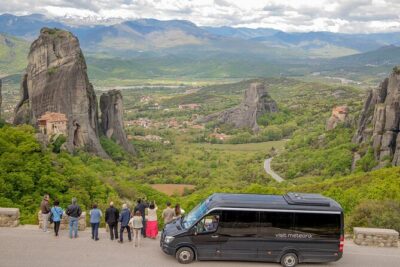
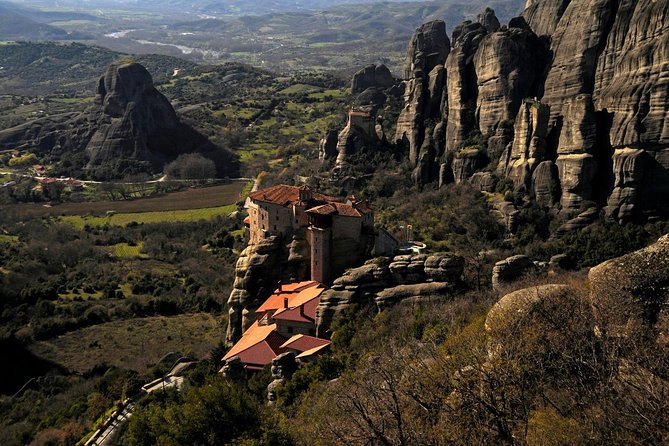
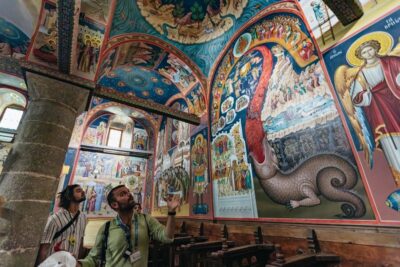
Then you reach the star of the show: Meteora. You’ll drive around the rocks and focus on the Orthodox monasteries built atop immense natural pillars. Meteora is UNESCO-listed under multiple criteria, which matters here because it’s not just pretty—it’s also a rare example of how architecture and faith adapted to geography.
You’ll visit at least two monasteries. The usual rhythm is:
- Drive/view locations first for photos and orientation.
- Then monastery time, keeping in mind you’ll pay a general ticket per monastery (example pricing given is about 3€ per monastery).
Two realities to plan for:
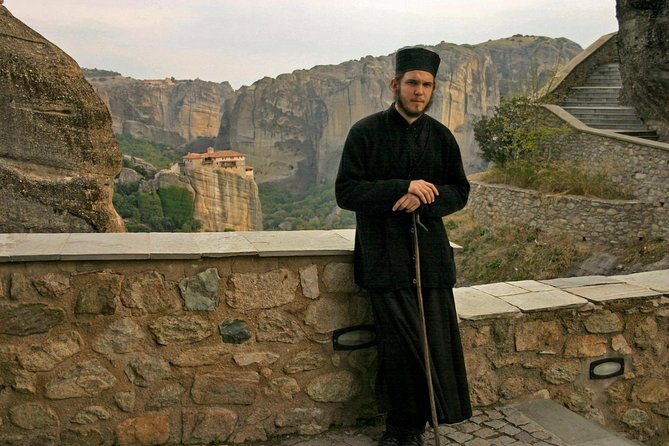
- This is an active religious area. Dress respectfully and keep timing tight where you need to move between buildings.
- Monasteries can mean stairs and uneven ground. It’s manageable for most people, but you’ll feel it if you’re used to flat walking only.
If you want one “rule of thumb” for Meteora: don’t wait until you’re at the monastery to take photos. The driving viewpoints often give you the shot that makes friends ask where you went.
Natural History Museum of Meteora and Mushroom Museum
You can also stop at the Natural History Museum of Meteora & Mushroom Museum. It’s not included, but it’s a smart counterbalance: while you’re already thinking about rocks and environment, it gives you a grounded look at local ecosystems and wildlife.
If your group is all-in on archaeology and architecture, you might choose to skip it later in the trip. If you love science or just want a break from stone staircases, this stop is a good one.
Kastraki at sunset: when the rocks look unreal
Day 1 finishes with the village of Kastraki, often described as picture-perfect from a distance—like it’s built under an eagle’s nest of cliffs. You’ll get time for a photography and sunset-style loop around the rocks, then drive through Kastraki and stop for dinner at a traditional tavern.
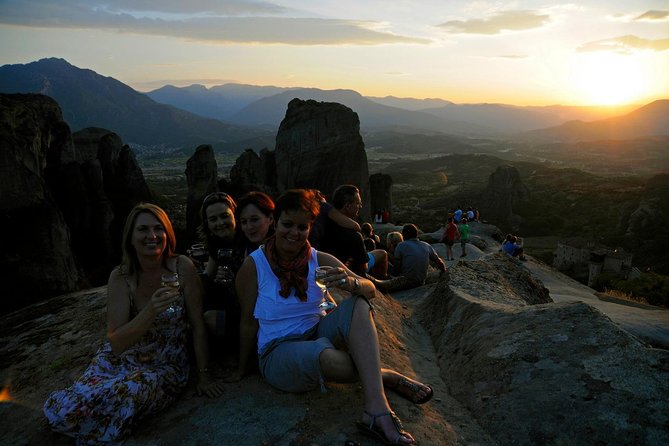
Here’s why this matters: Meteora scenery changes fast with light. Sunset is when the rocks go from dramatic to movie-like, and a flexible schedule makes a difference. Also, Kastraki is popular for staying, so if you’re considering hotel plans alongside the tour, factor in availability early.
Day 2 early light at Meteora plus caves and Parnassus-to-Delphi mythology
Day 2 starts after breakfast with a photography tour around Meteora in better morning light. This is one of the strongest “value” parts of the trip because you’re getting two looks at the same dramatic place—without extra transfers you’d otherwise have to organize yourself.
Second Meteora visit: photos before the crowds
You’ll depart around 8:00 am for the morning views, stopping at selected viewpoints. The key idea is lighting. Morning light reduces harsh contrast and makes stone textures and monastery outlines easier to read in photos.
Then you’ll head to:
- Theopetra Cave (an archaeological site with human occupation documented extremely far back, with information provided that it’s been occupied as early as 130,000 years ago).
You’ll get the basic shape and setting of the cave, and the “why” of its importance: deep time, open light, and a place people returned to.
A practical note: caves can be cooler and damp-feeling. Bring a light layer if you run cold.
Trikala Fort: a slow walk with real structure
Next comes Trikala Fort, a fortress walk above the city. It’s described as a well-preserved Justinian-era fortress, plus a clock on its east side that’s the city emblem.
This is a good stop if you want your history to be physical—walls, viewpoints, and a gentle climb—rather than only museum glass cases. You’ll walk up and spend about an hour.
Mount Parnassus option: Vagonetto mine tour or Corycian Cave
Then you head into Mount Parnassus territory, and this is where you can tailor the day to your interests.
Option A: Vagonetto (mine gallery 850)
Vagonetto is a mining park built around an old inactive mine gallery. You ride a small train down to gallery 850, about 200 meters underground. You’ll go through old galleries dressed as a miner (the tour description says you’re equipped for it) and see depictions of mining processes in very old geological material (you’ll be told about rocks more than 150 million years old). Ticket price provided is about 8€.
Option B: Corycian Cave
If you prefer myth, you’ll drive up to Corycian Cave, described as tied to Greek mythology and the Muses, sacred to nymphs, and associated with worship for Pan. It’s also noted as a refuge during foreign invasions in the 5th century.
Both options fit the theme of Parnassus, but they give you different flavors:
- Vagonetto = geology and industrial past.
- Corycian Cave = mythology and sacred landscape.
Delphi and the Apollo Oracle sites: the big name with context
Finally on Day 2, you reach Delphi, the ancient sanctuary tied to the oracle known as Pythia. The key things you’ll see in the plan include the Temple of Apollo area and the archaeological context that surrounds it.
This part works best when you go in with patience. Delphi isn’t one single viewpoint; it’s a slope of ruins where you need time to pick out names and functions. You’ll typically be in the open-air site area for about an hour and a half, but the experience is more about how you connect the pieces than about speed.
Delphi Museum first: what to see so the ruins make sense
Delphi can be confusing if you don’t have a mental map. That’s why it’s a smart move that you start with the Archaeological Museum of Delphi on Day 3.
Delphi Archaeological Museum (included)
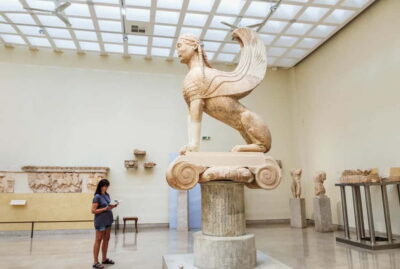
The museum is included and is described as one of Greece’s most important. You’ll see collections covering roughly a thousand years, with items from Mycenaean through Greek-Roman periods. A highlight mentioned is the Charioteer, a famous statue tied to a chariot-run complex from the Pythian Games.
This museum step is valuable because when you return to the ruins later (or just understand them on your way through), you’ll recognize what you’re looking at. It’s also indoor time, which helps when the daylight and walking add up.
Tholos of Athena Pronaia: the quick iconic photo you can identify
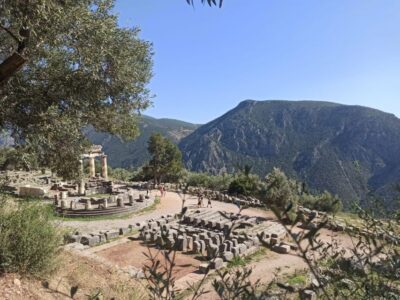
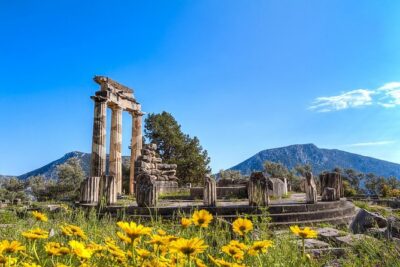
Next is Tholos of Athena Pronaia, a circular building built between 380 and 360 BC with 20 Doric columns on the exterior and Corinthian order columns inside (as described in the tour info). There’s also a strong size reference: about 14.76 m exterior diameter and around 13.5 m tall at the center.
The practical takeaway is the warning included in the description: the Tholos photo is more popular than the Apollo Temple photo, and visitors often confuse which structure they’re looking at. Here, you’ll see the Tholos in place, so you’ll know what it is.
Arachova stop: a mountain reset
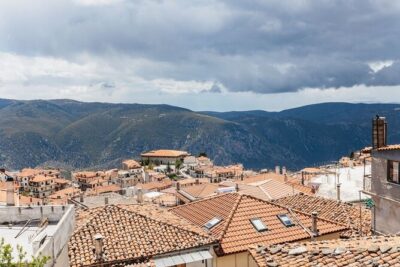
You’ll also stop in Arachova, a mountain village with a ski-resort feel in winter. The tour gives you about an hour, which is enough to breathe, grab a drink, and reset your legs before the next stop.
Arachova can feel a bit more modern and tourist-friendly than the ancient sites. That’s not a flaw—it’s a useful contrast so you don’t spend all three days only in ruins and caves.
Day 3 Thebes and the oracle-route vibe: from Levadia springs to museum time
After Delphi-side time, Day 3 keeps the trip grounded with stops that connect myth to geography and then ends with a strong museum finish.
Kryas Livadeia Springs and the oracle stage concept
You’ll pass through Levadia and stop at the Kryas Livadeia Springs area. There’s time for a drink or light lunch, and the tour info specifically mentions favorites like ice coffee and souvlaki.
Ancient context is part of the stop: this area is linked to the Oracle of Trofonios Zeus, with springs named Mnemosyne (Remembrance) and Lethe (oblivion). It’s also described as a stage before visiting Delphi and gaining power and riches through time.
Even if you don’t go deep on the myth details, the practical value is the break. You’ll have a moment near water and shade before the final museum push.
Archaeological Museum of Thebes (timing matters)
Then you finish at the Archaeological Museum of Thebes. This is a museum worth your attention if you like Greek artifacts beyond the famous big names. It’s described as important since some collections are rare or unique, spanning from the Palaeolithic to Post Byzantine periods.
Important planning detail: the museum is closed on Tuesdays and on certain date-specific closures (25–26 December, 1 January, 25 March, Easter Day, 1 May). Opening hours vary by season, with winter listed as 8:30–15:30 and summer 8:00–20:00.
So the tour is more reliable when you’re booking with your travel dates in mind. If your dates hit a closure, you could end up with a skipped museum day, and that changes the balance of the whole itinerary.
Price and what you actually get for $1,163.56

At $1,163.56 per person, you’re paying for a private, multi-day drive connecting four major regions: Thermopylae, Meteora, Delphi, and Thebes. That’s not cheap, but it’s also not “you sit still and hope for the best” pricing.
Here’s where the value comes from:
- Private transportation with fuel, tolls, parking included.
- Pickup and drop-off in Athens or Piraeus, which is often the hardest part to organize cleanly for multi-day routes.
- An experienced driver who behaves like a traveler, not a strict calendar manager. That flexibility is the big-ticket item in practice.
- Two Meteora monastery visits, plus Delphi Museum included on Day 3.
Where the cost shifts to you:
- Most site and museum tickets are not included. The tour provides example ticket pricing, and also notes seasonal differences for winter vs summer.
- Gratuities are suggested from 1€ per person (small, but it’s still a cost).
If you’re budget-minded, you’ll want to decide early how many ticketed extras you want: Meteora museum, Vagonetto, or Corycian Cave. If you’re ticket-happy, costs will rise. If you pick the versions that match your interests, you can keep spending controlled.
If you add accommodation, you can arrange hotels through the operator. The driver’s room is complimentary, and hotel pricing is given per double room and night with breakfast (plus weekend-holiday pricing). If you prefer to book your own hotel, you’ll still need an extra room for your driver. That’s one of those details that can surprise you later, so I’d treat it like part of your math.
Also note: the tour is listed as non-refundable and not changeable for any reason. Make sure your dates are firm before you lock it in.
Who this tour suits best (and who should think twice)
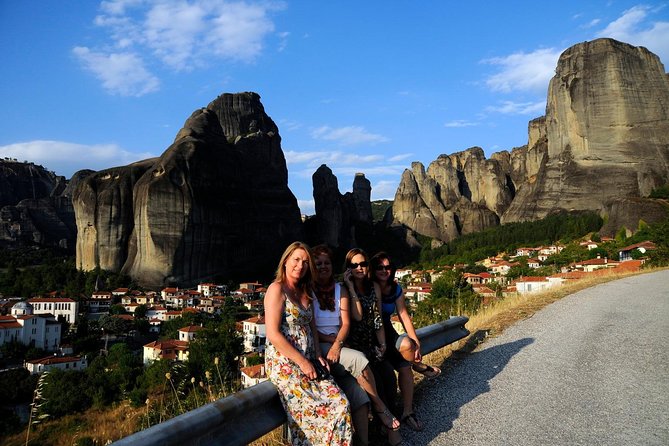
This fits you well if:
- You hate rigid schedules and want photo stops and flexible breaks.
- You want a single private road-trip connecting major Greek sites without hiring separate guides.
- You like a mix of religious sites, archaeology, and myth places—and you want your driver to connect the dots while you ride.
It may be less ideal if:
- You want a fully guided, licensed archaeologist walking you through every museum hall. The driver provides documentary and historical details while traveling, but isn’t a licensed tour guide inside sites.
- You’re traveling with a very tight budget and don’t want to think about ticket costs that vary by season.
A final practical note: the tour starts at 8:00 am. If you’re the type who needs a slow morning to function, plan your evenings so you can actually wake up and enjoy the day.
Should you book this Meteora–Delphi–Thebes private tour?

I’d book it if you want Greece that feels like a drive with real stops, not a race from one doorway to another. The biggest reason is the pacing: you can slow down for photos, adjust breaks, and still hit the big anchor sites—Meteora, Delphi, and Thebes.
You should also book it if you value the human part of the trip. The driver named Nikolaos, often referred to as Niko, is highlighted in past experiences for going the extra mile—suggesting things to do and eat, and even adding small touches like Greek iced coffee and learning ideas around the Greek language. That kind of care shows up in how smooth the day feels.
Don’t book it blindly if your main goal is a fully ticket-inclusive, no-decisions day. Here, you’ll decide between options on Parnassus, and you’ll manage museum/site tickets based on season and timing.
If your dates are solid and you’re okay planning for admissions, this is a strong way to connect Meteora monasteries and Delphi oracle history into one memorable road trip.
FAQ
Is this a private tour with only my group?
Yes. This is listed as a private tour/activity, meaning only your group participates.
Where do you pick up and drop you off?
Pickup and drop-off are offered from/to your hotel or apartment in Athens or Piraeus. You can also request another location.
What time does the tour start?
The start time is listed as 8:00 am.
Are tickets for the monasteries and museums included?
No. The tour states that admission fees for sites and museums are not included, with costs provided per site and differences by winter vs summer.
Will I be able to choose what to do on Mount Parnassus?
Yes. The plan includes Vagonetto (the mining park tour) as one option, or the Corycian Cave for Greek mythology if you prefer not to visit the mines.
Is the Delphi Museum ticket included?
Yes. The Delphi Archaeological Museum entry is listed as included.
Can the driver act as a guide inside archaeological sites and museums?
The driver is not a licensed tour guide to accompany you on walks inside archaeological sites or museums. If you want a licensed archaeologist guide, you need to hire one separately in advance.
Can you arrange hotel stays for me?
Yes. The tour can arrange accommodation in selected boutique hotels A’class or 3/4* hotels with breakfast for an additional cost, and the driver’s room is complimentary. If you book your own hotel, you need an extra room for the driver.
Just Your Group: More Private Days
- Best of Athens Half Day Private Tour★ 5.0 · 3,714 reviews
- Athens Full Day Private Tour★ 5.0 · 2,903 reviews
- Athens Greece Full Day private tour★ 5.0 · 785 reviews
- 4 Hours – Athens & Acropolis Highlights Private Tour★ 5.0 · 681 reviews
- Athens Full Day Private Tour★ 5.0 · 667 reviews
- Enjoy Cape Sounio Private Majestic Sunset With Seaside Dinner★ 5.0 · 613 reviews
The Monasteries of Meteora
- Athens: Meteora Monasteries Day Trip with Caves and Lunch★ 4.7 · 4,670 reviews
- Athens to Meteora: Monasteries, Caves & Seaside Stopovers★ 4.7 · 2,958 reviews
- Athens: Full-Day Meteora Tour with Local Guide & Greek Lunch★ 4.8 · 2,101 reviews
- Athens: Meteora Monasteries, Caves & Coastal Stopovers with Lunch★ 4.5 · 1,432 reviews
- Meteora Monasteries & Caves DayTrip from Athens with Greek Lunch★ 4.5 · 879 reviews
- From Athens: Delphi and Meteora 2-Day Guided Tour★ 4.5 · 825 reviews
North to Delphi: More Day Trips
- Athens: Mythology of Delphi, Museum and Arachova Guided Tour★ 4.7 · 5,102 reviews
- From Athens: Delphi Full Day V.R. Audio Guided Tour★ 4.6 · 3,028 reviews
- From Athens: Small-Group Delphi, Museum & Arachova Day Trip★ 4.8 · 2,476 reviews
- Delphi English Day Trip from Athens with Official Guide★ 4.5 · 2,199 reviews
- Athens: Delphi Oracle & Museum Tour with a Licensed Guide★ 4.8 · 2,121 reviews
- Historical Delphi One Day Tour with Arachova Stop & Expert Guide★ 4.5 · 1,247 reviews
Fresh Off the Boat: New Athens Reviews

Delphi Day Trips, compared.
 ★ 4.7Mythology of Delphi, Museum and Arachova Guided TourFrom $305,102 reviews
 ★ 4.6From Athens: Delphi Full Day V.R. Audio Guided TourFrom $303,028 reviews
 ★ 4.8From Athens: Small-Group Delphi, Museum & Arachova Day TripFrom $342,476 reviews
 ★ 4.5Delphi English Day Trip from Athens with Official GuideFrom $782,199 reviews
 ★ 4.8Delphi Oracle & Museum Tour with a Licensed GuideFrom $362,121 reviews
 ★ 4.5Historical Delphi One Day Tour with Arachova Stop & Expert GuideFrom $341,247 reviews
 ★ 4.5Premium Delphi Day Trip with an Expert Guide, Museum & LunchFrom $381,100 reviews
 ★ 4.5From Athens: Delphi and Meteora 2-Day Guided TourFrom $271825 reviews
Browse the lists this tour appears in