
Reviewed · CORINTH DAY TRIPS
Ancient Corinth, Acrocorinth, Museum, & Canal – Private Tour 5Hrs
Corinth has the feel of a time machine. In one focused private day, you get the Corinth Canal, the ancient Diolkos ship-transport route, and the big fortress of Acrocorinth before finishing at Ancient Corinth’s museum and standout ruins. I especially like the way this tour stitches engineering, mythology, and early Christianity into a clear story, and I also like the comfort factor of hotel pickup plus a private driver-guide who can pace you.
One watch-out: most stops list free entry, but the Ancient Corinth site entrance isn’t included, so you’ll want to budget for that added cost and be ready for a little walking once you arrive.
In This Review
- Key Things to Know Before You Go
- Private Half-Day Corinth Itinerary: How the 5 Hours Adds Up
- Hotel Pickup, Private Comfort, and a Driver-Guide Who Sets the Pace
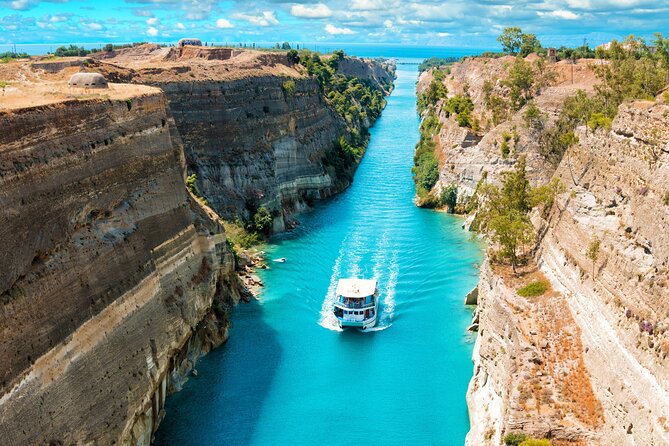
- The Corinth Canal: 19th-Century Engineering With Modern Trade Echoes
- Ancient Diolkos: The Ship-Transport Road That Changed the Game
- Acrocorinth Fortress: High Walls, Mythic Stories, and Big Sea Views
- Hadgimoustafa Spring: The Ottoman-Era Fountain Still Running
- Ancient Corinth: Museum + Apollo Temple + the Roman Agora
- Price and Value: What You’re Actually Paying For
- Logistics That Matter: Tickets, Mobile Entry, and Timing
- Who This Tour Suits Best (and Who Might Want to Skip It)
- Should You Book This Corinth, Acrocorinth, Museum, and Canal Private Tour?
- FAQ
- How long is the Ancient Corinth, Acrocorinth, Museum, & Canal private tour?
- What is the price per person?
- Is this tour private?
- Do you pick up from hotels in Athens?
- What language is the tour offered in?
- Are entrance fees included?
- What is included during the ride?
- How does pickup work for Airbnb apartments or for the port?
- What happens if weather is poor?
Key Things to Know Before You Go
- Hotel pickup and door-to-door drop-off in Athens, so you avoid the logistics hassle.
- Multiple major Corinth sights in one half-day, including Acrocorinth and the Corinth Canal.
- Most entrances are free in the itinerary, with the main paid piece at Ancient Corinth.
- Private pacing for your group, so you can linger if something grabs your attention.
- Air-conditioned private vehicle with Wi‑Fi and bottled water for the ride.
- A guide can make it personal, and one standout guide named Tas was praised for warm, engaging storytelling and photo sharing afterward.
The canal and old Corinth, a few more days
- From Athens: Ancient Corinth Day Trip with Canal & VR Guide
★ 4.6 · 1,073 reviews - Biblical Tour Letters ToThe Corinthians St Paul’s Footsteps 6Hour
★ 5.0 · 1,065 reviews - Private Biblical Tour Ancient Corinth & Isthmus Canal from Athens
★ 5.0 · 762 reviews - Athens: Ancient Corinth & Nafplio Full Day Trip with Swim
★ 4.8 · 531 reviews
Private Half-Day Corinth Itinerary: How the 5 Hours Adds Up
This is a smart “best-of Corinth” format. You’re not trying to cover everything in the region. Instead, you hit the big anchors: the engineering juggernaut at the Corinth Canal, the ancient ship-carrying route of the Diolkos, the high-walled fortress of Acrocorinth, and then the archaeological core at Ancient Corinth.
The timing is built for a private experience. You get hotel or apartment pickup in Athens, then drive toward the Isthmus, with multiple short stopovers that keep momentum. Your final stretch is the Ancient Corinth visit, which is where you’ll likely want the most attention: Temple of Apollo, the Roman Agora, and the area connected with the apostle Paul’s public proceedings (Acts 18:12–17).
Hotel Pickup, Private Comfort, and a Driver-Guide Who Sets the Pace
You start with a direct pickup at your Athens hotel lobby (or a specific meet-up point for apartments and ports). That matters more than it sounds. Corinth day trips can eat time fast when you’re juggling buses, transfers, and where to meet. This one is built to reduce that friction.
In the car, you get an air-conditioned private vehicle with Wi‑Fi and bottled water. That might sound like standard “nice-to-have,” but on a warm day it changes the feel of the outing. You’re less tired when you arrive at Acrocorinth’s viewpoints, and you spend more energy on the ruins instead of surviving the commute.
And the guide quality is part of the package. One review specifically calls out a guide and driver named Tas for planning the day according to the group’s wishes and staying flexible when the schedule needed adjusting. That sort of responsiveness is exactly what you want on a route like this, where a quick viewpoint can turn into a longer moment if the view is worth it.
The Corinth Canal: 19th-Century Engineering With Modern Trade Echoes
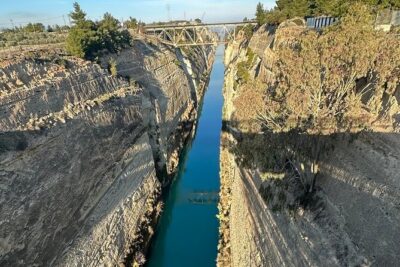
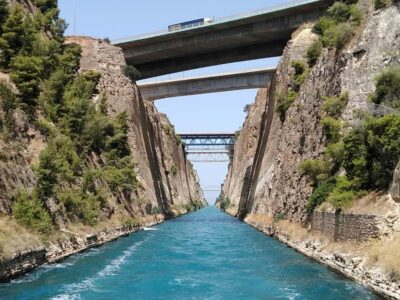
Your first real stop centers on the Isthmus corridor and the Corinth Canal. Even if you’re not an engineering person, it’s an easy place to appreciate scale. The canal is described as one of the most important 19th-century projects—an engineering milestone that played a catalytic role in Mediterranean trade.
What I like about starting here is the context it gives you. The canal isn’t just a photo stop. It sets up why Corinth mattered so long ago—and why the region’s geography keeps showing up in history. The very idea of cutting through a narrow link between seas is the modern version of an ancient problem: moving ships efficiently around bottlenecks.
Time-wise, this segment is brief. You’ll have enough time to see the canal and take in the setting, but you’re not stuck there. The tour moves you on to the deeper, more ancient story.
Just your group, at your own pace


Ancient Diolkos: The Ship-Transport Road That Changed the Game
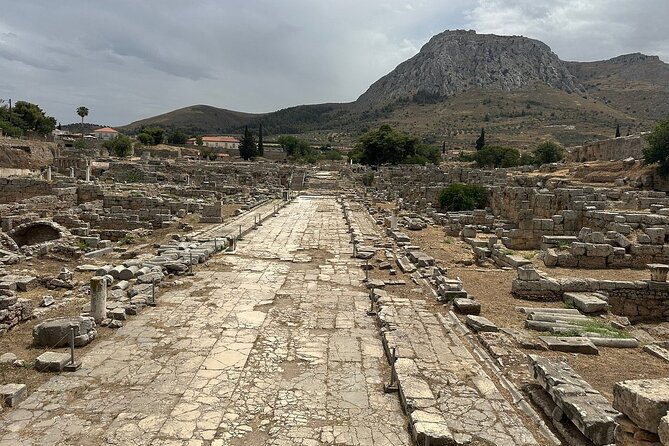
Next comes the Diolkos, the ancient limestone roads used to haul boats across the isthmus. This part is one of the most memorable connections in the itinerary because it’s practical engineering, not just ruins.
You’ll hear how ancient teams used boat trailers and animal and human power—slaves, oxen, and other animals—to heave vessels from the Corinthian Gulf to the Saronic Sea. That wasn’t a small tweak. It was a way to control a crucial maritime route, which the tour ties to Corinth’s dominance over Greek colonies.
Then the tour makes a historical leap to the apostle Paul. It connects the region’s importance—its power and reach—with why Paul chose Corinth and spent 18 months there, and why he was determined to establish his ministry. Whether you’re religious, curious, or simply historically minded, this linking of geography to people’s lives is what turns Diolkos from an interesting fact into a storyline you can actually follow.
Expect this stop to be informative rather than sprawling. It’s designed to give you the idea fast: the isthmus wasn’t just land between seas. It was a working system.
Acrocorinth Fortress: High Walls, Mythic Stories, and Big Sea Views
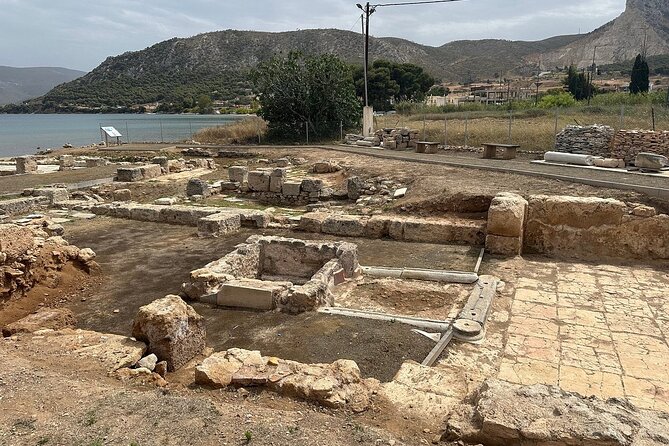
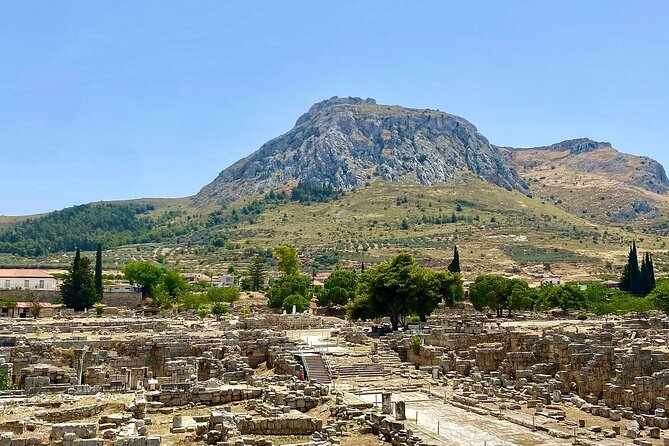
Acrocorinth is the headline. It’s the acropolis of ancient Corinth, set on a monolithic rock rising about 1886 feet above sea level. The description calls out 4.9 miles of walls, a keep, and three gates—so you can picture a place built to dominate and defend.
You’ll see the remains of different periods layered on top of each other: churches, mosques, houses, and cisterns. That mix matters because it helps you avoid a common trap—seeing a site as one single era. Here, the fortress becomes a long-lived strategic point.
The tour also mentions the temple of Aphrodite that once stood in the area, plus the mythology of Pegasus, the winged horse grazing at Acrocorinth. And there’s a Frankish tower for extra texture, with viewpoints over the valley and the Corinthian and Saronic seas.
This is also where a private guide helps. Even if you only have limited time at the fortress, a good driver-guide can point out what to look for so you’re not just staring at walls that all look similar at first glance. In a route like this, that interpretive help can be the difference between, It’s impressive, and I get why it was impressive.
Hadgimoustafa Spring: The Ottoman-Era Fountain Still Running
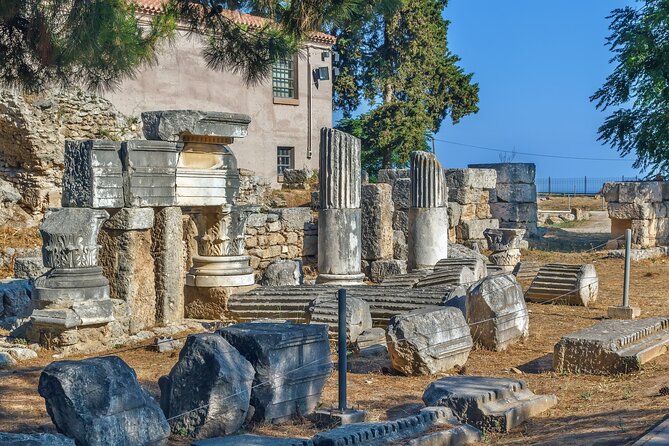
Right near the fortress, you’ll visit the Hadgimoustafa spring, described as a fountain built during the Ottoman empire in 1555. The story credits the discovery to water sources from the Upper Peiriene spring, with the legend involving Pegasus striking his hoof while trying to fly away from Bellerophon and the goddess Athena.
The practical takeaway is the contrast. One minute you’re on a hardened fortress site with walls and gates; the next, you’re at a place defined by flowing water and survival. Springs and cisterns are often where ancient sites become real. They’re not just scenery. They’re why people could hold a position and live through sieges.
Time here is set aside in a way that doesn’t feel rushed, but it still keeps the day moving toward the archaeology.
Ancient Corinth: Museum + Apollo Temple + the Roman Agora
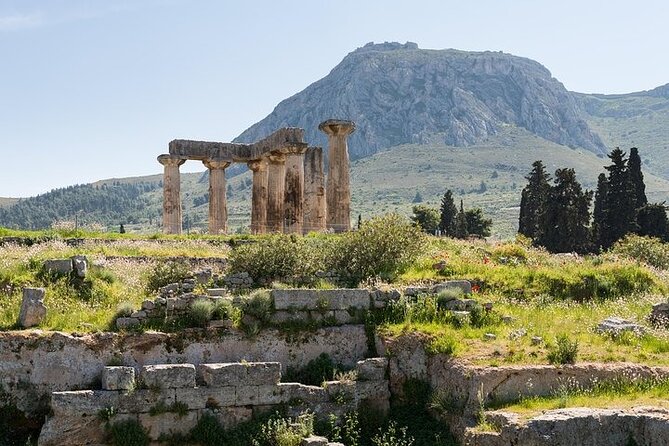
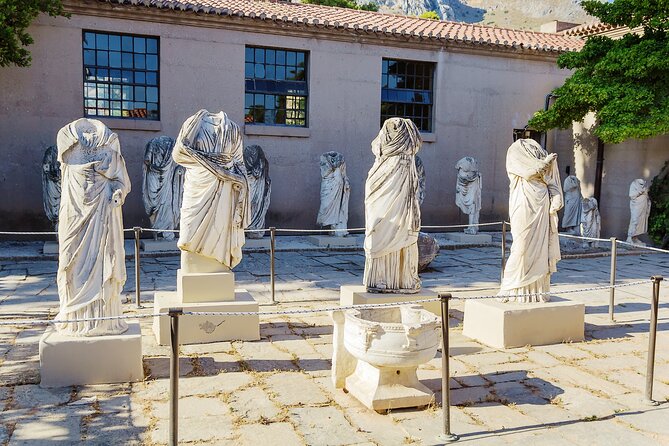
This is your final destination, and it’s the most substantial one. The tour includes time at the Archaeological Museum, followed by the Ancient Corinth archaeological area.
Here’s what you can expect to focus on:
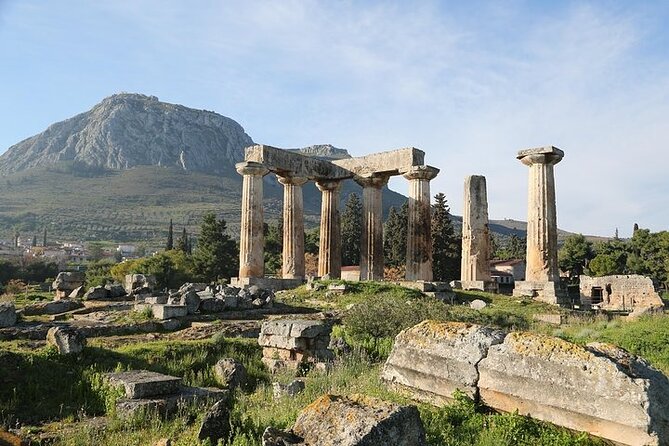
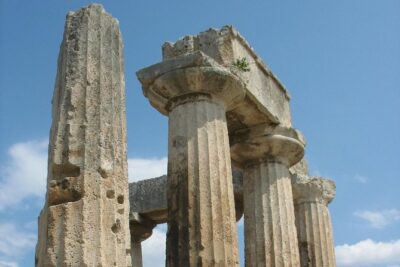
- Temple of Apollo, described as one of the earliest Doric temples in the Peloponnese and the Greek mainland, built around 560 BCE. The details highlight monolithic Doric columns, which are noted as rare in the ancient world.
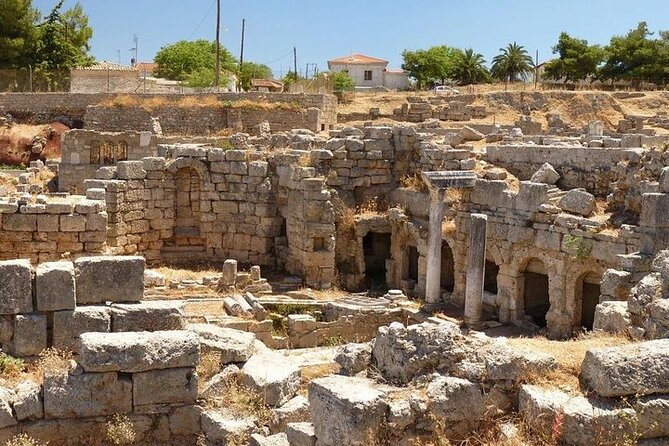
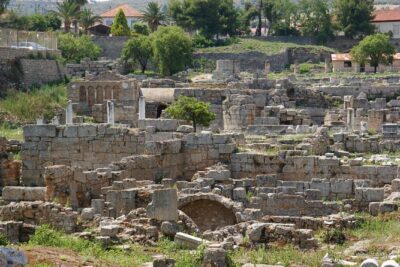
- Roman Agora, a central marketplace area often described as one of the best examples of a Roman market place. You’ll also encounter small temples and altars, Roman buildings, and entertainment structures like an amphitheatre and Roman odeon.
- Key features tied to daily life, including the Glaufkus fountain, Roman baths, and the Lechaion road and forum spaces.
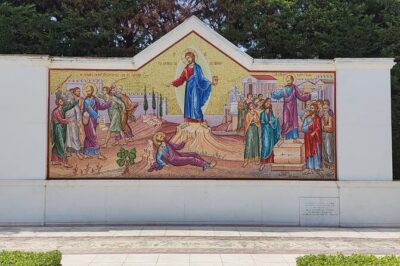
- The Bema connected with Paul, identified as the podium from where the apostle Paul was judged and presented officially as a Roman citizen. The tour points to Acts 18:12–17 and connects this spot directly to Paul’s preaching to Greeks and Romans.
This is where the tour’s theme really lands. Corinth wasn’t only a place of ships and walls. It was a place where commerce, politics, religion, and public debate collided.
One important note for budgeting: the Ancient Corinth site entrance is listed as not included. So if you’re comparing value, this is the only part you’ll likely pay for on the spot.
Price and Value: What You’re Actually Paying For
At $228.56 per person for a private 5-hour experience, you’re not buying a cheap checklist. You’re buying three things that add up fast in real life:
- Private transport and timing control
Hotel pickup and a dedicated vehicle cut down the wasted time that often eats budget day trips.
- A driver-guide with deep history knowledge
The tour is built around interpretation: canal engineering, Diolkos transport logistics, fortress defenses, and the Paul connection at the bema. That only works if someone helps you connect the dots.
- Value from mostly free entries
The itinerary lists admission tickets as free for several stops, including the Corinth Canal, the Diolkos, and Acrocorinth and the Hadgimoustafa spring. The main added cost is the Ancient Corinth site entrance.
In other words, if you like guided context and you want a private pace, the price can feel justified. If you’re trying to keep costs as low as possible and you don’t care about interpretation, you’d likely find cheaper self-guided options. But this is the kind of day where “someone who knows what you’re looking at” can be worth its weight in sunscreen.
Logistics That Matter: Tickets, Mobile Entry, and Timing
You get a mobile ticket, which simplifies entry once you’re in the right place. The tour is offered in English, which is a big deal on sites where visual cues alone can be confusing.
Duration is about 5 hours, and the time includes travel. That means you should plan for a half-day commitment rather than a quick sprint. It also means you’ll want to arrive with an appetite for short stops that add up to a full story.
The tour requires good weather. That doesn’t mean you’ll cancel at the first cloud, but it does mean the provider expects outdoor viewpoints and ruins to be workable. If weather turns, you may be offered a different date or a refund.
Who This Tour Suits Best (and Who Might Want to Skip It)
This private tour fits best if you want:
- A high-impact half-day out of Athens with minimal fuss.
- A guide who ties together myth, engineering, and early Christian references rather than just pointing at stones.
- A comfortable experience with pickup, drop-off, and in-car basics like water and Wi‑Fi.
You might consider skipping or reassessing if:
- You want a longer, slower archaeological day with more time at museums and multiple neighborhoods.
- You’re on a very strict budget where any extra site entrance cost changes the math.
- You prefer totally independent touring with no schedule.
Should You Book This Corinth, Acrocorinth, Museum, and Canal Private Tour?
If you want Corinth highlights with a sense-making guide, this is a strong pick. The big win is the structure: canal and Diolkos to explain the isthmus, Acrocorinth to feel the scale, then Ancient Corinth to land the history and the Paul connection in the actual ruins.
Book it if you like a guided storyline and you’d rather spend your time looking at the right details than figuring out transport and meeting points. If you’d rather wander at your own tempo for half a day inside one site, you may get more satisfaction elsewhere. But for most first-timers who want Corinth done well, this is the kind of plan that makes the time feel worth it.
FAQ
How long is the Ancient Corinth, Acrocorinth, Museum, & Canal private tour?
The tour duration is about 5 hours, and it includes travel time.
What is the price per person?
The price is $228.56 per person.
Is this tour private?
Yes. It is a fully private experience, limited to only your group.
Do you pick up from hotels in Athens?
Yes. Pickup and drop-off are offered, meeting you at your hotel lobby. Apartment pickup uses an agreed meet point at the building entrance.
What language is the tour offered in?
The tour is offered in English.
Are entrance fees included?
Most listed admissions in the itinerary are marked as free, but the Ancient Corinth site entrance is not included.
What is included during the ride?
You get transportation by private air-conditioned vehicles with Wi‑Fi and bottled water.
How does pickup work for Airbnb apartments or for the port?
For an Airbnb, the driver contacts you upon arrival so you can meet at the building entrance. For port pickup, the driver meets you in the arrivals area holding a signboard with your name.
What happens if weather is poor?
The experience requires good weather. If it’s canceled due to poor weather, you’ll be offered a different date or a full refund.
More Tour Reviews in Athens
- Athens: Acropolis & up to 5 Archaeological Sites Combo Pass★ 4.2 · 13,904 reviews
- Athens: Acropolis, Parthenon & Acropolis Museum Guided Tour★ 4.8 · 9,316 reviews
- The Acropolis, Parthenon & Acropolis Museum Guided Tour★ 4.7 · 8,493 reviews
- Athens: Cape Sounion & Poseidon Temple Sunset Half-Day Trip★ 4.8 · 8,241 reviews
- Acropolis: Premium Acropolis and Parthenon Guided Tour★ 4.8 · 5,208 reviews
- Athens: Mythology of Delphi, Museum and Arachova Guided Tour★ 4.7 · 5,102 reviews
Just Your Group: More Private Days
- Best of Athens Half Day Private Tour★ 5.0 · 3,714 reviews
- Athens Full Day Private Tour★ 5.0 · 2,903 reviews
- Athens Greece Full Day private tour★ 5.0 · 785 reviews
- 4 Hours – Athens & Acropolis Highlights Private Tour★ 5.0 · 681 reviews
- Athens Full Day Private Tour★ 5.0 · 667 reviews
- Enjoy Cape Sounio Private Majestic Sunset With Seaside Dinner★ 5.0 · 613 reviews
Corinth and the Canal
- From Athens: Ancient Corinth Day Trip with Canal & VR Guide★ 4.6 · 1,073 reviews
- Biblical Tour Letters ToThe Corinthians St Paul’s Footsteps 6Hour★ 5.0 · 1,065 reviews
- Private Biblical Tour Ancient Corinth & Isthmus Canal from Athens★ 5.0 · 762 reviews
- Athens: Ancient Corinth & Nafplio Full Day Trip with Swim★ 4.8 · 531 reviews
- Athens: Corinth Canal, Mycenae & Nafplio Premium Guided Tour★ 4.7 · 322 reviews
- Private Tour of Apostle Paul’s Footsteps in Ancient Corinth★ 5.0 · 275 reviews
Fresh Off the Boat: New Athens Reviews





Corinth Day Trips, compared.
 ★ 4.6From Athens: Ancient Corinth Day Trip with Canal & VR GuideFrom $411,073 reviews
 ★ 5.0Biblical Tour Letters ToThe Corinthians St Paul’s Footsteps 6HourFrom $1701,065 reviews
 ★ 5.0Private Biblical Tour Ancient Corinth & Isthmus Canal from AthensFrom $301762 reviews
 ★ 4.8Ancient Corinth & Nafplio Full Day Trip with Swim531 reviews
 ★ 4.7Corinth Canal, Mycenae & Nafplio Premium Guided TourFrom $32322 reviews
 ★ 5.0Private Tour of Apostle Paul’s Footsteps in Ancient CorinthFrom $169275 reviews
 ★ 4.3Corinth Canal, Mycenae and Nafplio Day TourFrom $129252 reviews
 ★ 4.5Corinth Half-Day Trip from Athens with Entrance TicketsFrom $91242 reviews
Browse the lists this tour appears in