
Reviewed · CORINTH DAY TRIPS
Ancient Corinth and canal Day trip from Athens: Private Tour
A canal and a fortress in one day. You’ll travel from Athens along the coast to the Corinth Canal, then work your way through Ancient Corinth with stops tied to Greek mythology and St. Paul. It’s the kind of route that makes the Peloponnese feel close, even when you’re only gone for about 6 hours.
What I like most is the pacing you can actually feel. You spend real time at Ancient Corinth (about 2 hours) instead of doing a frantic drive-by, and your guide can be flexible so you don’t feel rushed at each stop. The second big plus is the personal setup: Andrew’s Unique Tours runs a private group up to 3, with pickup from your Athens accommodation or the Piraeus cruise terminal.
One consideration: site tickets are not included, so you’ll want to budget for admissions on the archaeological parts. Also, this experience depends on good weather, and one of the best parts, Acrocorinth, is only a short stop (about 15 minutes), so you’ll get less time there than you might want.
In This Review
- Key things to know before you go
- Why this Corinth day trip feels like a smart escape from Athens
- Private SUV, pickup, and what you really pay for
- Corinth Canal: modern waterway, ancient problem
- The Diolkos trackway: how boats crossed land in ancient Corinth
- Ancient Corinth (Archaia Korinthos): the main stage for mythology and Paul
- Temple of Apollo and the second look that helps it click
- Acrocorinth: Upper Corinth fortress and the viewpoint payoff
- The museum breaks: Archaeological Museum of Corinth
- Price and logistics: where the cost makes sense
- How to plan your own visit time at each stop
- Who should book this tour
- Should you book Andrew’s Unique Tours?
- FAQ
- How long is the Ancient Corinth and canal day trip from Athens?
- Is pickup included from Athens and Piraeus?
- What vehicle is used for this private tour?
- Are entry tickets to Ancient Corinth and the museums included?
- What’s included in the price?
- What happens if the weather is poor?
Key things to know before you go
- Corinth Canal quick stop, strong photo payoff: see the waterway connecting the Ionian and Aegean seas, plus the Isthmus setting
- Diolkos boat-overland history: a paved trackway concept that let ancient vessels avoid the long circumnavigation
- Ancient Corinth gets the time it deserves: around 2 hours at the main site, including the Temple of Apollo area and St. Paul’s preaching location
- Acrocorinth is brief but meaningful: a short visit to the Upper Corinth fortress that’s all about viewpoints
- No licensed site guide included: you’ll get a driver who knows history, but plan to self-explore at the sites
- Private value depends on your group size: up to 3 people helps spread the $570.15 group price
The canal and old Corinth, a few more days
- From Athens: Ancient Corinth Day Trip with Canal & VR Guide
★ 4.6 · 1,073 reviews - Biblical Tour Letters ToThe Corinthians St Paul’s Footsteps 6Hour
★ 5.0 · 1,065 reviews - Private Biblical Tour Ancient Corinth & Isthmus Canal from Athens
★ 5.0 · 762 reviews - Athens: Ancient Corinth & Nafplio Full Day Trip with Swim
★ 4.8 · 531 reviews
Why this Corinth day trip feels like a smart escape from Athens
From Athens, this is a clean way to get out to Corinth without losing your whole day to logistics. You’re not just seeing ruins. You’re moving through places that explain why Corinth mattered: trade routes, boat travel across the Isthmus, and the religious story tied to the Corinthians.
The drive along the coastal highway helps. It keeps the day from feeling like nonstop museum air-conditioning. You get that rhythm of road-to-view-to-site. Then the day snaps into focus at Corinth, where mythology, politics, and early Christianity are all part of the same physical landscape.
I also like the “multiple layers in one loop” approach. You’re not only staring at one monument. You go from the canal (modern engineering in an ancient geography) to the archaeological site, and then up toward the fortress area at Acrocorinth. Even with limited time, the contrast helps your brain connect the dots faster.
Private SUV, pickup, and what you really pay for
Let’s talk value, because this is a private tour. The price is $570.15 per group for up to 3 people, lasting about 6 hours. That’s not cheap if you’re going solo, but it becomes more reasonable if you’re splitting with two friends or family.
You get a real car for the day: an SUV (Skoda Kodiaq) or a Mercedes E-Class taxi car. And you get pickup and drop-off from your Athens accommodation. If you’re on a cruise, you also get pickup/drop-off at the Piraeus cruise ship terminal, which is a big deal when you’re working with tight cruise timing.
What’s included is practical: bottled water plus tolls, and a professional driver who knows history. Here’s the key nuance: the driver is not a licensed guide who will walk with you inside each site. In other words, you’ll be self-guided on the archaeological grounds, while the driver supports the story and logistics.
I like that transparency, because it changes how you prepare. If you want a lot of spoken commentary inside the sites, you might want to bring along your own guidebook or an offline map so you can read and connect the dots on your own. If you’re happy to explore at your own pace, this format works well—and it also explains why the visit time is allocated the way it is.
Corinth Canal: modern waterway, ancient problem
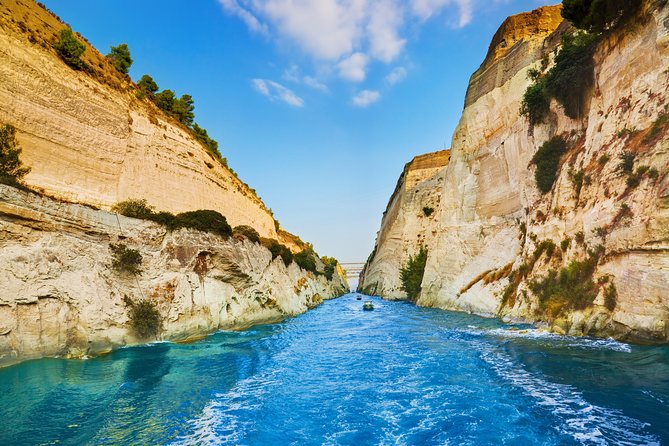
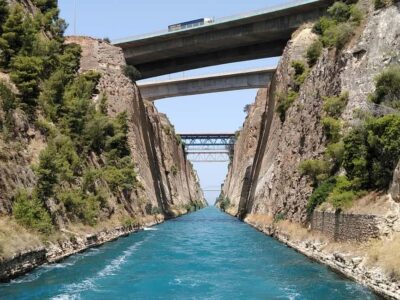
Your first stop is the Corinth Canal, with about 30 minutes on site. The basic idea is easy to grasp when you’re standing there: the canal connects the Ionian Sea and the Aegean Sea by cutting through the Isthmus of Corinth. You’re seeing the solution to a problem that ancient sailors still had to solve the hard way.
Even if you’re not a “facts and figures” person, the canal gives you instant context. You can look at the narrow geography and understand why people cared so much about moving ships efficiently. It also sets up what comes next: a land-based shortcut.
Since admission at this stop is listed as free, you’re not forced into ticket math early in the day. Use this first chunk of time to slow down, take photos, and get your bearings.
Just your group, at your own pace


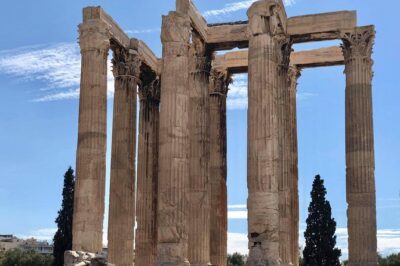
The Diolkos trackway: how boats crossed land in ancient Corinth
Next comes the Diolkos, where you’ll spend about 15 minutes. This is one of those concepts that sounds like a trivia fact until you connect it to why Corinth mattered.
The Diolkos was a paved trackway near Corinth that allowed boats to be moved overland across the Isthmus. The goal was simple: avoid the long and dangerous trip around the Peloponnese peninsula. So instead of waiting for the sea to cooperate, ancient crews used engineering on land.
I find this stop especially satisfying because it’s not just “look at ruins.” It’s a story about problem-solving. You’re basically seeing the ancient version of route planning, and it makes the later archaeological pieces feel more intentional.
Ancient Corinth (Archaia Korinthos): the main stage for mythology and Paul
This is the big one. You’ll get about 2 hours at Ancient Corinth, and it’s also the stop where you’ll see many of the classic highlights.
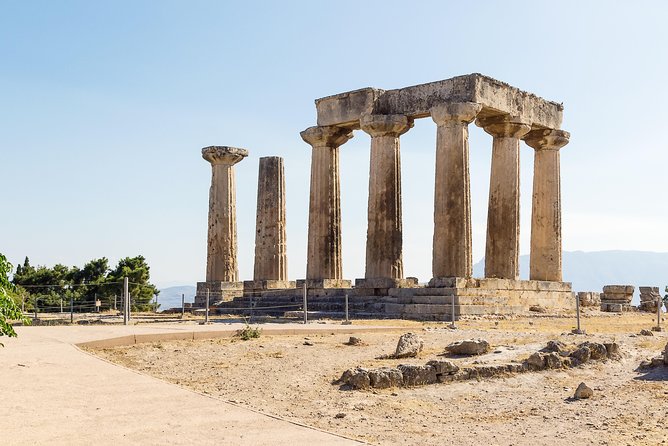
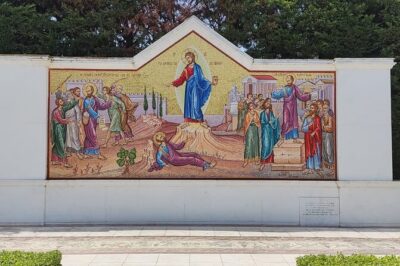
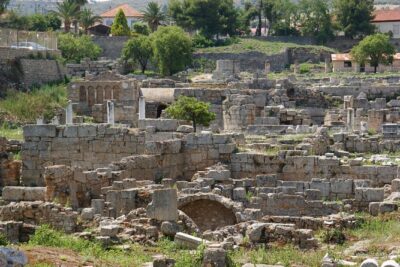
Among the key sights you’ll encounter are the Temple of Apollo (noted around 540 BCE), the theater, the Roman Odeon, and the Glauke fountain area. You’ll also have time around the Vima (step), described as the place from where St. Paul preached to the Corinthians in 52 AD. That’s a powerful connection point because it shifts the tone from Greek myth to early Christian history without changing location.
Also on your radar here is the Lechaion Street and the museum time included in the stop. Since the museum is mentioned as part of this stop’s site time, plan to use at least some of your 2 hours to get indoor context, not only stone-and-columns context.
One practical note: admission tickets are not included at Ancient Corinth. That’s not a dealbreaker, but it means you should be ready to buy entry on the day and not treat the 2-hour visit like a free stroll.
The site itself covers a lot of ground. You won’t feel pressured to sprint if you keep a steady pace, but you also shouldn’t plan to spend 2 hours staring at one spot. With the time allotted, you’ll get the best payoff by moving in a loose loop: start with the major religious/architectural highlights, then follow the thread toward the Paul connection, then take your museum break.
Temple of Apollo and the second look that helps it click
After Acrocorinth, the itinerary includes a stop specifically labeled for the Temple of Apollo, with about 10 minutes. You may have already seen Apollo’s temple as part of your broader Ancient Corinth time. This second chance matters because it gives you a different “after” perspective once you’ve already climbed toward the fortress area.
The Temple of Apollo at Corinth is described as one of the earliest Doric temples in the Peloponnese and the Greek mainland, built around 560 BCE with local oolithic limestone. If you’re the kind of traveler who likes to understand why a structure looks the way it does, the Doric style detail helps you read the remaining stone shapes instead of just admiring them.
Ten minutes isn’t long, but it works as a punctuation mark. After fortress viewpoints and Paul-related stops, the temple reminds you that Corinth’s identity was tied to worship, civic power, and prophecy.
Acrocorinth: Upper Corinth fortress and the viewpoint payoff
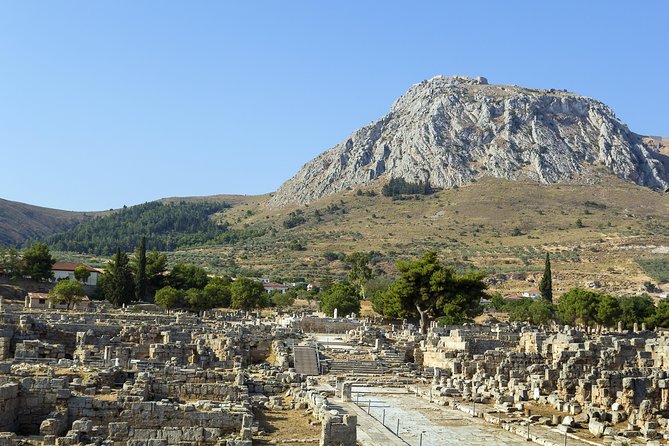
Then you head to Acrocorinth (Upper Corinth), described as the acropolis/fortress of Ancient Corinth, with about 15 minutes allocated.
This is where the day turns from “site viewing” to “place imagining.” A fortress acropolis was not built for comfort. It was built for control. Even without a long visit, you can read the logic of the location: it’s high, it’s commanding, and it lets you see how the region connects.
Because this stop is short, I recommend you use the time intentionally. Spend a few minutes looking out over the area first, then only afterward decide what you want to focus on closer up. If you’re relying on photo stops, aim for one or two steady angles rather than hopping around for nonstop shots.
Also, don’t forget the weather factor. Since the whole experience requires good weather, this kind of viewpoint stop is exactly the first thing that can get ruined by fog or rain.
The museum breaks: Archaeological Museum of Corinth
Rounding out the archaeology side is the Archaeological Museum of Corinth, with about 30 minutes. This museum was constructed between 1931 and 1932 with the intent to display findings from excavations, and it’s located within the archaeological site area.
Even if you only have half an hour, museum time is often what transforms ruins from “pretty stones” into something you can explain to a friend later. You’ll get a clearer sense of objects and artifacts tied to the site, which helps the outdoor structures make more sense.
Because tickets for the museum are not included, budget time and money for entry. And if the indoor space is crowded, move through at a calm pace rather than trying to read everything line-by-line.
Price and logistics: where the cost makes sense
The headline price is $570.15 per group (up to 3). So the question is simple: does paying for privacy buy you something you actually care about?
Here’s what you’re buying with private transport:
- A smoother day with pickup and drop-off from Athens and also the Piraeus cruise terminal
- A driver who can handle the day’s history context while you focus on your own pacing
- The chance to spend extra time at stops when you want, rather than being locked into a strict group rhythm
The included bottled water is small but helpful on a half-day outing.
The biggest cost trade-off is that you’re not getting a licensed, on-site guide included for the archaeological grounds. That doesn’t mean you’ll be lost. It just means you should plan to actively read signage or use your own interpretive support.
Also, because you’re in a private SUV/taxi car rather than a big bus, you won’t have much downtime for wandering around freely between stops. Your schedule is controlled, which is good if you want structure, and less ideal if you want a slow, unscripted day.
How to plan your own visit time at each stop
One thing that really matters on a tour like this is how you use the limited minutes. The good news is that the itinerary gives you the right kind of timing balance: longer time at the main site, shorter time at the viewpoint areas, and quick hits for the canal and Diolkos.
My practical tip: treat Ancient Corinth like your anchor. Use the roughly 2 hours to take your time with the major highlights and then decide whether you need the museum portion most. If you skip indoor context at the site, the later Archaeological Museum of Corinth stop becomes more important.
For Acrocorinth, arrive with a quick plan. Look out first, then choose one or two photo angles or structural viewpoints to focus on. With only about 15 minutes, trying to do everything usually means missing the best angle.
For the Corinth Canal and Diolkos, you’re there for context more than for long browsing. Forty-five minutes total across these two stops is enough if you keep moving and capture the big visuals.
Who should book this tour
This tour fits best if you:
- Want a private day trip without committing to a full-day itinerary
- Like biblical history tied to real places, especially the St. Paul preaching connection at Corinth
- Enjoy ancient engineering stories like the Diolkos and want that context, not just ruins
- Are traveling with a small group (up to 3) and want your schedule to feel yours
It also makes sense for cruise days because the tour includes pickup and drop-off at Piraeus. If you’ve got limited time and still want more than a quick port-side walk, this is built for that.
If you prefer a full guided experience with a licensed guide inside every site, you might feel you’re missing spoken commentary. But if you’re happy to explore and read, the driver-history format can still give you a satisfying day.
Should you book Andrew’s Unique Tours?
If you want a focused, high-impact Corinth day with private transport and smart stop order, I’d book it. The best reason is the balance: a proper visit at Ancient Corinth, paired with the canal and the fortress viewpoint. That mix helps the day feel cohesive instead of random.
I also appreciate the human side—Andrew is described as polite and friendly, and the pacing can be flexible so you can spend as much time as you want at each stop. For a private trip, that matters because you’re not stuck with a rigid group tempo.
Just go in with two expectations set: admission tickets are not included, and weather matters. If you check conditions and you’re ready to budget for site entry, this is an efficient way to see why Corinth mattered.
FAQ
How long is the Ancient Corinth and canal day trip from Athens?
The tour lasts about 6 hours.
Is pickup included from Athens and Piraeus?
Yes. The tour includes pick up and drop off from your accommodation in Athens, and pick up/drop off at the Piraeus cruise ship terminal.
What vehicle is used for this private tour?
You’ll travel in an SUV (Skoda Kodiaq) or a Mercedes E-Class taxi car.
Are entry tickets to Ancient Corinth and the museums included?
No. Tickets to the archaeological sites and museums are not included, though admission at the Corinth Canal and the Diolkos is free.
What’s included in the price?
Included are bottled water, tolls, professional drivers with historical knowledge (not licensed to accompany you in any site), and the pickup/drop-off mentioned above.
What happens if the weather is poor?
This experience requires good weather. If it’s canceled due to poor weather, you’ll be offered a different date or a full refund.
More Tour Reviews in Athens
- Athens: Acropolis & up to 5 Archaeological Sites Combo Pass★ 4.2 · 13,904 reviews
- Athens: Acropolis, Parthenon & Acropolis Museum Guided Tour★ 4.8 · 9,316 reviews
- The Acropolis, Parthenon & Acropolis Museum Guided Tour★ 4.7 · 8,493 reviews
- Athens: Cape Sounion & Poseidon Temple Sunset Half-Day Trip★ 4.8 · 8,241 reviews
- Acropolis: Premium Acropolis and Parthenon Guided Tour★ 4.8 · 5,208 reviews
- Athens: Mythology of Delphi, Museum and Arachova Guided Tour★ 4.7 · 5,102 reviews
Just Your Group: More Private Days
- Best of Athens Half Day Private Tour★ 5.0 · 3,714 reviews
- Athens Full Day Private Tour★ 5.0 · 2,903 reviews
- Athens Greece Full Day private tour★ 5.0 · 785 reviews
- 4 Hours – Athens & Acropolis Highlights Private Tour★ 5.0 · 681 reviews
- Athens Full Day Private Tour★ 5.0 · 667 reviews
- Enjoy Cape Sounio Private Majestic Sunset With Seaside Dinner★ 5.0 · 613 reviews
Corinth and the Canal
- From Athens: Ancient Corinth Day Trip with Canal & VR Guide★ 4.6 · 1,073 reviews
- Biblical Tour Letters ToThe Corinthians St Paul’s Footsteps 6Hour★ 5.0 · 1,065 reviews
- Private Biblical Tour Ancient Corinth & Isthmus Canal from Athens★ 5.0 · 762 reviews
- Athens: Ancient Corinth & Nafplio Full Day Trip with Swim★ 4.8 · 531 reviews
- Athens: Corinth Canal, Mycenae & Nafplio Premium Guided Tour★ 4.7 · 322 reviews
- Private Tour of Apostle Paul’s Footsteps in Ancient Corinth★ 5.0 · 275 reviews
Fresh Off the Boat: New Athens Reviews





Corinth Day Trips, compared.
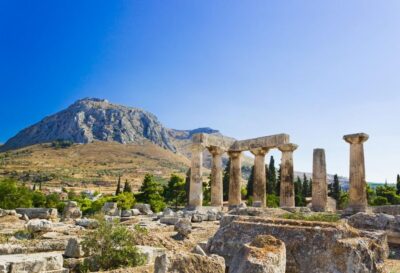 ★ 4.6From Athens: Ancient Corinth Day Trip with Canal & VR GuideFrom $411,073 reviews
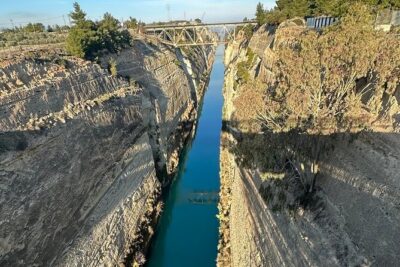 ★ 5.0Biblical Tour Letters ToThe Corinthians St Paul’s Footsteps 6HourFrom $1701,065 reviews
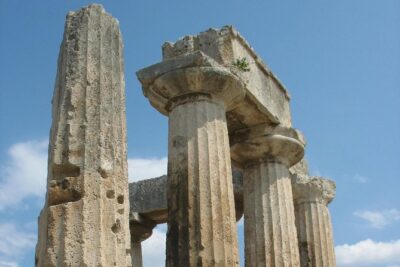 ★ 5.0Private Biblical Tour Ancient Corinth & Isthmus Canal from AthensFrom $301762 reviews
 ★ 4.8Ancient Corinth & Nafplio Full Day Trip with Swim531 reviews
 ★ 4.7Corinth Canal, Mycenae & Nafplio Premium Guided TourFrom $32322 reviews
 ★ 5.0Private Tour of Apostle Paul’s Footsteps in Ancient CorinthFrom $169275 reviews
 ★ 4.3Corinth Canal, Mycenae and Nafplio Day TourFrom $129252 reviews
 ★ 4.5Corinth Half-Day Trip from Athens with Entrance TicketsFrom $91242 reviews
Browse the lists this tour appears in