
Reviewed · CORINTH DAY TRIPS
Ancient Corinth, Temple of Hera, Blue Lake full day private tour from Athens
Corinth feels bigger than you expect. This full-day private outing gives you an efficient circuit beyond Athens, with driver narration as you move between ruins, views, and water. I especially like the air-conditioned private vehicle and the relaxed pacing of multiple short stops that still add up to a meaningful day.
For value, here’s the one tradeoff to note: two of the main sites (Ancient Corinth and the Archaeological Museum) are ticketed and cost extra, so your total day budget is a bit higher than the free stops. Still, it’s a smart way to cover a lot of ground without dealing with transfers on your own.
In This Review
- Key things to know before you go
- Why this Athens-to-Corinth private day feels efficient
- Price and value: what you’re actually buying
- The Corinth Canal: short stop, big wow factor
- Ancient Corinth: ruins that connect to Paul and the Romans
- The Archaeological Museum: where the site’s story gets organized
- Temple of Apollo and Akrokorinthos: two different kinds of ruins
- Temple of Apollo (quick hit)
- Akrokorinthos (Upper Corinth)
- Limni Vouliagmeni (Blue Lake): the reset you’ll be glad you planned
- Perachora’s Heraion: a sanctuary that ends on the water
- How the driver narration changes the whole day
- Included extras that matter more than you think
- Who should book this private Corinth and Blue Lake tour
- Should you book this Ancient Corinth, Heraion, and Blue Lake private tour?
- FAQ
- How long is the Ancient Corinth, Temple of Hera, and Blue Lake private tour?
- Is this tour private?
- What’s included in the price?
- Are entrance fees included?
- What language is the tour offered in?
- Do I get a licensed tour guide at the sites?
- Are there any free stops during the day?
- Where does pickup happen?
- What is the cancellation policy?
Key things to know before you go
- A private car means real flexibility: pickup is offered and you return to your starting point (or a spot you prefer).
- Most stops are free: Corinth Canal, Temple of Apollo, Akrokorinthos, Limni Vouliagmeni, and Perachora’s Heraion don’t require extra fees.
- Your driver tells the story: you get fluent English commentary from the road, even though the driver isn’t an official site guide.
- You’ll hit the classics and the sideways stops: Corinth Canal plus Ancient Corinth, then Perachora’s Heraion and Blue Lake for a change of pace.
- This is a long day: plan on about 8 to 9 hours and expect some walking at elevated sites like Akrokorinthos.
The canal and old Corinth, a few more days
- From Athens: Ancient Corinth Day Trip with Canal & VR Guide
★ 4.6 · 1,073 reviews - Biblical Tour Letters ToThe Corinthians St Paul’s Footsteps 6Hour
★ 5.0 · 1,065 reviews - Private Biblical Tour Ancient Corinth & Isthmus Canal from Athens
★ 5.0 · 762 reviews - Athens: Ancient Corinth & Nafplio Full Day Trip with Swim
★ 4.8 · 531 reviews
Why this Athens-to-Corinth private day feels efficient
This tour works because it avoids the usual Athens problem: you spend your day fighting logistics instead of seeing things. You get one private ride with hotel/airport/port pickup, then a sequence of stops that make sense geographically and thematically.
I also like the mix of “big-name” and “less obvious but cool” moments. Ancient Corinth is the headline, sure. But the Corinth Canal views and the Perachora waterfront sanctuary keep the day from becoming one long museum-style experience.
The private format matters too. It’s not a group bus where you’re stuck with whatever timing the crowd needs. Your driver can handle narration at each stop and you can usually settle into the right pace for your own group.
Price and value: what you’re actually buying
The price is $220.73 per person for a private, 8 to 9 hour day. That sounds like a lot until you translate what’s included: a private air-conditioned vehicle, WiFi onboard, bottled water, and pickup/drop-off at the place that matters to you.
Where it can feel very good value is when you’re traveling as a small group. You’re effectively paying for convenience and time. Instead of planning a bus-and-train combo to the Peloponnese, you’re paying to have someone else handle the driving while you focus on the sites.
Also, a chunk of your day is built from free stops. Tickets are only listed as not included for Ancient Corinth & the Archaeological Museum of Ancient Corinth (about €15 per person total), while the rest of the stops are free. So your cost has some built-in balance.
The Corinth Canal: short stop, big wow factor
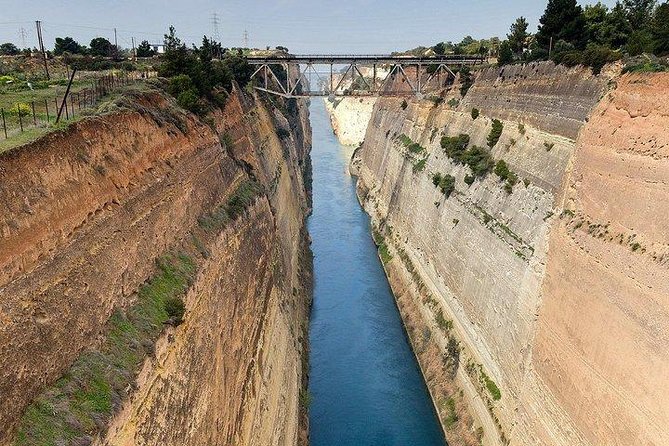
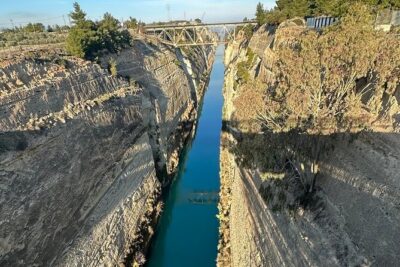
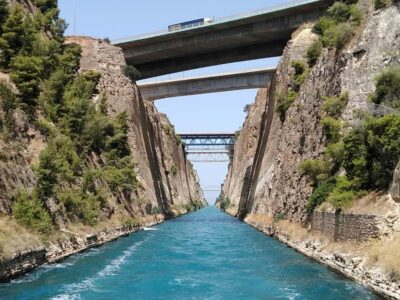
The Corinth Canal is only one part view, one part reality check. It’s a man-made cut through the Isthmus of Corinth, linking the Ionian Sea and the Saronic Gulf. And the numbers help you understand why it’s such a dramatic sight.
From the viewpoint, you see steep limestone walls and ships moving through a channel that’s surprisingly narrow. The canal is 6.4 km long and only 21.4 meters wide at the base, with no locks. That combination makes it a barrier for many modern vessels, which is why what you’re seeing isn’t a constant mega-ship parade.
You’ll get around 30 minutes here, and that’s about right. You’re not meant to linger all day. You’re meant to park yourself, take in the walls, and then move on while the view is still fresh.
Practical tip: bring your camera finger-ready. This is one of those places where the best angles are quick and then change as you reposition.
Just your group, at your own pace


Ancient Corinth: ruins that connect to Paul and the Romans
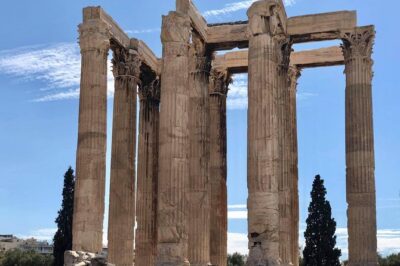
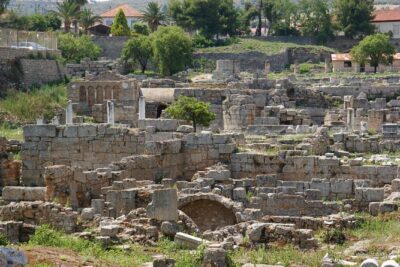
Ancient Corinth is a city you can feel in your head even if you don’t know every stone name. It was a major city-state on the isthmus, roughly halfway between Athens and Sparta. The modern city sits just a few kilometers northeast, which helps you understand why this place remained important for so long.
This stop is also one of the most text-connected places in the region. Corinth shows up in the two letters of Saint Paul (First and Second Corinthians) and is mentioned in Acts during Paul’s missionary travels. It’s also a topic in Pausanias’ Description of Greece.
And then there’s the real historical weight: Ancient Corinth was enormous for its time, with a population around 90,000 in 400 BC. The Romans demolished Corinth in 146 BC, then later rebuilt it in 44 BC and made it the provincial capital.
You get about 1.5 hours at Ancient Corinth, and that timing usually works well because you can do a meaningful walk without rushing. The setting is what makes the time feel earned: you’re seeing how the city sat on key routes and power systems, not just isolated columns.
One consideration: since this is a ticketed stop and you’re on a full-day schedule, keep your entry time in mind. If you’re the type who likes to read every label carefully, you may want to pace yourself so you don’t run out of energy for the later sites.
The Archaeological Museum: where the site’s story gets organized
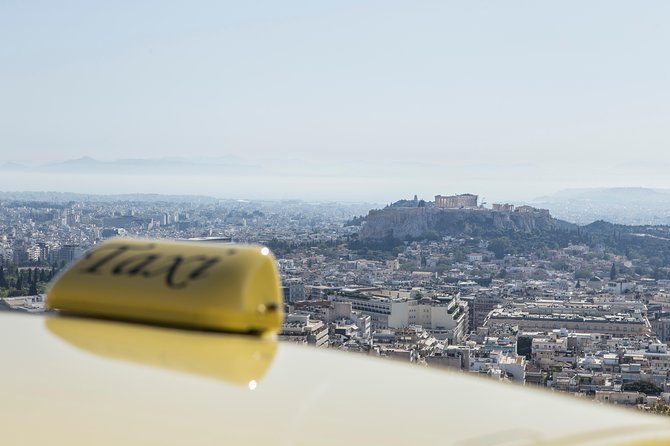
Right at the heart of the experience is the Archaeological Museum of Ancient Corinth, which was built between 1931 and 1932 specifically to display finds from the excavations. It sits within the archaeological site itself, under the jurisdiction of the 37th Ephoreia of the Greek Archaeological Service.
This museum stop can save you from the classic ruins problem: you see fragments outside and you’re left wondering what they once meant. Inside, you get a clearer sense of what the excavated spaces were and how they fit together.
You’ll spend about 1 hour here. That’s a good length. Enough time to get oriented and connect what you saw outside to what you’re looking at now.
The museum’s placement is also a clue to what you’ll enjoy on this tour. The broader Ancient Corinth site includes big named features and city elements such as Hadgimoustafa spring, Lechaion Road, a Basilica, the Fountain of Peirene, Stoa, Agora, Odien, plus other temples and a theatre. Even if you don’t memorize each label, knowing these are part of the same place helps you mentally map the city.
Temple of Apollo and Akrokorinthos: two different kinds of ruins
After Corinth, the day starts stacking viewpoints and elevated feels.
Temple of Apollo (quick hit)
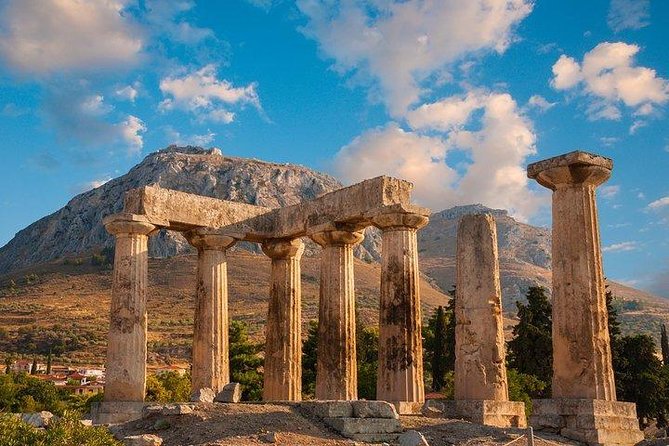
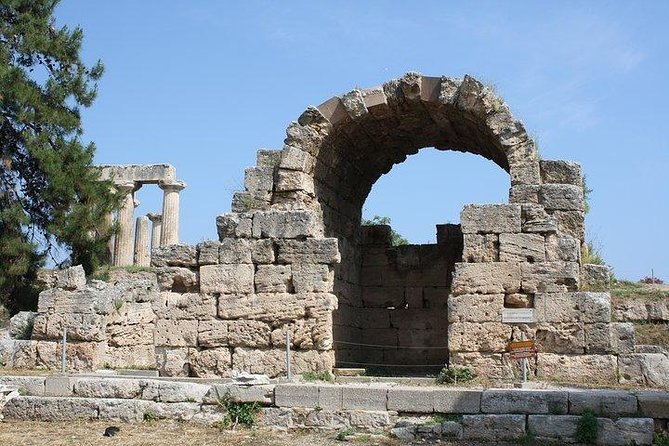
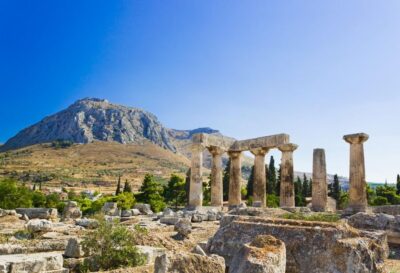
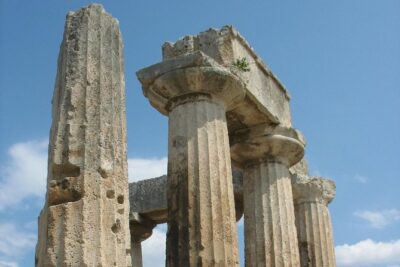
The Temple of Apollo dates to 550 BC, and the tour gives you about 15 minutes. This is not a long temple-stroll kind of stop. Think of it as a fast historical marker and a chance to absorb the scale and setting.
If you like quick architectural moments, you’ll enjoy this. If you want more time in every site, you’ll probably wish it were longer.
Akrokorinthos (Upper Corinth)
Then comes the real “how did they manage that” moment: Akrokorinthos, the acropolis on a monolithic rock overseeing the ancient city.
This place was more than a view platform. It had a secure water supply, and its fortress function made it a key defense system. Since it commands the isthmus, it was able to help repel enemies entering the Peloponnese by land.
You get about 1 hour here, and it’s a very worthwhile allocation. The setting forces you to think beyond the architecture. You start imagining movement: who could approach, who could see, and why this location mattered.
Practical tip: wear shoes you trust. Elevated sites typically mean uneven ground and a bit of climb.
Limni Vouliagmeni (Blue Lake): the reset you’ll be glad you planned

After ruins and stone, you get a proper scenery change at Limni Vouliagmeni, also called Blue Lake.
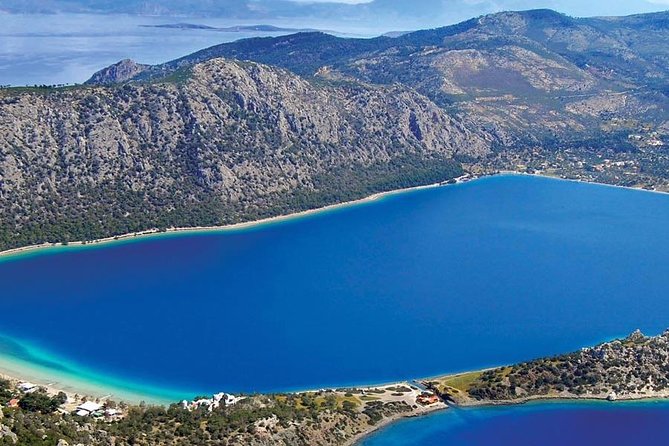
This lagoon is 16 km northwest of Loutraki, near the archaeological area at Perachora. It’s compact: up to 2 km long and about 1 km wide, with depth not exceeding 40 meters. And unlike Loutraki’s beach, it has a sandy beach, which makes it a more comfortable stretch if you want to sit down for a bit.
What I like about this stop is that it feels separate from the rest of the day. It’s not “just another ruin.” It’s a nature-and-water pause.
The lagoon connects to the Corinthian Gulf through a very narrow canal (under 6 meters wide). In ancient times, it had names like Eschatiotis and Gorgopis, the latter tied to a story of Gorgi, daughter of Megareas, who drowned there.
You’re only here for about 30 minutes, but that’s exactly the right amount for most people in a full 8–9 hour day. Use it to cool off, look at the water rhythm, and take photos before you head back to the next major site.
Perachora’s Heraion: a sanctuary that ends on the water

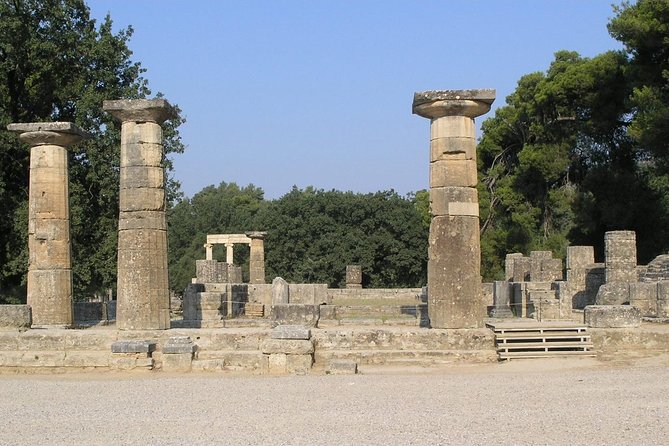
The last major stop is the Heraion in Perachora, a sanctuary of Hera located in a small cove on the Corinthian Gulf at the end of the Perachora peninsula.
This site is the kind of place where you understand why sanctuaries weren’t only about belief. They also had a geographic logic. The sanctuary faced the harbors of Corinth across the gulf, which likely put it under Corinth’s control even though there was debate among Argos, Megara, and Corinth.
The remains include more than just one building. You’ll see an unusually constructed Hera temple and remains of other structures such as:
- an L-shaped stoa
- a large cistern
- dining rooms
- and a possible second temple
It’s also a timeline lesson. Cult activity may have started as early as the 9th century BCE and continued until 146 BCE, when the Roman general Mummius sacked Corinth during conflict with the Achaean League. Later in the Roman period, domestic structures were built on the site, meaning it stopped functioning as a sanctuary.
You get about 1 hour here, and that makes sense. It’s long enough to understand the layout and short enough that you don’t feel stuck in an end-of-day energy dip.
If you want a final-site memory that feels calm, this is a good one. The cove setting helps. You’re not just reading ruins; you’re watching the sea line.
How the driver narration changes the whole day
This tour stands or falls on the storytelling quality, and the setup is designed to deliver it. You’ll have professional drivers who know the region and can provide fluent English narration.
One important note: the drivers are not licensed tour guides, and they won’t enter the archaeological sites with you. But they can still answer questions and explain what you’re seeing while you travel between stops and while you’re waiting for your timing inside.
This format often works best when you treat it like a guided drive plus self-paced site visits. You get context fast, then you can wander at your own speed without feeling rushed by someone trying to keep a group moving.
Based on past experiences with this provider, drivers such as George, Costa, Tom, and Panajotis (also called Notis) have been praised for history and helpfulness. Even if your driver is different, you can expect that the goal is the same: clear explanations and a friendly approach.
Included extras that matter more than you think
A private tour can feel overpriced until you see what’s handled for you. Here, you get the practical basics:
- hotel/airport/port pickup and drop-off
- air-conditioned vehicle
- bottled water
- WiFi on board
- narration from your driver in fluent English
- and a mobile ticket option mentioned in the tour features
You also get flexibility: pickup time is adjustable upon request, and your driver will return you to the same place or to a point you prefer.
If you’re arriving by plane or ship, the driver holding a sign with your name is the kind of small detail that prevents stress. Nobody wants to wander around an arrival hall guessing which transfer is theirs.
Who should book this private Corinth and Blue Lake tour
This is a great choice if you want:
- a hassle-free day beyond Athens with minimal planning
- a mix of major ancient sites plus scenic stops
- the comfort of a private vehicle and driver narration
- enough time at key places like Ancient Corinth and Akrokorinthos without turning it into a sprint
It may not be ideal if you want a lot of guided time inside every site. Because the driver isn’t a licensed site guide, you’ll still be doing the actual site wandering yourself.
It also isn’t a match if you’re hoping to add extra activities that don’t fit the rules. Extreme sports or third-party activities aren’t allowed, which can lead to cancellation if plans change.
Should you book this Ancient Corinth, Heraion, and Blue Lake private tour?
I’d book it if your goal is a smart, story-led Peloponnese day without headaches. The value comes from the private transport, the variety (canal, Corinth, museum, acropolis, lagoon), and the fact that many stops are free, which helps keep the day’s total cost under control.
Skip it if you’re the type who needs a licensed guide inside every archaeological room and prefers slower days with fewer transitions. This tour is built for momentum.
If you’re aiming for one unforgettable day that covers the Corinth story from sea-level canal engineering to hilltop defense and then ends at a sanctuary by the water, this is a strong pick.
FAQ
How long is the Ancient Corinth, Temple of Hera, and Blue Lake private tour?
It runs about 8 to 9 hours.
Is this tour private?
Yes. It’s a private tour, meaning only your group participates.
What’s included in the price?
The tour includes hotel/airport/port pickup and drop-off, a private air-conditioned vehicle, WiFi onboard, bottled water, and driver narration.
Are entrance fees included?
No. Entrance fees are not included for Ancient Corinth and the Archaeological Museum of Ancient Corinth (approximately €15 per person). Other listed stops are free.
What language is the tour offered in?
The tour is offered in English.
Do I get a licensed tour guide at the sites?
A licensed tour guide is not included, though it may be available upon request depending on availability. Your driver provides commentary but is not a licensed site guide.
Are there any free stops during the day?
Yes. Corinth Canal, Temple of Apollo, Akrokorinthos, Limni Vouliagmeni, and Perachora’s Heraion are listed as admission ticket free.
Where does pickup happen?
Pickup is available from hotels, airports, and ports. The driver meets you at the hotel lobby, the apartment entrance, the arrival hall with a sign for airports, or at the port gate after disembarking.
What is the cancellation policy?
You can cancel for a full refund up to 24 hours in advance of the experience start time. Changes within 24 hours of the start time aren’t accepted.
More Tour Reviews in Athens
- Athens: Acropolis & up to 5 Archaeological Sites Combo Pass★ 4.2 · 13,904 reviews
- Athens: Acropolis, Parthenon & Acropolis Museum Guided Tour★ 4.8 · 9,316 reviews
- The Acropolis, Parthenon & Acropolis Museum Guided Tour★ 4.7 · 8,493 reviews
- Athens: Cape Sounion & Poseidon Temple Sunset Half-Day Trip★ 4.8 · 8,241 reviews
- Acropolis: Premium Acropolis and Parthenon Guided Tour★ 4.8 · 5,208 reviews
- Athens: Mythology of Delphi, Museum and Arachova Guided Tour★ 4.7 · 5,102 reviews
Just Your Group: More Private Days
- Best of Athens Half Day Private Tour★ 5.0 · 3,714 reviews
- Athens Full Day Private Tour★ 5.0 · 2,903 reviews
- Athens Greece Full Day private tour★ 5.0 · 785 reviews
- 4 Hours – Athens & Acropolis Highlights Private Tour★ 5.0 · 681 reviews
- Athens Full Day Private Tour★ 5.0 · 667 reviews
- Enjoy Cape Sounio Private Majestic Sunset With Seaside Dinner★ 5.0 · 613 reviews
Corinth and the Canal
- From Athens: Ancient Corinth Day Trip with Canal & VR Guide★ 4.6 · 1,073 reviews
- Biblical Tour Letters ToThe Corinthians St Paul’s Footsteps 6Hour★ 5.0 · 1,065 reviews
- Private Biblical Tour Ancient Corinth & Isthmus Canal from Athens★ 5.0 · 762 reviews
- Athens: Ancient Corinth & Nafplio Full Day Trip with Swim★ 4.8 · 531 reviews
- Athens: Corinth Canal, Mycenae & Nafplio Premium Guided Tour★ 4.7 · 322 reviews
- Private Tour of Apostle Paul’s Footsteps in Ancient Corinth★ 5.0 · 275 reviews
Fresh Off the Boat: New Athens Reviews





Corinth Day Trips, compared.
 ★ 4.6From Athens: Ancient Corinth Day Trip with Canal & VR GuideFrom $411,073 reviews
 ★ 5.0Biblical Tour Letters ToThe Corinthians St Paul’s Footsteps 6HourFrom $1701,065 reviews
 ★ 5.0Private Biblical Tour Ancient Corinth & Isthmus Canal from AthensFrom $301762 reviews
 ★ 4.8Ancient Corinth & Nafplio Full Day Trip with Swim531 reviews
 ★ 4.7Corinth Canal, Mycenae & Nafplio Premium Guided TourFrom $32322 reviews
 ★ 5.0Private Tour of Apostle Paul’s Footsteps in Ancient CorinthFrom $169275 reviews
 ★ 4.3Corinth Canal, Mycenae and Nafplio Day TourFrom $129252 reviews
 ★ 4.5Corinth Half-Day Trip from Athens with Entrance TicketsFrom $91242 reviews
Browse the lists this tour appears in