
Reviewed · CITY TOURS
“Athens City Tour – 4 Hours”
Athens in one smooth afternoon. This private 3–4 hour highlights tour is built for comfort, with an air-conditioned vehicle, Wi‑Fi, and pickup from hotels or even Port of Piraeus. I like how the day mixes the big-ticket classics—especially the Acropolis area—with quick stops that help you get your bearings fast.
My favorite part is the practical pacing. You can cover major sights with minimal hassle, and drivers like Andreas (and others you may get) have a knack for adjusting the route around real-life crowds and traffic so you don’t waste your limited time.
One thing to plan for: the archaeological tickets are not included (the Acropolis is listed as €30 per person, and prices vary by season). Also, the driver isn’t a licensed site guide inside museums and temples, unless a licensed guide is arranged on request.
In This Review
- Key things that make this Athens highlights tour work
- Private Athens sightseeing with pickup, A/C, and Wi‑Fi
- Acropolis Museum first: setting up the Parthenon hill
- Parthenon area in limited time: what to focus on
- Panathenaic Stadium: athletics with Olympic energy
- Temple of Olympian Zeus and Hadrian’s Gate: massive scale, partial ruins
- Syntagma Square and the Unknown Soldier: theater in a suit
- University buildings and the Academy: Athens as an idea
- Lycabettus and Plaka: viewpoint and wandering time
- Monastiraki: a quick taste of Agora life
- Price and logistics: why $170.75 can still be fair value
- Who this Athens highlights tour suits best
- Should you book this Athens highlights tour?
- FAQ
- How long is the Athens City Tour – 4 Hours?
- What’s included in the tour price?
- Are museum and archaeological tickets included?
- Does the driver act as a licensed tour guide inside sites?
- Where can the driver pick you up?
- Is the tour private?
Key things that make this Athens highlights tour work
- Private comfort, not group chaos: A/C vehicle, Wi‑Fi, bottled water, and mobile chargers keep the day manageable.
- Acropolis time saver: You get help purchasing skip-the-line entry time tickets (you cover the ticket cost).
- Driver knowledge that fits your pace: You can personalize stops and spend a little more time where you care most.
- Smart Athens mix: Acropolis + stadium + Zeus + parliament/guard + Plaka and old-city walking time.
- Hotel or cruise pickup: Meet right at your lodging, or at the Port of Piraeus with a name sign.
- Family-friendly vehicle: Mercedes vehicles may include child seats, which is handy for families.
Bigger sweeps across the city
- Athens: City Sightseeing Hop-On Hop-Off Bus Tour
★ 4.3 · 4,520 reviews - City Sightseeing Athens, Piraeus & Beach Riviera Hop-On Hop-Off Bus Tours
★ 4.0 · 1,887 reviews - Athens: City Electric Bike Tour with Acropolis Visit Option
★ 4.9 · 1,017 reviews - Acropolis, Parthenon & Athens Old City Heritage Walking Tour
★ 4.5 · 876 reviews
Private Athens sightseeing with pickup, A/C, and Wi‑Fi

Athens can feel like two cities at once: the ancient monuments and the modern street life, traffic included. This tour is designed to connect those worlds without turning your day into a logistics puzzle. You get pickup from wherever you’re staying, including Port of Piraeus if you’re on a cruise, and a driver meets you at the reception or right by the ship.
The vehicle setup is a big part of the value. Expect air-conditioning, Wi‑Fi on board, and bottled water. In summer heat (or any day when you’re tired from travel), that matters more than people think. You’re not constantly waiting, walking between far-flung corners, or figuring out parking and bus routes.
One more small but real perk: the tour uses a mobile-ticket approach, and they provide mobile chargers. That’s useful for map apps, ticket confirmations, and translating signs while you’re moving.
Acropolis Museum first: setting up the Parthenon hill
You start with the Acropolis Museum stop (about 1 hour 15 minutes). This isn’t just a warm-up. It helps you see what you’re about to face on the hill: the Parthenon complex and the surrounding religious buildings. When you understand what the pieces were made for, the stones look less like a postcard and more like a coherent story of Athens’ Classical period.
A practical note: museum admission isn’t included, so plan to handle ticket costs directly. The good news is that the tour offers assistance with purchasing skip-the-line tickets for relevant entries, which cuts down the waiting time that can make or break a half-day plan.
After the museum, you’ll spend time on the Acropolis hill area itself—time is limited, but the tour hits the key landmarks. On the agenda are the big names you probably came for:
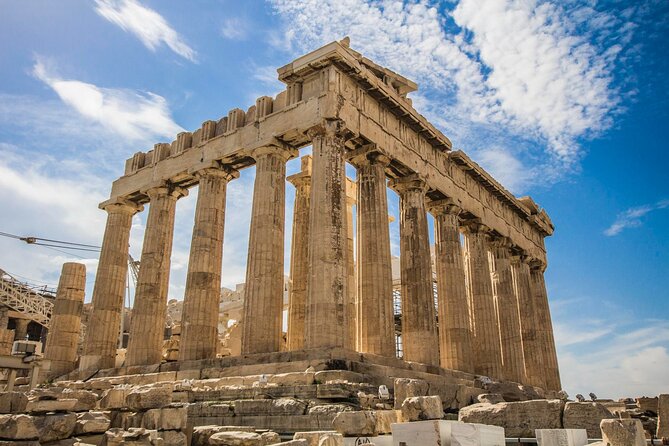
- Parthenon (built 447–438 BC, with decoration continuing afterward)
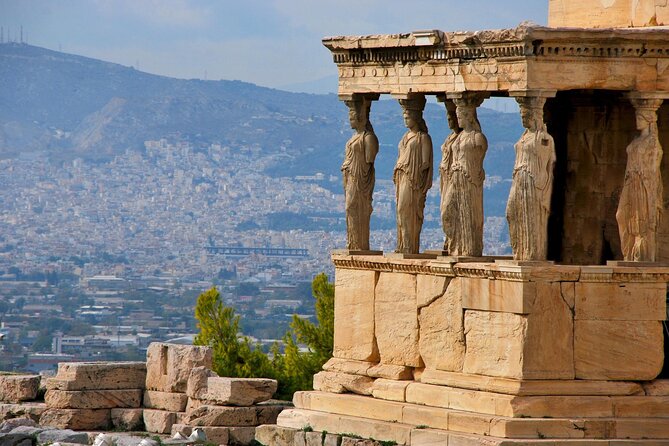
- Erechtheion (including the famous Karyatids)
- Temple of Athena Nike
- Theatre of Dionysus
- Odeon of Herodes Atticus
Here’s the honest trade-off. In 3–4 hours, you don’t get a slow, deep archaeological study. But you do get a guided route that keeps you from wandering in circles, plus enough context to recognize what you’re looking at and why it mattered.
If you’re the type who likes “tell me what I’m seeing” more than “give me a worksheet,” this format is a strong fit. And if you’re traveling with someone who needs a steadier pace, you can ask your driver to manage the walk-and-rest balance during the Acropolis segment.
Parthenon area in limited time: what to focus on
The Acropolis is a hilltop workout disguised as a sightseeing stop. Your best strategy is to let the driver map the walking for you, then focus your attention where the view and the architecture line up.
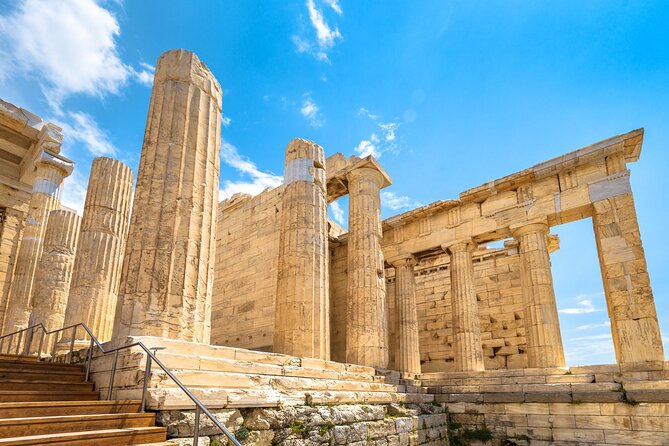
At the Parthenon, look for the difference between what you see today and what once stood complete. The Parthenon’s reputation comes from it being the culmination of Doric design in Classical Greece. Even in a partially worn state, it still reads as an intentional system: columns, proportions, and sculpture working together.
At the Erechtheion, the point isn’t only the building. It’s the role of the Ionic style and the famous Karyatids. If you’re used to Greek ruins that feel like random leftovers, the Erechtheion helps you see the design choices.
And at sites like the Theatre of Dionysus and the Odeon of Herodes Atticus, the big payoff is imagining what the spaces were used for—public life, performance, and ceremony in the same footprint where you’re standing now.
One consideration: the Acropolis complex has specific closure dates (for example, Jan 1, Mar 25, May 1, Easter Sunday, and Dec 25–26). If your dates fall around those, you’ll want a backup plan, because the tour can’t magically run where the site is shut.



Panathenaic Stadium: athletics with Olympic energy
Next comes Panathenaic Stadium, also known as Kallimarmaro. It’s short on time (about 10 minutes), but it’s one of those Athens stops that feels bigger than the minutes you spend there.
This is the oldest stadium still in operation in the world, and it has an Olympic connection that hits a specific kind of traveler nerve. If you like sports history, or if you simply enjoy seeing where a city’s identity shows up, this stop is a fun counterpoint to temple-and-ruins fatigue.
Tickets aren’t included here either, so you’ll decide whether you want to add an entry. Even without an interior visit, you’ll still get the main sense of scale and the “this was made for crowds” feeling.
Temple of Olympian Zeus and Hadrian’s Gate: massive scale, partial ruins

After the stadium, you head to the Temple of Olympian Zeus area. Like so many Athens monuments, the site is half-complete, which can sound disappointing—until you notice what it teaches. You’re seeing the difference between what was planned at full ambition and what survived time, damage, and rebuilding cycles.
You’ll also see the Arch of Hadrian (Hadrian’s Gate). It’s a monumental gateway that functioned like a marker of two different zones: the road from the city center toward the eastern complex, including Olympian Zeus.
This pairing works because your brain starts to build connections. Stadium to Zeus temple to imperial gateway. It’s Athens showing layers of belief and power, from Classical religion to Roman-era presence.
Nearby, the route can include stops around the Zappeion and National Gardens areas, plus views that connect Athens’ ancient footprint to its modern layout.
Syntagma Square and the Unknown Soldier: theater in a suit
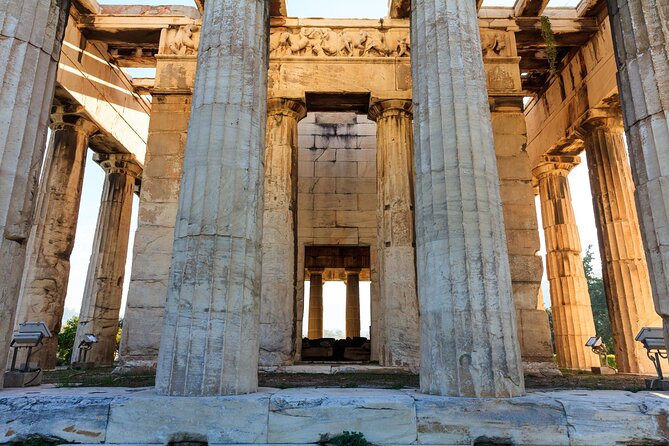
Then comes the Athens that feels current: Syntagma Square and the changing of the guard at the Monument to the Unknown Soldier. This stop is around 10 minutes, and it’s timed so you can catch the ritual.
If you’ve never seen the Evzones (the guard unit), prepare for costumes and choreography that look almost surreal against the city’s everyday traffic. The point of this stop isn’t only the moment itself. It’s that it gives Athens personality beyond ruins—ceremony, discipline, and national symbolism right in the center.
The area is also where the Hellenic Parliament building sits, looking out over Constitution Square (Syntagma Square). If your time is short, this is a quick way to learn what the modern city’s “front door” feels like.
University buildings and the Academy: Athens as an idea

As you move along, the tour can include views around the National and Kapodistrian University of Athens, the Platonic Academy area, and the National Library (Vallianeion).
These stops are brief, so treat them as signposts. You’re not going to “complete Plato” in 10 minutes, but you’ll gain a sense that Athens has always been about more than temples. It’s been about teaching, debate, and institutions tied to big thinkers and civic life.
This is also where having a driver who can explain what you’re looking at pays off. Without context, many of these buildings are just good-looking walls. With context, they become part of the city’s long argument with itself.
Lycabettus and Plaka: viewpoint and wandering time
If the schedule allows, you’ll reach Lycabettus (Mount Lycabettus) for about 30 minutes. Lycabettus rises to about 277 meters above sea level, and the area has the church of Agios Georgios at the top. There’s also a cable car option in the area (the tour description notes it operates), but the tour time is brief—so you’ll use this stop for a look and a breather rather than a full hike.
After that, you get time in Plaka, usually about 55 minutes. Plaka sits below the Acropolis, and it’s one of the best places in Athens to slow down. The streets are tight and old-feeling, with neoclassical houses, red-tile roofs, and little stairways that twist upward. You’ll also find traditional taverns and street cafés for frappé breaks and casual browsing.
This portion is where you decide what kind of traveler you are:
- If you love wandering, you can treat this as your souvenir and snack window.
- If you want photos, this is where you’ll catch the “Athens postcard” angles without hunting for them on your own.
One practical note: Plaka time depends on the day’s pace and your interests. If you want more shopping time, tell your driver early. A half-day tour is all about priorities, and you’ll get the best result when you communicate them up front.
Monastiraki: a quick taste of Agora life
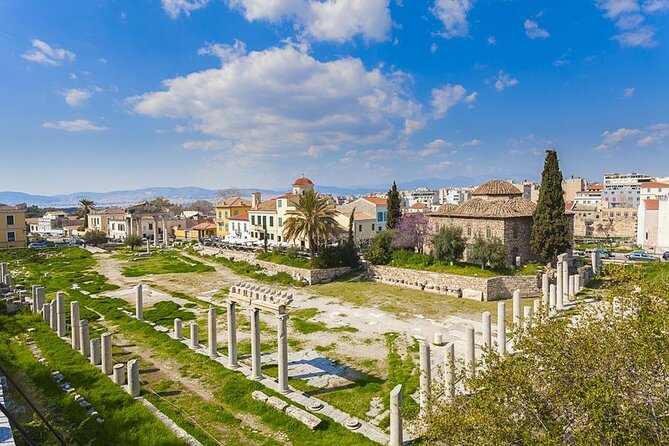
The route also swings through Monastiraki, which links nicely into the ancient core. You may see or spend time around iconic layers like Hadrian’s Library, the Ancient Agora, and the Stoa of Attalos.
Here’s what makes this stop worth it even when time is tight:
- Hadrian’s Library gives you a sense of Roman-era cultural infrastructure, with an internal courtyard and pool bordered by 100 columns.
- The Agora was the gathering place of Greek city-states—politics, social life, and public order all in one “meeting space.”
- The Stoa of Attalos helps you picture how people moved, shopped, and sheltered in ancient Athens.
Even if you don’t go in-depth, you walk away with a better map in your head. And that’s the real win of a highlights tour: you leave understanding what to seek tomorrow when you return on your own—or what to revisit if you only had a day.
Price and logistics: why $170.75 can still be fair value
At $170.75 per person, this Athens City Tour isn’t a budget bus ride. So you should measure value in terms of what you avoid:
- You avoid paying for multiple taxis or dealing with transfers across spread-out sites.
- You avoid wasting your best time waiting in lines for key entries.
- You get pickup and drop-off without extra charges, including from central hotels and Port of Piraeus.
Also, the tour includes an air-conditioned private vehicle, Wi‑Fi, bottled water, and mobile chargers. Those aren’t souvenirs, but they prevent the day from feeling like a punishment.
What’s not included is the biggest cost piece: archaeological admissions. The Acropolis is listed at €30 per person, and the museum and other sites have additional ticket costs. Ticket prices vary by season, and that affects your total spend.
Then there’s the guide issue: the driver speaks English and provides historical context, but the driver is not a licensed tour guide to accompany you inside sites and museums. On request, a licensed guide may be available depending on availability. If you want a true licensed museum-and-temple guide experience, ask ahead of time.
If your goal is smart pacing, comfort, and a route that makes the city make sense fast, the pricing often lands in the reasonable zone for a private half-day.
Who this Athens highlights tour suits best
This tour fits best if you want a “greatest hits” Athens day without renting a car and without spending your hours stuck in transit.
It’s especially good for:
- First-timers who need context on the major sites (Acropolis, stadium, Plaka, and the central squares)
- Families who want comfort and a flexible pace in an A/C vehicle
- Travelers with limited mobility who want shorter walking bursts and room to rest in the vehicle (ask your driver how they plan the day)
- Anyone on a cruise or short schedule who needs hotel-to-sight-to-drop-off efficiency
If you’re the kind of traveler who wants a long, slow, academic excavation-style visit, you might find the stops feel too short. But if your goal is to see the key monuments and feel oriented, this tour delivers.
Should you book this Athens highlights tour?
Book it if you want maximum Athens per hour with pickup, comfort, and driver-led context. The biggest payoff is that you can hit the Acropolis area, then keep moving through stadium, Zeus/imperial Athens, Syntagma ceremony, and old-city neighborhoods like Plaka and Monastiraki—without the usual navigation headaches.
Skip or rethink it if you’re specifically searching for a licensed museum-and-temple guide experience throughout every interior site, since the driver isn’t a licensed guide for accompaniment. Also, if you’re traveling during a period when the Acropolis is closed, you’ll need to confirm your dates before committing.
If you do book, do two things: bring a clear priority list (Acropolis vs. Plaka vs. photography), and plan for ticket costs so the day stays smooth.
FAQ
How long is the Athens City Tour – 4 Hours?
It runs approximately 3 to 4 hours.
What’s included in the tour price?
You get an English-speaking driver, a private A/C vehicle with Wi‑Fi, bottled water and mobile chargers, and hotel/Airbnb/Port of Piraeus pickup and drop-off without extra charge. The tour also assists with purchasing skip-the-line tickets (you cover ticket costs).
Are museum and archaeological tickets included?
No. Tickets are not included for archaeological places and museums. The Acropolis entrance fee is listed as €30 per person, and ticket prices vary by season.
Does the driver act as a licensed tour guide inside sites?
The driver provides historical knowledge but is not licensed to accompany you at any site or museum. A licensed tour guide may be available upon request depending on availability.
Where can the driver pick you up?
The driver can pick you up from hotels, Airbnb locations, the Port of Piraeus (outside the cruise ship with a sign showing your name), or metro/bus stations. You choose the preferred meeting point and provide the exact address.
Is the tour private?
Yes. It’s a private tour/activity, so only your group participates.
The City, End to End
- Athens: City Sightseeing Hop-On Hop-Off Bus Tour★ 4.3 · 4,520 reviews
- City Sightseeing Athens, Piraeus & Beach Riviera Hop-On Hop-Off Bus Tours★ 4.0 · 1,887 reviews
- Athens: City Electric Bike Tour with Acropolis Visit Option★ 4.9 · 1,017 reviews
- Acropolis, Parthenon & Athens Old City Heritage Walking Tour★ 4.5 · 876 reviews
- Athens: City Pass with Acropolis, Museums, HoHo & Transport★ 3.9 · 802 reviews
- Athens: City Bike tour with Acropolis Visit Option★ 4.9 · 665 reviews
More Tours in Athens
- Athens: Acropolis, Parthenon & Acropolis Museum Guided Tour★ 4.8 · 9,316 reviews
- The Acropolis, Parthenon & Acropolis Museum Guided Tour★ 4.7 · 8,493 reviews
- Acropolis: Premium Acropolis and Parthenon Guided Tour★ 4.8 · 5,208 reviews
- Athens: Mythology of Delphi, Museum and Arachova Guided Tour★ 4.7 · 5,102 reviews
- Acropolis and Parthenon Guided Walking Tour★ 5.0 · 4,755 reviews
- Greek Food Walking Tour in Athens★ 5.0 · 4,740 reviews
More Tour Reviews in Athens
- Athens: Acropolis & up to 5 Archaeological Sites Combo Pass★ 4.2 · 13,904 reviews
- Athens: Acropolis, Parthenon & Acropolis Museum Guided Tour★ 4.8 · 9,316 reviews
- The Acropolis, Parthenon & Acropolis Museum Guided Tour★ 4.7 · 8,493 reviews
- Athens: Cape Sounion & Poseidon Temple Sunset Half-Day Trip★ 4.8 · 8,241 reviews
- Acropolis: Premium Acropolis and Parthenon Guided Tour★ 4.8 · 5,208 reviews
- Athens: Mythology of Delphi, Museum and Arachova Guided Tour★ 4.7 · 5,102 reviews
Fresh Off the Boat: New Athens Reviews





City Tours, compared.
 ★ 4.3City Sightseeing Hop-On Hop-Off Bus TourFrom $254,520 reviews
 ★ 4.0City Sightseeing Athens, Piraeus & Beach Riviera Hop-On Hop-Off Bus ToursFrom $261,887 reviews
 ★ 4.9City Electric Bike Tour with Acropolis Visit OptionFrom $531,017 reviews
 ★ 4.5Acropolis, Parthenon & Athens Old City Heritage Walking TourFrom $34876 reviews
 ★ 3.9City Pass with Acropolis, Museums, HoHo & TransportFrom $93802 reviews
 ★ 4.9City Bike tour with Acropolis Visit Option665 reviews
 ★ 4.9Discover the City Electric Bike TourFrom $54544 reviews
 ★ 5.0The Acropolis, Athens Walking City Tour and Acropolis MuseumFrom $12442 reviews
Browse the lists this tour appears in