
Reviewed · MYCENAE & NAFPLIO DAY TRIPS
Biblical Ancient Corinth Canal Epidaurus Nafplio Private Tour
Corinth and Epidaurus in one day is a smart move. You’ll stitch together war-era ruins, Greek medicine, and postcard views, all from a private air-conditioned vehicle that keeps the day moving. I like that the route isn’t just “see monuments”—it connects the geography (isthmus, harbor, hills) to the stories (Paul, Asklepios, defense forts).
I also like the flexibility the tour offers. The driving and commentary are led by guides/drivers such as Giannis, Themos, and Chris—and the tone is practical: they help you adjust timing and interests without turning the day into a sprint. The one drawback to plan for is cost add-ons: entrance fees and sites inside museums aren’t included, so your total will land higher than the base price.
In This Review
- Key things I’d focus on before you go
- Why this Corinth–Epidaurus–Nafplio route works in one long day
- Corinth Canal: the 19th-century shortcut with a 2,000-year dream
- Ancient Corinth, the museum, and the Apollo area: where Paul fits beside temples
- Akrokorinthos (Acrocorinth): the fortress view that explains everything
- Epidaurus sanctuary and theatre: medicine, mythology, and the famous acoustics
- Nafplio’s harbor break: lunch, coffee, and the Lion of the Bavarians
- Palamidi Castle, Akronauplia, and Bourtzi: views that pay off the stairs
- Comfort and customization: why the private driver changes the whole experience
- Price and value: what $240.93 really buys, plus the entry fees to plan for
- Should you book this private tour?
- FAQ
- What does the price include?
- How long is the tour?
- Is it only my group on the tour?
- Do I need tickets for the archaeological sites?
- Can the itinerary be changed?
- What happens if the weather is bad?
Key things I’d focus on before you go
- A full day, private transport: A/C, WiFi, and bottled water in a vehicle sized for your group (1–3 in sedan, 4–7 in minivan).
- Corinth’s story is told on the ground: Corinth Canal, Ancient Corinth, the museum, Apollo, and then the hilltop fortress.
- Epidaurus is two experiences for the price of time: the sanctuary focus plus museum time and the theatre visit.
- Nafplio breaks up the ruins: lunch/coffee/shopping time in a working harbor town.
- Views are the reward: Palamidi Castle and Bourtzi are built for photos and skyline moments.
- Budget for entries: key sites like Ancient Corinth, Palamidi, and the Epidaurus archaeological site have separate admission.
Into the Argolid, past the Lion Gate
- From Athens: Small-Group Mycenae, Epidaurus & Nafplio Trip
★ 4.8 · 2,805 reviews - From Athens: Mycenae, Epidaurus & Nafplio Full-Day Tour
★ 4.5 · 2,530 reviews - Mycenae, Epidaurus and Nafplio Tour from Athens
★ 4.6 · 2,201 reviews - 4-Day Classical Greece Tour: Epidaurus, Mycenae, Olympia, Delphi, Meteora
★ 4.5 · 732 reviews
Why this Corinth–Epidaurus–Nafplio route works in one long day
This tour strings together four major “why should I care?” stops: Corinth (myth, Paul, Rome), Akrokorinthos (defense and control of the isthmus), Epidaurus (medicine sanctuary plus theatre acoustics), and Nafplio (a medieval-and-Venetian harbor town with hilltop views). Doing it in one day saves you from repeating transfers and keeps your itinerary tight.
The pacing is built around short site windows plus longer ones where it counts: Ancient Corinth gets about 90 minutes, Epidaurus territory gets enough time for the theatre and museum, and Nafplio gives you the one thing ruins always steal—real free time for food and wandering. For a day that’s about 8.5 hours total, it’s a workable balance.
The “private” part matters here. With one group, your driver can shift the order slightly or pause longer at a view point if you’re slow-walking photos or trying to cool off. That’s not a small thing in Greek summer sun.
Corinth Canal: the 19th-century shortcut with a 2,000-year dream
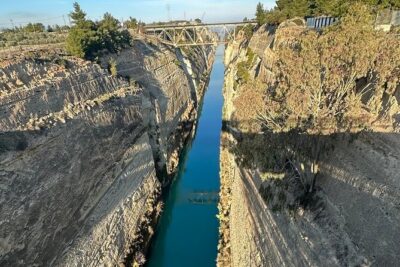
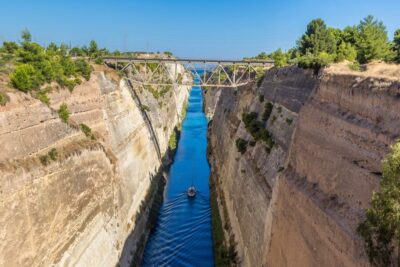
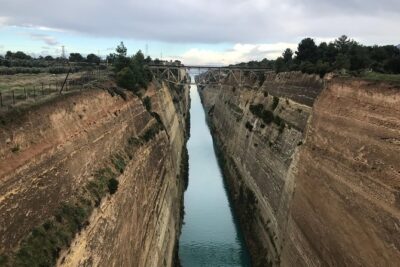
You start with the Corinth Canal, the narrow waterway slicing across the isthmus. It’s basically the geography explaining itself: the canal links the Gulf of Corinth with the Saronic Gulf, separating mainland Greece from the Peloponnese like a man-made “island.”
What I like is the historical framing. The canal was executed in the late 19th century, but the idea was older—shipping had a long detour of about 185 nautical miles around the Peloponnese. The story even reaches back to the tyrant Periander (around 602 BC), who is tied to the earlier dream of a canal and the construction of the diolkos, a stone road where ships could be hauled on wheeled platforms.
Your stop is short (about 20 minutes) and the ticket is free, which is perfect as a warm-up. You get the “aha” moment early, then spend the rest of the day inside the places where history was actually lived.
Ancient Corinth, the museum, and the Apollo area: where Paul fits beside temples
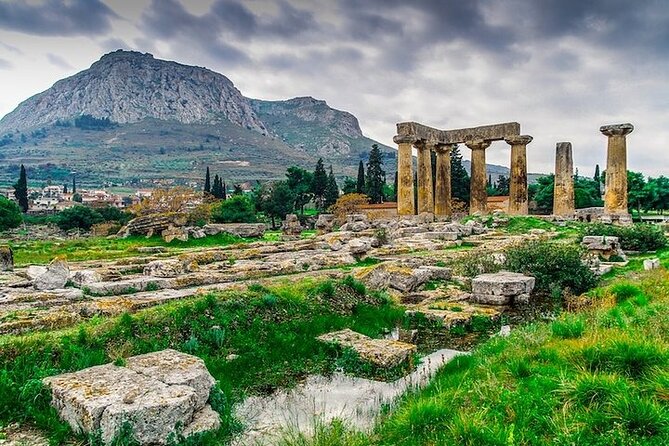
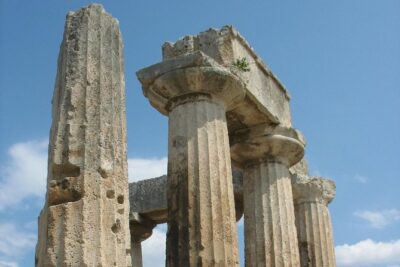
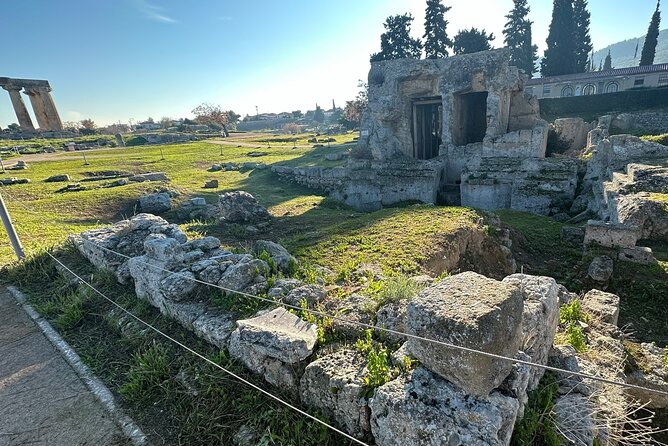
Ancient Corinth is one of those places where you feel multiple eras stacked on top of each other. It was a major city-state on the isthmus, positioned halfway between Athens and Sparta—meaning it was a crossroads whether you were trading goods or plotting politics. The modern ruins are about 5 kilometers from today’s city, so you’ll be seeing the ancient footprint, not just imagining it.
If you’re Christian, Corinth shows up through Saint Paul’s letters (First and Second Corinthians) and references in Acts. But the city isn’t only biblical. It was also enormous for its time—population estimates are around 90,000 in 400 BC—and it went through Roman destruction (146 BC) and rebuilding (after 44 BC), eventually becoming a provincial capital.
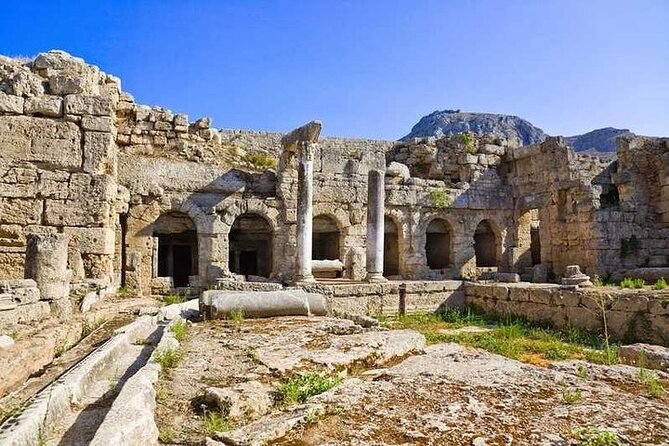
After about 1 hour 30 minutes roaming the site, you move to the Archaeological Museum of Corinth. This is your “slow down” moment. The museum was constructed in 1931–1932 to present findings from the recent excavations, and it sits within the archaeological site itself. I like that it’s not separate from the story; you’re seeing artifacts connected to features like the Hadgimoustafa spring, the Lechaion Road, the Agora, Fountain of Peirene, Stoa, and the theatre.
You also pass key architectural highlights like the Temple of Apollo (built around 550 BC, described as among the earliest Doric temples in the Peloponnese and Greek mainland). The stop is brief (around 10 minutes), so it’s better thought of as a guided orientation point than a full “how it was built” deep dive.
A practical consideration: museum time is included as time on the schedule, but museum entry fees are not included, so factor that into your budget.
The canal and old Corinth, a few more days
Akrokorinthos (Acrocorinth): the fortress view that explains everything

Then comes Akrokorinthos, also called Acrocorinth—an acropolis on a monolithic rock above Corinth. This is the “defense geography” stop. The fortress repeatedly served as a last line of defense because it controlled access to the Isthmus of Corinth, meaning whoever held the hill had leverage over entry into the Peloponnese peninsula.
Your time here is about 30 minutes. It’s enough to get up top, look around, and understand why the site mattered, without turning the day into a hiking marathon. You’ll likely find yourself slowing down at viewpoints, because the scale of the isthmus is easier to grasp from height.
Wear shoes with grip and plan for sun. Even if the walk is not long, you’re moving on rocky or uneven ground and you won’t have shade everywhere.
Epidaurus sanctuary and theatre: medicine, mythology, and the famous acoustics
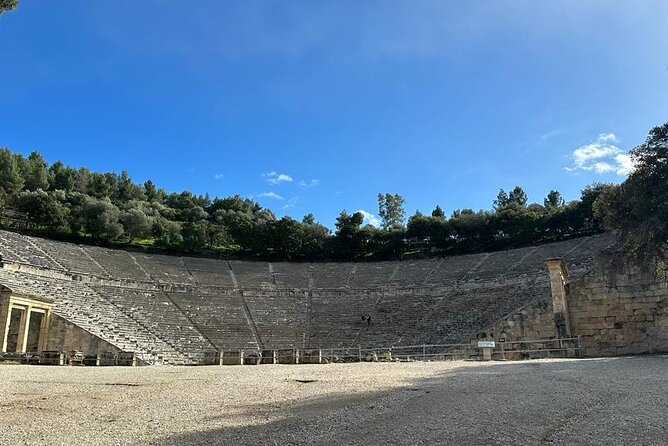
Epidaurus is where the day changes tone. Instead of a crossroads city, you get a setting built for healing and performance. The tour includes time at the Epidaurus amphitheatre area, plus the Epidaurus Archaeological Museum and the sanctuary of Asklepios.
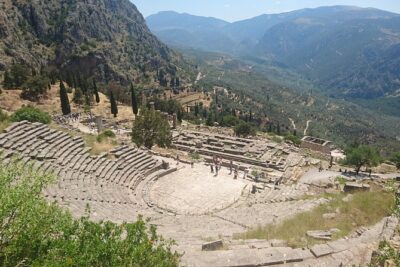
The most famous part is the Ancient Theatre of Epidaurus, known for classic Greek construction and astonishing acoustics. You’ll hear the idea that if you drop a pin or coin on the stage, it can be heard even if you’re far back—so even the last seats are not the “bad view” seats.
The day also leans into the arts. The theatre is associated with performances from writers like Euripides, Sophocles, Aristophanes, and Aeschylus, and the sanctuary setting makes those names feel less like classroom trivia.
Then you get the medicine angle. The Asclepius sanctuary was the main holy site dedicated to Asclepius, the ancient Greek demi-god of medicine. It’s described as rivaling major cult centers like Olympia and Delphi—which helps explain why so much care went into the place. The temple dates to the early 4th century BC.
There’s a museum stop too (about 30 minutes). The Epidaurus museum is known for reconstructions of temples and its columns with inscriptions. It was established in 1902 and opened in 1909, with artifacts from the surrounding area.
Here’s the consideration I’d tell you up front: Epidaurus works best if you go in with a light attention span and let the site do the talking. If you’re the type who likes to read every inscription, you’ll probably wish you had more time and maybe a licensed site guide at least for the theatre or sanctuary areas.
Nafplio’s harbor break: lunch, coffee, and the Lion of the Bavarians
After several archaeological stops, the schedule gives you space to breathe with about 1 hour of free time in Nafplio for lunch, coffee, and shopping. That matters. Ruin days can turn your body into a stopwatch. Nafplio is a chance to reset your legs and let the day feel human again.
Nafplio is a seaport town expanded up the hills near the Argolic Gulf. It carries layers from medieval rule (Argos and Nauplia) and even the later revolutionary period—Nafplio is tied to being a capital during the Greek Revolution era.
One specific stop you’ll likely appreciate is the Lion of the Bavarians, carved into rock above Michael Iatrou Street. It’s huge, and the story is unusually detailed: the sleeping lion was made by German sculptor Christian Ziegel, commissioned by King Louis (father of Otto). The memorial ties to Bavarian soldiers of Otto’s dynasty who died in Nafplio in 1833 from a typhoid epidemic. Locals also have an unofficial story blaming bitter foods, which gives you a nice blend of official history plus local folklore.
If you don’t want to shop, you can still use this hour to walk down toward the harbor, cool off, and rehydrate before the hilltop climb later.
Palamidi Castle, Akronauplia, and Bourtzi: views that pay off the stairs
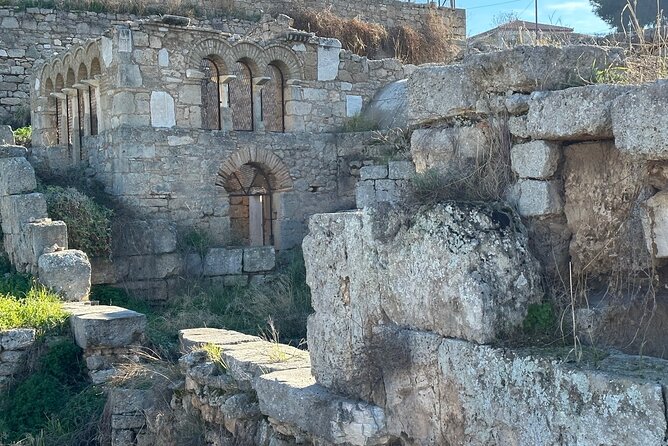
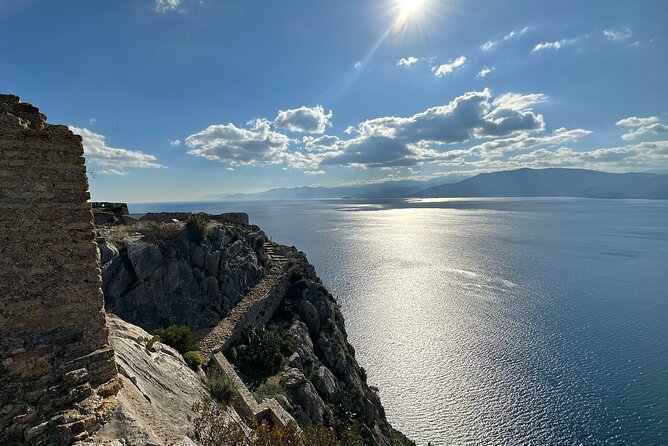
Palamidi Castle is one of the biggest visual rewards in the whole day. The fortress is described as one of Greece’s best-preserved, built by the Venetians during their second occupation (1686–1715). It sits on a 216-meter-high hill, and it’s built for line-of-sight control over Nafplio and the Argolic Gulf.
You’ll get around 30 minutes here, and you’ll feel the effort quickly. The route is famous for its steps: 913 steps are mentioned, while locals often say it’s over 1,000—or even 999. Either way, it’s not a casual stroll, but it’s doable for most people if you move steadily and take breaks.
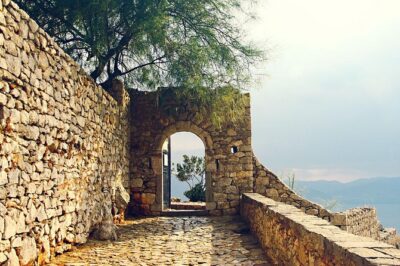
There’s also time for Akronauplia, the oldest part of Nafplio. It served as a town on its own until the 13th century, then the Venetians and Franks turned it into fortifications. It later became a prison area, but the Greek government shifted it toward tourism because the viewpoints are worth the climb.
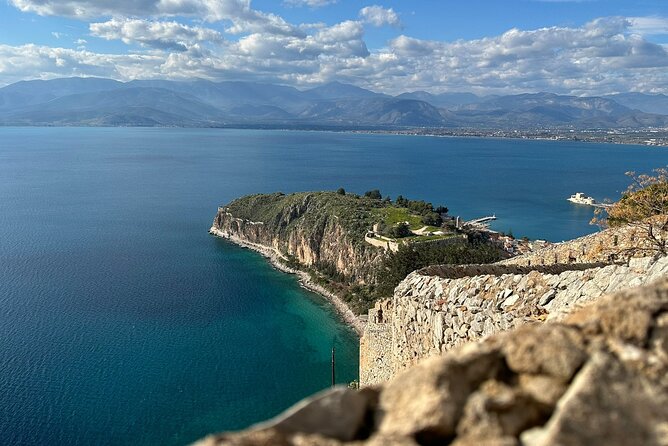
Finally, you’ll see Bourtzi, the water castle in the harbor. It’s Venetian and sits in the middle of the water, which makes it ideal for photos from the harbor side. Your stop is short (about 10 minutes), but it’s a quick way to end the day with a postcard view.
Comfort and customization: why the private driver changes the whole experience
This tour is fully private, meaning only your group rides together and only your group’s day matters. That’s why you’ll often enjoy it more than a bus tour that forces everyone into the same rhythm. Groups of 1–3 go in a luxurious sedan, while groups of 4–7 go in comfortable mini vans, and every vehicle includes WiFi, A/C, and bottled water.
A/C and water aren’t luxury for this route—they’re survival tools. Corinth and Epidaurus can be sun-heavy, and Nafplio adds more wandering time. Having cold air and water on hand keeps you from losing your day to heat.
Your driver is also the key to “personalized experience.” The tour notes that the program can be customized based on your needs, and pickup time is adjustable. In the reviews, guides like Giannis, Themos, and Chris are singled out for being flexible—one example is helping a family adjust stops and still getting them to a good lunch spot in Nafplio, and another is making sure a multi-generational group felt comfortable with shaded breaks.
One fair warning: the tour does not include a licensed guide inside archaeological sites. The driver provides historical knowledge and direction, but if you crave deeper, site-specific explanations in the moments that matter, you might consider hiring a licensed guide on-site or using guided info available on location.
Price and value: what $240.93 really buys, plus the entry fees to plan for
At $240.93 per person for an ~8.5-hour private tour, you’re paying for three things: transportation, expert English-speaking drivers, and a bundled route that covers a lot of ground without you coordinating buses and tickets separately.
What’s included:
- pickup and drop-off from Athens areas like hotel/Airbnb/port
- modern private vehicle with WiFi and A/C
- bottled water and fuel/tolls
- mobile ticket
- group transportation sized to your group
- driver guidance and the option to customize
What costs extra:
- Ancient Corinth (Archaia Korinthos): €15.00 per person
- Palamidi Castle: €20.00 per person
- Archaeological Site of Epidaurus: €20.00 per person
- Museum and other site entries are marked not included (so assume separate admissions for those listed as not included)
Lunch in Nafplio is not included, and the schedule only promises time for it. So the “real cost” depends on how many paid entries you choose to cover in your exact route and how you handle Nafplio meals.
If you’re traveling with family or friends, private transport often starts to look good value fast. You avoid split tickets, waiting, and the “bus shuffle” that ruins archaeology days.
Should you book this private tour?
Yes—if you want a one-day hit of Corinth + Epidaurus + Nafplio without logistics stress. This is the right choice for history lovers who also want a genuine break for food and views, and for mixed-age groups who need comfort, shade, and a driver who can slow down.
Book it if:
- you prefer a private pace over a group bus
- you care about both mythology and real geography (isthmus, hill forts, harbor castles)
- you’d like to end in a lively town instead of another empty parking lot
Think twice if:
- you already know you’ll want formal, licensed guides inside multiple sites (entry-guide time isn’t included here)
- you don’t want to add entrance fees on top of the base price
If you do book, bring comfortable shoes, a hat, and a little patience with stairs. Then let the day do what it’s best at: connect places that usually get separated into two separate trips.
FAQ
What does the price include?
The tour price includes a fully private day trip with hotel/Airbnb or port pickup and drop-off, transportation in a modern vehicle with WiFi, A/C, and bottled water, and an expert English-speaking driver with historical knowledge. Fuel and tolls are also included. Entrance fees and meals are not included.
How long is the tour?
The duration is about 8 hours 30 minutes.
Is it only my group on the tour?
Yes. This is a private tour, so only your group participates.
Do I need tickets for the archaeological sites?
Yes. Entrance fees are not included for several stops. Ancient Corinth (Archaia Korinthos) is €15.00 per person, Palamidi Castle is €20.00 per person, and the Archaeological Site of Epidaurus is €20.00 per person. Other museum/site admissions are also listed as not included.
Can the itinerary be changed?
Yes. The tour is private and you can customize the program according to your needs. Pickup time is also adjustable upon request.
What happens if the weather is bad?
This experience requires good weather. If it’s canceled due to poor weather, you’ll be offered a different date or a full refund.
Just Your Group: More Private Days
- Best of Athens Half Day Private Tour★ 5.0 · 3,714 reviews
- Athens Full Day Private Tour★ 5.0 · 2,903 reviews
- Athens Greece Full Day private tour★ 5.0 · 785 reviews
- 4 Hours – Athens & Acropolis Highlights Private Tour★ 5.0 · 681 reviews
- Athens Full Day Private Tour★ 5.0 · 667 reviews
- Enjoy Cape Sounio Private Majestic Sunset With Seaside Dinner★ 5.0 · 613 reviews
Corinth and the Canal
- From Athens: Ancient Corinth Day Trip with Canal & VR Guide★ 4.6 · 1,073 reviews
- Biblical Tour Letters ToThe Corinthians St Paul’s Footsteps 6Hour★ 5.0 · 1,065 reviews
- Private Biblical Tour Ancient Corinth & Isthmus Canal from Athens★ 5.0 · 762 reviews
- Athens: Ancient Corinth & Nafplio Full Day Trip with Swim★ 4.8 · 531 reviews
- Athens: Corinth Canal, Mycenae & Nafplio Premium Guided Tour★ 4.7 · 322 reviews
- Private Tour of Apostle Paul’s Footsteps in Ancient Corinth★ 5.0 · 275 reviews
Into the Argolid: Mycenae and Nafplio
- From Athens: Small-Group Mycenae, Epidaurus & Nafplio Trip★ 4.8 · 2,805 reviews
- From Athens: Mycenae, Epidaurus & Nafplio Full-Day Tour★ 4.5 · 2,530 reviews
- Mycenae, Epidaurus and Nafplio Tour from Athens★ 4.6 · 2,201 reviews
- 4-Day Classical Greece Tour: Epidaurus, Mycenae, Olympia, Delphi, Meteora★ 4.5 · 732 reviews
- Athens: Ancient Corinth & Nafplio Full Day Trip with Swim★ 4.8 · 531 reviews
- Mycenae and Nafplion Day Trip from Athens with Official guide★ 4.5 · 501 reviews
Fresh Off the Boat: New Athens Reviews





Mycenae & Nafplio Day Trips, compared.
 ★ 4.8From Athens: Small-Group Mycenae, Epidaurus & Nafplio TripFrom $342,805 reviews
 ★ 4.5From Athens: Mycenae, Epidaurus & Nafplio Full-Day TourFrom $332,530 reviews
 ★ 4.6Mycenae, Epidaurus and Nafplio Tour from AthensFrom $332,201 reviews
 ★ 4.54-Day Classical Greece Tour: Epidaurus, Mycenae, Olympia, Delphi, MeteoraFrom $766732 reviews
 ★ 4.8Ancient Corinth & Nafplio Full Day Trip with Swim531 reviews
 ★ 4.5Mycenae and Nafplion Day Trip from Athens with Official guideFrom $78501 reviews
 ★ 4.2Argolis: Full-Day Tour in Mycenae & NafplioFrom $41350 reviews
 ★ 4.53-Day Classical Greece Tour: Epidaurus, Mycenae, Nafplion, Olympia, DelphiFrom $520342 reviews
Browse the lists this tour appears in