
Reviewed · CORINTH DAY TRIPS
Private Biblical Ancient Corinth Tour from Athens
Corinth feels close, not mythic. This private day trip strings together real places tied to early Christian stories, plus a jaw-dropping engineering stop at the Corinth Canal. I love the mix of big views from Acrocorinth and the calm, adjustable pace of having your own driver and schedule.
Here’s the one thing to consider: the Acrocorinth approach is a steep, rocky climb, and conditions can make it harder than you expect—especially if access is limited that day.
In This Review
- Key highlights at a glance
- Price and logistics that actually matter for value
- Your private driver experience: smooth, not stiff
- Corinth Canal: the engineering stop that gives context fast
- The Diolkos trackway: how ancient ships beat the long route
- Kenchreai and Paul: the port stop with Bible breadcrumbs
- Acrocorinth climb: fortress views worth the effort
- Museum of Ancient Corinth: how to get more from the €15
- Ancient Corinth ruins: Paul’s city in workable chunks
- Lunch and village time: where the day slows down on purpose
- Who should book this tour (and who should reconsider)
- Booking decision: should you spend your day on Corinth from Athens?
- FAQ
- How long is the Private Biblical Ancient Corinth Tour from Athens?
- What’s included in the tour price?
- Is the archaeological museum admission included?
- Do we have a licensed tour guide during site visits?
- How does pickup work?
- What language is the tour offered in?
- What if the weather is bad?
Key highlights at a glance
- Corinth Canal from above: see the isthmus cut and watch ships pass below
- Ancient transport tech at the Diolkos: understand how boats were moved overland
- Paul-linked port area (Kenchreai): connect the coastline with Acts and Romans
- Acrocorinth fortress views: the kind of vantage point you remember long after
- Museum details you can actually use: artifacts, labels, and layout that help you picture the city
The canal and old Corinth, a few more days
- From Athens: Ancient Corinth Day Trip with Canal & VR Guide
★ 4.6 · 1,073 reviews - Biblical Tour Letters ToThe Corinthians St Paul’s Footsteps 6Hour
★ 5.0 · 1,065 reviews - Private Biblical Tour Ancient Corinth & Isthmus Canal from Athens
★ 5.0 · 762 reviews - Athens: Ancient Corinth & Nafplio Full Day Trip with Swim
★ 4.8 · 531 reviews
Price and logistics that actually matter for value
This is priced at $204.81 per person for an 8-hour private-style outing from Athens. What you’re really paying for is the door-to-door convenience: air-conditioned vehicle, WiFi onboard, bottled water, and pickup that returns you to the same place.
One catch: the Archaeological Site and Museum entry (€15 per person) is not included, and you also won’t have a licensed tour guide walking through the sites with you. Instead, your driver is there to provide fluent English commentary and answer questions, but they typically won’t enter the archaeological areas with you. For me, that’s the key value equation: if you love chatting and asking lots of questions while you travel, the setup works well. If you want a guide holding your hand inside every room and temple, you’ll want to adjust expectations (or plan to focus your questions on the drive segments).
Also, the tour runs best with good weather. If conditions are bad, you may be offered a different date or a refund.
Your private driver experience: smooth, not stiff
This tour is built around private transportation, so you’re not stuck waiting for a slow-moving group. Your personal driver picks you up and returns you to the same starting point—hotel lobby, apartment entrance, or the port disembarkation area (if you’re coming in through Piraeus).
What I like about this style is simple: it feels less like a checklist and more like a route you can breathe on. The itinerary includes multiple stops that could easily become rushed, but with a private vehicle you can usually time things so you’re not sprinting between locations.
Tip that can save your day: use the drive time. Ask your driver to set the scene for the next stop—how the place fits into the early Christian story and what you should watch for when you arrive.
Corinth Canal: the engineering stop that gives context fast
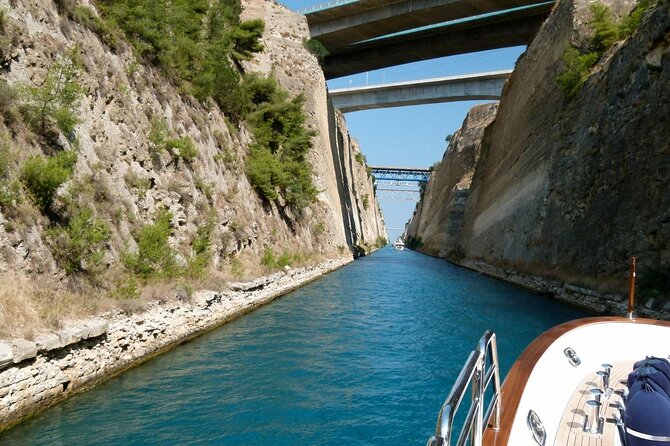
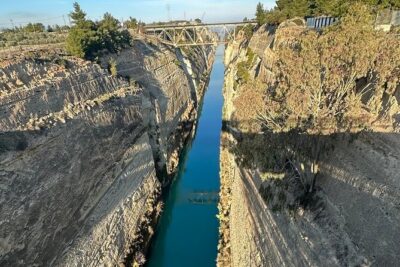
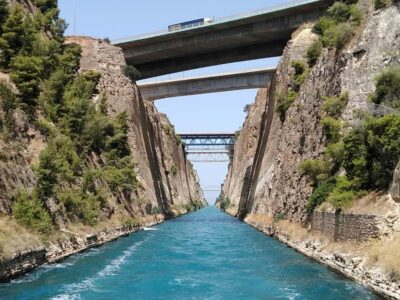
Your day starts with the Corinth Canal area, and it’s one of those rare stops that’s visually impressive and explainable in plain terms. The canal slices through the Isthmus of Corinth, linking the Ionian Sea (Gulf of Corinth) with the Aegean Sea (Saronic Gulf).
A few details help you “read” what you’re seeing:
- It’s 6.4 km long and about 21.4 meters wide at the base, which is why it’s impossible for many modern ships.
- From higher viewpoints, you get the best sense of the cut—steep limestone walls and vessels moving through below.
Even if you’re not a transportation nerd, this stop pays off because it explains why Corinth mattered. The canal isn’t just a modern shortcut; it’s a reminder that geography can steer trade, travel, and power.
Practical note: this is a place where you’ll want good shoes and a steady stance. Look for safe viewpoints and take your time looking down.
More private options, your group only



The Diolkos trackway: how ancient ships beat the long route
Next comes the Diolkos, a paved trackway from Ancient Greece near Corinth. If the canal is modern engineering, the Diolkos is the ancient answer.
Here’s what makes it cool: it let boats be moved overland across the Isthmus of Corinth. That shortcut helped vessels avoid the long and risky journey around the Peloponnese peninsula.
The Diolkos wasn’t just a clever idea; it had real roles:
- It moved goods.
- In wartime, it could speed up naval campaigns.
When you’re on site, try to picture the logistics. Think of it as an early “rail + transport” system, where the key advantage was controlling the bottleneck of the landscape.
If you like history that connects to real-world mechanics, this stop is a strong reason to book this tour instead of taking a generic bus to ruins.
Kenchreai and Paul: the port stop with Bible breadcrumbs
Then you’ll head to Kenchreai, one of the two major ports tied to Ancient Corinth’s trade. Kenchreai served eastern routes via the Saronic Gulf, while Lechaion (on the other side of the isthmus) connected west toward Italy and Europe via the Corinthian Gulf.
What you’re seeing here is a “traffic map” in physical form: ships coming from the east, plus overland movement north and south. This matters because Paul’s early journeys weren’t lived in a vacuum. They were built on routes.
The tour’s biblical connection is explicit:
- Acts 18:18 places Paul at Kenchreai during his second missionary journey, where he had his hair cut to fulfill a vow, likely a Nazirite vow.
- Romans 16:1 mentions Phoebe connected to the local assembly.
How to make this stop more than a trivia break: stand where you can sense the relationship between sea and movement. Even if you don’t see ancient harbor structures from every angle, the location explains why this would be a place people passed through, talked at, and traded through.
If your driver is chatty (some are), ask them to connect the coastal setting to Paul’s timing—why ports mattered so much.
Acrocorinth climb: fortress views worth the effort
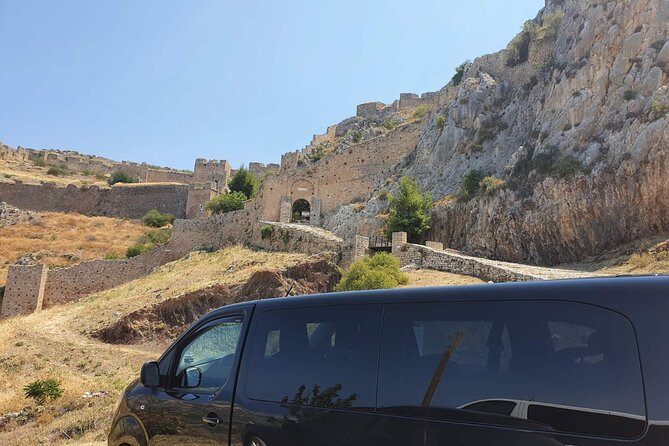
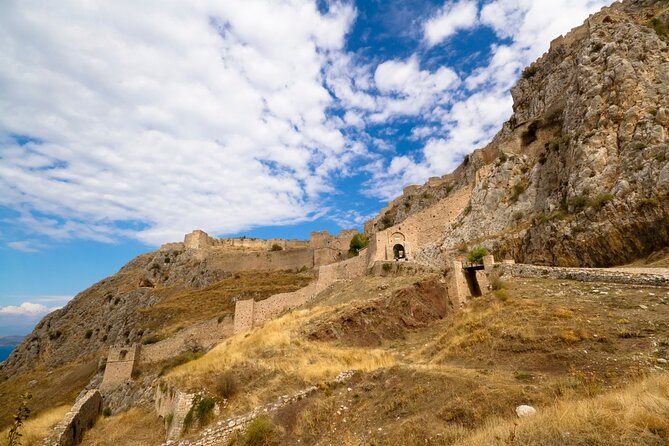
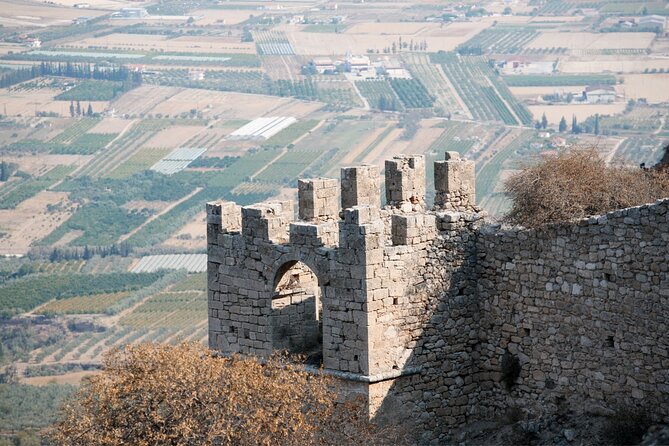
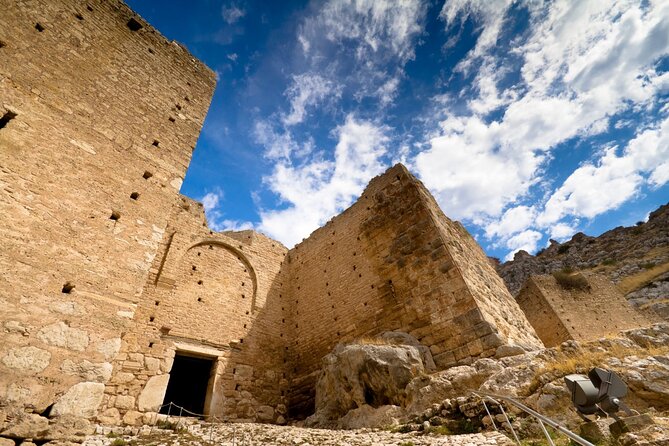
The big physical moment of the day is Acrocorinth, the “Upper Corinth” acropolis. It’s a monolithic rock rising above the ancient city, and it served as a secure defensive position thanks to a water supply.
George Forrest described it as the most impressive of the acropolises of mainland Greece. More importantly than the quote is the point: Acrocorinth gave defenders control over the Isthmus, so it could repel enemies entering the Peloponnese.
The views are the payoff. You get a strong sense of why someone could watch the approach routes and why the region’s geography shaped its fate.
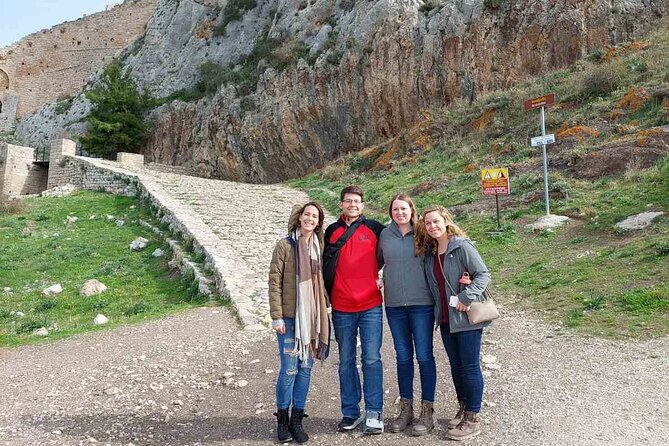
That said, this stop is the one place where you should be honest with yourself. One person’s experience described a steep, rocky, slippery path that took longer than expected, and access timing can change during the day. If you have knee issues, balance problems, or you hate uneven ground, consider whether you want to tackle the full climb. You can still enjoy the area by staying closer to what’s accessible.
What I recommend:
- Wear shoes with grip.
- Give yourself extra time, not just “walk-fast time.”
- Bring water—especially in warmer months—since it’s an active climb.
Museum of Ancient Corinth: how to get more from the €15
You’ll spend time at the Archaeological Museum of Corinth, and this is where your day goes from scenery to understanding. The museum was built in 1932 to house artifacts from excavations, with construction tied to the American School of Classical Studies (supported by a donation from Ada Small Moore).
The building design follows a “Chicago school” architectural model, and the layout is organized around two atriums, which gives the spaces a distinct feel.
A few specifics you can use to get more out of your visit:
- Arrive ready to connect objects to places you just saw (canal, port areas, fortress).
- Use the museum to anchor your mental map of what Ancient Corinth included.
- Expect that not everything will feel labeled in the “story form” you might want—so ask questions while you’re still on the bus/vehicle if your driver can help clarify.
Museum entry is not included in the tour price, so factor that €15 per person into the real total. For many people, it’s worth it because it gives you something sturdy to carry back into the ruins without guessing.
Ancient Corinth ruins: Paul’s city in workable chunks
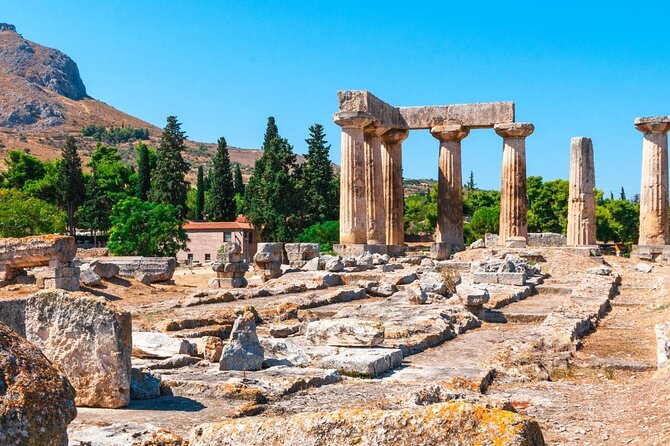
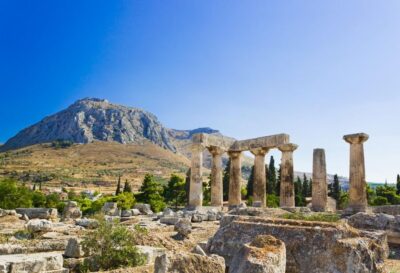
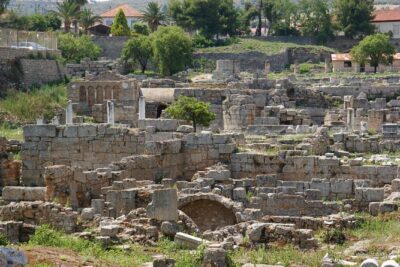
Then comes Ancient Corinth, the archaeological site associated with the city-state on the Isthmus of Corinth—roughly halfway between Athens and Sparta. It’s also about 5 km southwest of the modern city.
This is the stop where the tour earns its “biblical” label in practical ways. Corinth shows up heavily in the New Testament, especially through 1 and 2 Corinthians, plus Acts describing Paul’s missionary work there.
It’s also historically weighty beyond religion. Ancient Corinth was one of the largest and most important Greek cities, with a population of around 90,000 in 400 BC.
When you walk through the ruins, keep your expectations flexible. The site is big enough that you’ll want a few mental anchors, not an attempt to see everything at once. People often connect the area with:
- the Bema (a key platform area tied to public life),
- spots connected to Paul’s preaching,
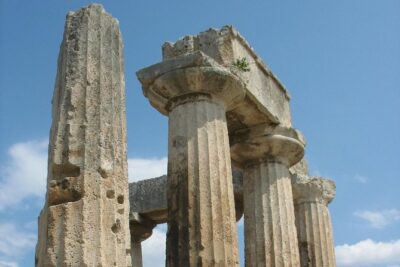
- Roman-era features like the Roman marketplace and the Temple of Apollo.
You may also find there’s a lot happening at once in your eyes—columns, ground-level patterns, and traces of older and newer layers. That’s where having a driver explain context earlier in the day helps you avoid feeling lost.
If you’re the type who likes a steady plan, focus on just 3 things you want to understand:
1) why Corinth sat where it did,
2) what kind of public spaces dominated the city,
3) how the Christian story became rooted in this place.
Lunch and village time: where the day slows down on purpose
After the museum, you’ll get a break with free time. This is when you can stroll the village shops, pick up handmade souvenirs, and take a real breath.
Lunch is handled in a practical way: you’ll have free time for a Greek meal at a local taverna. Some driver recommendations focus on places near the sea with good views, which makes the lunch feel like part of the experience rather than a pit stop.
My advice: don’t schedule anything right after this tour back in Athens if you can help it. You’ll likely return tired in the good way, with a head full of names and locations.
Who should book this tour (and who should reconsider)
This tour fits best if you want:
- a one-day way to see Corinth’s key geography (canal, port area, fortress),
- the connection between place and early Christianity,
- a private day plan with room for conversation and pacing,
- good value for a route that would otherwise take multiple tickets and logistics.
You might reconsider if:
- you don’t do well with steep, uneven climbs (the Acrocorinth ascent is a real physical factor),
- you expect a licensed guide walking inside every site (your driver won’t enter archaeological areas with you),
- you’re trying to minimize extra costs (the museum/site entry is extra).
Booking decision: should you spend your day on Corinth from Athens?
I think this is a strong choice if your goal is to leave Athens with a clearer sense of why Corinth mattered—geographically, historically, and spiritually. The canal viewpoint gives you instant orientation, and the combination of Kenchreai + Acrocorinth + Ancient Corinth turns the theme into something you can actually picture.
Book it if you’ll enjoy asking questions while you’re on the road and if you’re comfortable with a moderately demanding hike. Skip or plan carefully if you’re worried about access, slippery paths, or you want an in-site licensed guide for every stop.
If you do book: wear grippy shoes for Acrocorinth, budget the €15 museum entry, and use the drive time to set up what you want to understand next. That’s the difference between seeing ruins and feeling you finally get the place.
FAQ
How long is the Private Biblical Ancient Corinth Tour from Athens?
It runs for about 8 hours.
What’s included in the tour price?
You get private transportation in an air-conditioned vehicle, WiFi onboard, bottled water, and pickup offered with return to the same place.
Is the archaeological museum admission included?
No. Entry/Admission to the Archaeological Site and Museum (€15.00 per person) is not included.
Do we have a licensed tour guide during site visits?
No. A licensed tour guide is not included. Your driver isn’t an official tour guide, but they are knowledgeable and can answer questions in fluent English. They don’t enter the archaeological sites with you.
How does pickup work?
Your personal driver picks you up and returns you to the same place. If you stay in a hotel, they wait at the lobby; for apartments, they wait at the entrance; if you’re coming from Piraeus Port, they wait at the disembarkation area.
What language is the tour offered in?
The tour is offered in English, and the driver provides commentary in English.
What if the weather is bad?
This experience requires good weather. If it’s canceled due to poor weather, you’ll be offered a different date or a full refund.
More Tours in Athens
- Athens: Acropolis, Parthenon & Acropolis Museum Guided Tour★ 4.8 · 9,316 reviews
- The Acropolis, Parthenon & Acropolis Museum Guided Tour★ 4.7 · 8,493 reviews
- Acropolis: Premium Acropolis and Parthenon Guided Tour★ 4.8 · 5,208 reviews
- Athens: Mythology of Delphi, Museum and Arachova Guided Tour★ 4.7 · 5,102 reviews
- Acropolis and Parthenon Guided Walking Tour★ 5.0 · 4,755 reviews
- Greek Food Walking Tour in Athens★ 5.0 · 4,740 reviews
More Tour Reviews in Athens
- Athens: Acropolis & up to 5 Archaeological Sites Combo Pass★ 4.2 · 13,904 reviews
- Athens: Acropolis, Parthenon & Acropolis Museum Guided Tour★ 4.8 · 9,316 reviews
- The Acropolis, Parthenon & Acropolis Museum Guided Tour★ 4.7 · 8,493 reviews
- Athens: Cape Sounion & Poseidon Temple Sunset Half-Day Trip★ 4.8 · 8,241 reviews
- Acropolis: Premium Acropolis and Parthenon Guided Tour★ 4.8 · 5,208 reviews
- Athens: Mythology of Delphi, Museum and Arachova Guided Tour★ 4.7 · 5,102 reviews
Corinth and the Canal
- From Athens: Ancient Corinth Day Trip with Canal & VR Guide★ 4.6 · 1,073 reviews
- Biblical Tour Letters ToThe Corinthians St Paul’s Footsteps 6Hour★ 5.0 · 1,065 reviews
- Private Biblical Tour Ancient Corinth & Isthmus Canal from Athens★ 5.0 · 762 reviews
- Athens: Ancient Corinth & Nafplio Full Day Trip with Swim★ 4.8 · 531 reviews
- Athens: Corinth Canal, Mycenae & Nafplio Premium Guided Tour★ 4.7 · 322 reviews
- Private Tour of Apostle Paul’s Footsteps in Ancient Corinth★ 5.0 · 275 reviews
Fresh Off the Boat: New Athens Reviews




Corinth Day Trips, compared.
 ★ 4.6From Athens: Ancient Corinth Day Trip with Canal & VR GuideFrom $411,073 reviews
 ★ 5.0Biblical Tour Letters ToThe Corinthians St Paul’s Footsteps 6HourFrom $1701,065 reviews
 ★ 5.0Private Biblical Tour Ancient Corinth & Isthmus Canal from AthensFrom $301762 reviews
 ★ 4.8Ancient Corinth & Nafplio Full Day Trip with Swim531 reviews
 ★ 4.7Corinth Canal, Mycenae & Nafplio Premium Guided TourFrom $32322 reviews
 ★ 5.0Private Tour of Apostle Paul’s Footsteps in Ancient CorinthFrom $169275 reviews
 ★ 4.3Corinth Canal, Mycenae and Nafplio Day TourFrom $129252 reviews
 ★ 4.5Corinth Half-Day Trip from Athens with Entrance TicketsFrom $91242 reviews
Browse the lists this tour appears in