
Reviewed · CLASSICAL GREECE MULTI-DAY TOURS
“A Day in Ancient Olympia:The Cradle of the Olympics Games”
Olympia starts with one long, good drive. You’ll roll from Athens to the Peloponnese, making smart stops that keep the day moving.
I especially like the door-to-door pickup (Athens hotels or Port Piraeus) plus the air-conditioned Mercedes with Wi-Fi, water, and charging. You’re not wasting time figuring out buses or transfers.
One thing to consider: the driver is English-speaking but not a licensed site/museum guide, so you’ll want to read the signs, use any on-site explanations, or request a licensed guide if that style of learning matters to you.
In This Review
- Key things I’d plan around
- Why this Olympia day works better than a rushed “drive and hope” plan
- Isthmus of Corinth: the quick stop that sets up the whole Peloponnese story
- Entering Ancient Olympia: Zeus, the stadium, and the flame altar in one sweep
- The stadium: where running wasn’t just sport
- Temple of Zeus: massive, built for myth
- Altar of Hera: where the flame ties past to present
- Philippieion: a circular building with a specific political message
- Palaestra: training for boxing, wrestling, and jumping
- Museums in Olympia: why I’d treat them as part of the site, not an add-on
- Archaeological Museum of Olympia: statues you’ll recognize in photos
- Museum of the Olympic Games: the history angle in a compact format
- Admission fees and the real value of this $327.43 price
- The day flow: how to pace yourself so you don’t feel squeezed
- Who should book this Olympia day trip (and who should think twice)
- Should you book this “Cradle of the Olympics” day trip?
- FAQ
- Is pickup included from Athens and Port Piraeus?
- How long is the tour?
- What’s included in the car ride?
- Do I need to pay for admission fees?
- Is there a licensed tour guide included?
- Are the tickets mobile?
Key things I’d plan around
- Time-saving private transfers so you can fit Corinth and Olympia in one day
- Skip-the-line ticket help (you still pay the ticket costs) to reduce waiting
- Olympia without rush stress: stadium, Zeus, Hera altar, and major buildings on the grounds
- Two museum stops: the Archaeological Museum plus the Museum of the Olympic Games
- Practical ride comforts: A/C, Wi-Fi, water, and mobile chargers
Olympia to Delphi over several days
- 4-Day Classical Greece Tour: Epidaurus, Mycenae, Olympia, Delphi, Meteora
★ 4.5 · 732 reviews - Delphi, Thermopylae, Corycian Cave 300 Spartans Tour
★ 5.0 · 492 reviews - Athens: Delphi, Corycian Cave, and 300 Battlefield Day Trip
★ 4.8 · 344 reviews - 3-Day Classical Greece Tour: Epidaurus, Mycenae, Nafplion, Olympia, Delphi
★ 4.5 · 342 reviews
Why this Olympia day works better than a rushed “drive and hope” plan
This is the kind of day trip that makes sense if you want real context, not just photos. The biggest value is simple: you’re getting private transportation across the route with comfort built in, so you can spend your energy on the sites themselves.
The itinerary also gives you a rare combo: one classic stop outside Olympia (Isthmus of Corinth) and then the entire Olympia experience—ruins, stadium, temples, and museum time. That’s a lot to pack into 8–10 hours, but the plan is structured to help you move efficiently.
Also, a detail I appreciate when I’m planning: the pickup is flexible. You can start from your hotel/Airbnb reception in Athens or right by a cruise terminal at Port Piraeus, with the driver meeting you with a sign. You’ll be better off with fewer handoffs, and this tour is built for that.
Isthmus of Corinth: the quick stop that sets up the whole Peloponnese story
Your day starts with a short but meaningful pause at the Isthmus of Corinth. It’s a narrow strip that links Central Greece to the Peloponnese. And while it looks like just another “road cut through,” it’s historically a big deal.
Here’s what makes this stop click:
- The Corinth Canal, opened to connect the Saronic Gulf with the Gulf of Corinth, runs through the narrowest point of the area.
- Long before modern engineering, the location mattered strategically. A defensive wall was built as early as the end of the 5th century BC and later preserved into Byzantine times (the Hexamilion).
You’ll only have about 15 minutes, and that’s exactly right for this kind of moment. Don’t try to make it a full museum stop. Treat it like a breather with history—then you’re ready for Olympia.
Tip for your visit: wear shoes you can walk in comfortably, because even a short stop can mean uneven ground and quick photo angles. The value here is understanding why this neck of land shaped movement for centuries.
Entering Ancient Olympia: Zeus, the stadium, and the flame altar in one sweep
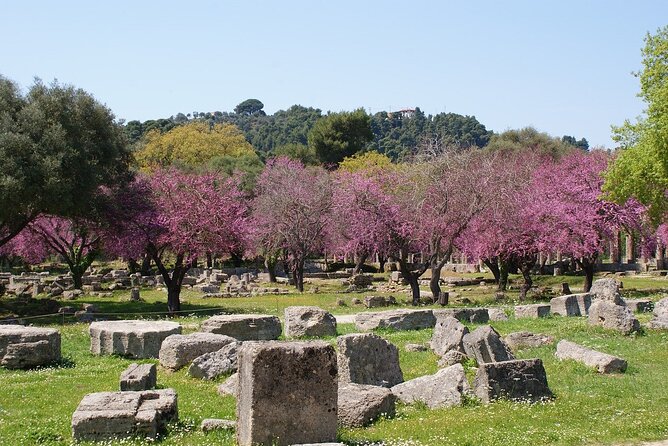
Ancient Olympia is one of those places where the setting helps you understand what you’re looking at. It sits in the Alpheios river valley, near Mount Kronios, in an area that feels removed from everyday life—exactly what you want for a sanctuary devoted to Zeus.
Olympia’s claim to fame is straightforward: it was a major Panhellenic religious sanctuary where the Olympic Games were held every four years through Classical antiquity, from the 8th century BC to the 4th century AD. Later, the games were restored in 1894, tied to an international idea of peaceful competition.
What you’ll see on the grounds is where the time actually pays off. The plan doesn’t just mention famous ruins—it guides you through the parts that connect like a story.

The stadium: where running wasn’t just sport
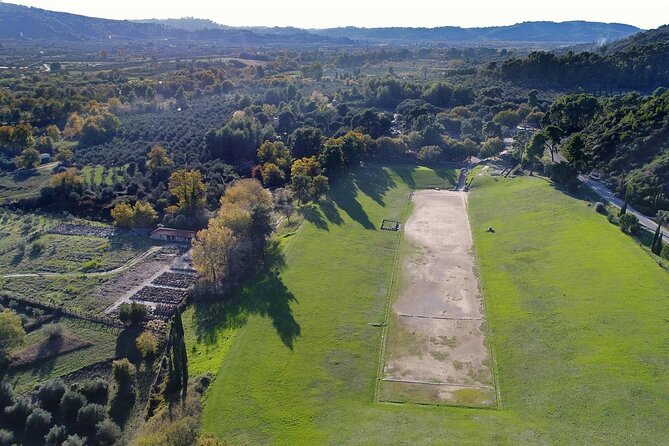
The stadium is the heart of the athletics side. The racetrack runs over 200 meters long and is about 30 to 34 meters wide. Even if you don’t know every technical detail, you’ll get the scale quickly. It helps you imagine the intensity of competition in an era that didn’t have modern stadium design.
If you like figuring out how spaces worked, spend an extra minute watching how the viewing lines connect. The buildings around you give clues about where crowds likely stood and how athletes moved.
Temple of Zeus: massive, built for myth
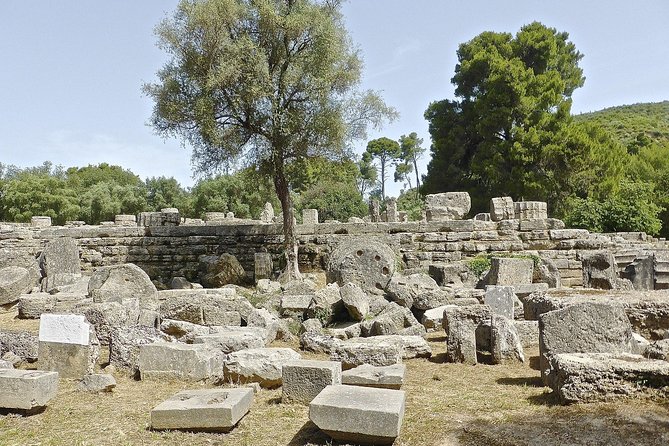
Close by is the Temple of Zeus, built in the 5th century BC. It was made of limestone and marble, and historical records mention a giant golden statue of Zeus inside.
Even though you won’t see gold today, the site explains why Zeus mattered. The temple isn’t a small shrine. It’s the architectural statement of power—religious, political, and cultural all at once.
Altar of Hera: where the flame ties past to present
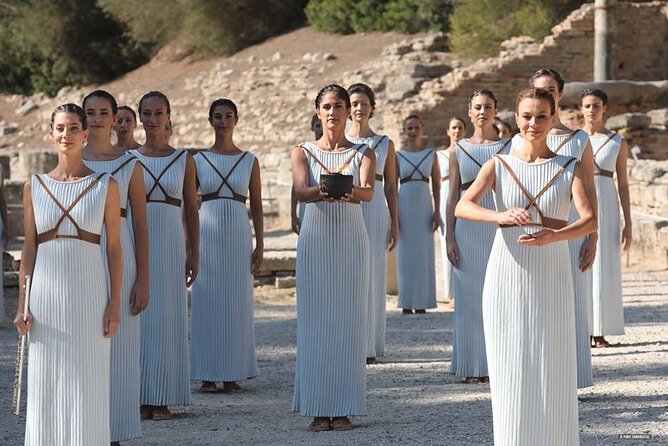
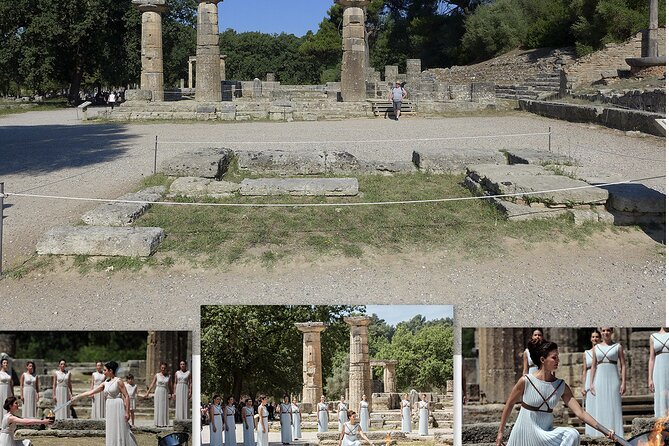
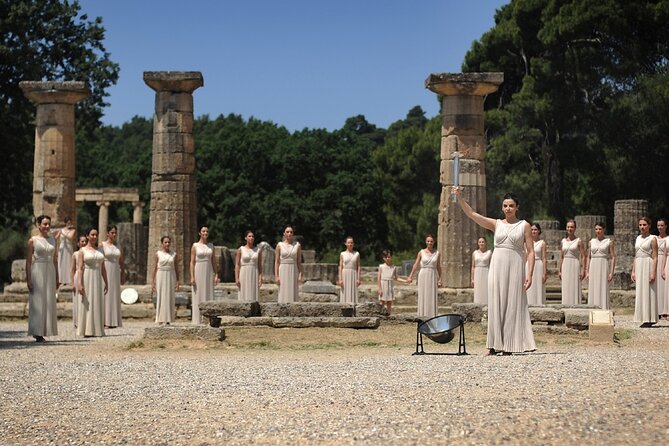
One of my favorite moments to plan for is the altar to goddess Hera, built in the 7th century BC in the Dorian style. It’s also where the Olympic flame is lit before the games.
This is one of those details that makes the modern Olympic ritual feel less generic. You’re standing at a spot that symbolizes continuity, not just brand branding.
Philippieion: a circular building with a specific political message
The Philippieion is described as the only circular building inside the Altis. It was dedicated to Zeus by Philip II of Macedon. That matters because it shows how Olympia wasn’t frozen in time; it attracted attention and investment from powerful rulers.
If you’re the kind of person who likes spotting unusual architecture, this building is a highlight because it breaks the usual rectangle/column expectations.
Palaestra: training for boxing, wrestling, and jumping
Then there’s the palaestra, west of the Altis enclosure near the Kladeos river. Built in the 3rd century BC as part of the gymnasium complex, it was used for boxing, wrestling, and jumping practice.
This part gives you the athletic reality behind the spectacle. It’s easy to think only of the main events in the stadium. The palaestra helps you picture the training side—the work that made competition possible.
Museums in Olympia: why I’d treat them as part of the site, not an add-on
Ruins alone can leave gaps. Olympia’s museums fill some of those gaps by showing objects connected to what you just walked through.
You’ll have two museum blocks:
- Archaeological Museum of Olympia (~1 hour)
- Museum of the Olympic Games (~45 minutes)
Even with limited time, the structure helps. You see the sanctuary first, then you get the artifacts and interpretation that make the stones make more sense.
Archaeological Museum of Olympia: statues you’ll recognize in photos
This museum is often described as one of the best in Greece, and the layout is designed so you don’t feel lost. There are many rooms, and exhibits are labeled well enough that you can move quickly without completely missing context.
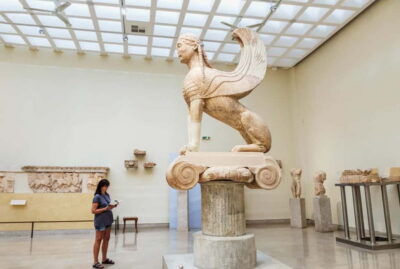
Two exhibits get special attention here: the statues of Hermes of Praxiteles and Nike Paionios. Even if you only catch them for a few minutes, they’re worth slowing down for. They show different artistic approaches—movement, expression, and the way ancient artists captured athletic ideals.
Practical note: with only an hour, I’d choose priorities in your head before you walk in. For example, look first for key sculptures, then spend the remaining time on anything related to the games and sanctuary area.
Museum of the Olympic Games: the history angle in a compact format
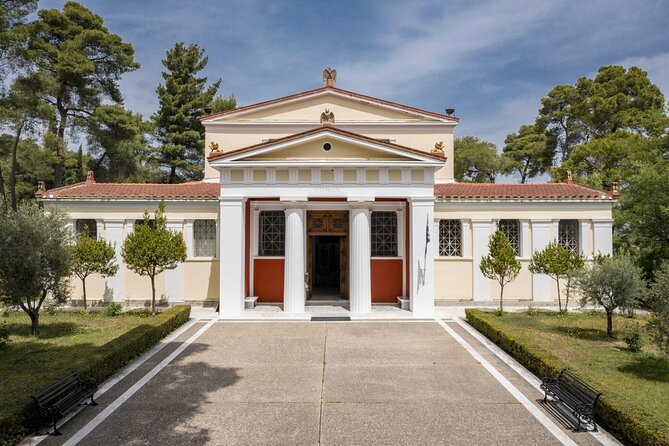
The Museum of the History of the Olympic Games is housed in the old archaeological museum building and focuses on findings related to the ancient games. Think of it as the interpretation layer that connects objects to traditions and events.
With 45 minutes, you won’t read everything. But you’ll come away with a clearer timeline and a better sense of what the games meant beyond the stadium race.
Admission fees and the real value of this $327.43 price
At $327.43 per person, the headline cost can look steep until you break down what’s actually included.
Included:
- Round-trip pickup and drop-off from your Athens accommodation or Port Piraeus
- A comfortable air-conditioned Mercedes with Wi-Fi, water, and chargers
- Private transportation for your group
- English-speaking driver with knowledge of the history
- Help purchasing skip-the-line tickets (you cover ticket cost)
- Mobile chargers and bottled water
- Mobile ticket support
Not included (important):
- Admission fee for the Archaeological Site of Olympia: €20.00 per person
- Museum admission fees for both museums are not included
- Lunch isn’t included
- A licensed tour guide is not provided as a default; you can request one depending on availability
So where does the money go? Mostly into time saved and comfort gained. For Olympia, that matters because you’re working with a long day. Private transfers reduce friction and keep you on schedule. The skip-the-line help is another value add—less waiting, more time where it counts.
One more practical caution: the driver is not a licensed guide and can’t accompany you inside sites or museums. That doesn’t mean the day is dry or unhelpful—your driver still has history knowledge—but you’ll be leading your own museum experience with on-site interpretation. If you want someone to explain details while you’re inside, plan to request a licensed guide.
The day flow: how to pace yourself so you don’t feel squeezed
This is a full-day plan, roughly 8–10 hours, and it’s built around a few anchored segments:
- Short, free stop at Isthmus of Corinth (~15 minutes)
- Olympia ruins grounds visit, then
- Two museum stops
That’s a lot, so pacing is everything. I’d go in expecting a “high signal” day:
- Walk the key ruins in a logical route
- Allow time at the stadium and the Zeus/Hera area
- Use museum time to focus on the most famous exhibits and the story themes
Also, because you’re sitting in the car part of the day, bring whatever helps you stay comfortable for the ride (a light layer can be useful even with A/C). The vehicle includes water and chargers, which reduces your own planning burden.
And yes—if something goes wrong, the operator has shown they can handle it. One service note mentions an electronics problem in the car that didn’t affect the trip because the driver managed it professionally. That’s exactly what you want to hear when you’re investing in a long day out of Athens.
Who should book this Olympia day trip (and who should think twice)
This tour fits best if you want:
- One-day Olympia without the stress of trains, buses, or complicated transfers
- Comfort and reliability: A/C, Wi-Fi, water, and chargers
- A structured day that includes both Olympia museums, not just the ruins
It may feel less ideal if you:
- Want a licensed expert guiding you inside every site and museum for deep, constant narration
- Prefer a slower pace with lots of free time to wander without fixed blocks
If you’re traveling with kids, the car comes with child seats (if needed), which makes a difference on a long day. And if you like practical value, this kind of private transfer is usually the easiest way to get the Olympia highlights without eating up your day to get there.
Should you book this “Cradle of the Olympics” day trip?
I’d book it if you want Olympia plus a smart stop at the Isthmus of Corinth, with private transportation and museum time, and you’re okay doing some of the interpretation yourself inside the sites. The included comforts (A/C, Wi-Fi, water, chargers) and the door-to-door pickup make the day feel efficient rather than exhausting.
I’d think twice if you’re the type who needs a licensed guide walking you through every room. In that case, request a licensed tour guide when available, and plan to spend your museum time with clear priorities.
FAQ
Is pickup included from Athens and Port Piraeus?
Yes. Pickup and drop-off from your Athens accommodation or from Port Piraeus are included without extra charge, and the driver meets you at the location you provide.
How long is the tour?
The duration is approximately 8 to 10 hours.
What’s included in the car ride?
You get an air-conditioned Mercedes-Benz vehicle with Wi-Fi, bottled water, mobile chargers, and seating comfort. Child seats are available as equipped on the vehicle.
Do I need to pay for admission fees?
Yes. The Archaeological Site of Olympia has an admission fee of €20.00 per person, and admission tickets for the museums are not included. The tour can assist with skip-the-line purchasing, but you cover the ticket costs.
Is there a licensed tour guide included?
An English-speaking driver with history knowledge is included, but the driver is not a licensed tour guide to accompany you inside sites or museums. A licensed tour guide can be requested depending on availability.
Are the tickets mobile?
Yes. You’ll receive a mobile ticket, and you’ll also get assistance with skip-the-line ticket purchasing.
More Tour Reviews in Athens
- Athens: Acropolis & up to 5 Archaeological Sites Combo Pass★ 4.2 · 13,904 reviews
- Athens: Acropolis, Parthenon & Acropolis Museum Guided Tour★ 4.8 · 9,316 reviews
- The Acropolis, Parthenon & Acropolis Museum Guided Tour★ 4.7 · 8,493 reviews
- Athens: Cape Sounion & Poseidon Temple Sunset Half-Day Trip★ 4.8 · 8,241 reviews
- Acropolis: Premium Acropolis and Parthenon Guided Tour★ 4.8 · 5,208 reviews
- Athens: Mythology of Delphi, Museum and Arachova Guided Tour★ 4.7 · 5,102 reviews
Classical Greece, Coast to Coast
- 4-Day Classical Greece Tour: Epidaurus, Mycenae, Olympia, Delphi, Meteora★ 4.5 · 732 reviews
- Delphi, Thermopylae, Corycian Cave 300 Spartans Tour★ 5.0 · 492 reviews
- Athens: Delphi, Corycian Cave, and 300 Battlefield Day Trip★ 4.8 · 344 reviews
- 3-Day Classical Greece Tour: Epidaurus, Mycenae, Nafplion, Olympia, Delphi★ 4.5 · 342 reviews
- Delphi & Thermopylae Full Day Private Tour from Athens★ 5.0 · 259 reviews
- Thermopylae, Meteora and Delphi Private Full Day Tour★ 5.0 · 216 reviews
Fresh Off the Boat: New Athens Reviews




Classical Greece Multi-Day Tours, compared.
 ★ 4.54-Day Classical Greece Tour: Epidaurus, Mycenae, Olympia, Delphi, MeteoraFrom $766732 reviews
 ★ 5.0Delphi, Thermopylae, Corycian Cave 300 Spartans TourFrom $169492 reviews
 ★ 4.8Delphi, Corycian Cave, and 300 Battlefield Day TripFrom $170344 reviews
 ★ 4.53-Day Classical Greece Tour: Epidaurus, Mycenae, Nafplion, Olympia, DelphiFrom $520342 reviews
 ★ 5.0Delphi & Thermopylae Full Day Private Tour from AthensFrom $338259 reviews
 ★ 5.0Thermopylae, Meteora and Delphi Private Full Day TourFrom $287216 reviews
 ★ 4.84-Day Tour of Mycenae, Epidaurus, Olympia, Delphi & MeteoraFrom $747168 reviews
 ★ 5.0Thermopylae and Delphi Private Full-Day Tour from AthensFrom $270114 reviews
Browse the lists this tour appears in