

Reviewed · ACROPOLIS & PARTHENON TOURS
Athens: Acropolis Guided Walking Tour
The Acropolis turns myth into real stone. I love how the theater of Dionysus brings ancient festivals to life, and I also like the small-group Q&A that lets you ask follow-up questions. One possible drawback: the tour is in Spanish only, and if you don’t pick the option with the entry ticket, you’ll need to sort your ticket time slot carefully.
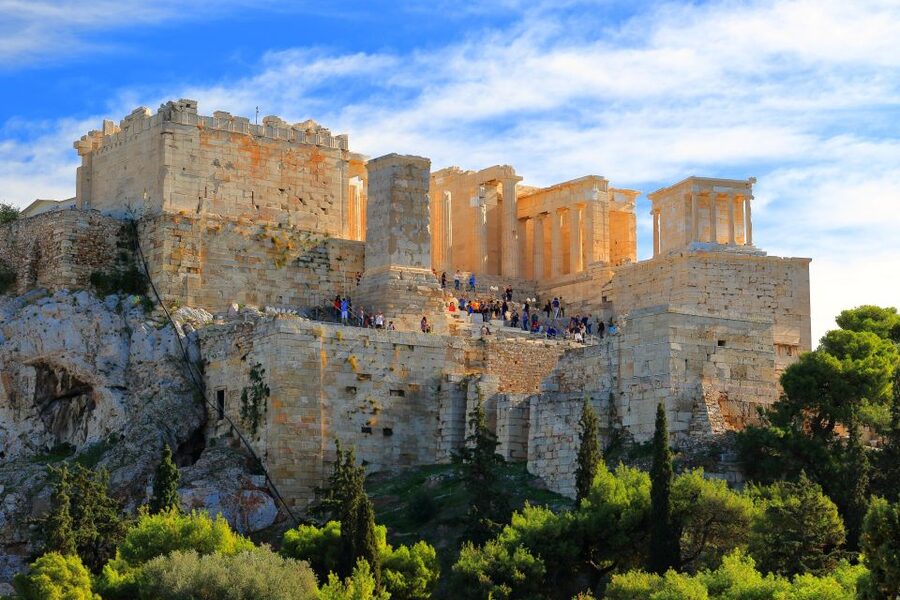
This 2-hour walk is built around the main landmarks on the rocky citadel, without feeling like you’re sprinting from sign to sign. You’ll pass through the Propylaea, then work your way around key spots tied to the goddess Athena and Greek mythology, guided by a licensed professional.
After the tour, you get free time to stay longer and explore on your own pace. That’s a nice setup, because the Acropolis rewards slow looking, not just checklist ticking.
In This Review
- Key things I’d note before you go
- Why $34 for a 2-hour Acropolis walk feels like good value
- Starting at the Propylaea: the gateway that sets your mindset
- Parthenon area and the Athena focus you’ll actually remember
- Athena Nike and Caryatides: the small details that change the whole picture
- Erechtheion and Herodes Atticus: myths and performance in the same breath
- Theater of Dionysus: the scale shock that makes the myths click
- Caryatides, Athena Nike, and the rest: how to pace your attention
- Spanish-only guidance: what it means and how to make it work
- After the 2-hour tour: use your free time wisely
- Entry ticket reality check: timing slots you should not ignore
- Accessibility and what’s not allowed
- Who this tour is best for
- Should you book the Athens Acropolis Guided Walking Tour?
- FAQ
- Is the Acropolis entry ticket included in the tour price?
- How long is the Acropolis guided walking tour?
- What language is the live guide?
- What are the entry ticket time-slot rules?
- Can I bring a baby stroller or a wheelchair?
- What is the cancellation policy?
Key things I’d note before you go
- Small group, real questions: You’re not stuck watching from the back row.
- Dionysus theater context: You’ll get the festival angle, not just the photo stop.
- Athena sites in sequence: Propylaea, Parthenon views, Athena Nike, Caryatides, and more connect clearly.
- Stop-by-stop mythology explanations: The guide links names and gods to what you see.
- Optional entry ticket: Your total cost depends on whether you select the ticket option.
- Free time at the end: You can linger where you’re most curious.
More ways up the sacred rock, set side by side
- Athens: Acropolis & up to 5 Archaeological Sites Combo Pass
★ 4.2 · 13,904 reviews - Athens: Acropolis, Parthenon & Acropolis Museum Guided Tour
★ 4.8 · 9,316 reviews - The Acropolis, Parthenon & Acropolis Museum Guided Tour
★ 4.7 · 8,493 reviews - Acropolis: Premium Acropolis and Parthenon Guided Tour
★ 4.8 · 5,208 reviews
Why $34 for a 2-hour Acropolis walk feels like good value
At $34 per person for a 2-hour guided experience, what you’re really paying for is interpretation—someone helping you read the ruins like a story. The Acropolis can look like a pile of ancient stone until you know what to notice. With a licensed guide and commentary tying Greek gods and myths to specific structures, the time adds up fast.
The cost value depends on one detail: the Acropolis entry ticket is optional. If you choose the option that includes it, your planning is simpler. If you don’t, you’ll need to buy your entry ticket in advance, and timing matters because of time slots. Either way, the guide portion is the main benefit here—especially if you want the “why” behind the Parthenon area and the theater spaces.
One more practical point: the tour is Spanish, so if you speak English better than Spanish, you may still enjoy the visuals, but you’ll lose some of the nuance in the mythology and architecture commentary. If you do speak some Spanish (or you’re willing to try), this is a strong way to get oriented quickly.
Starting at the Propylaea: the gateway that sets your mindset
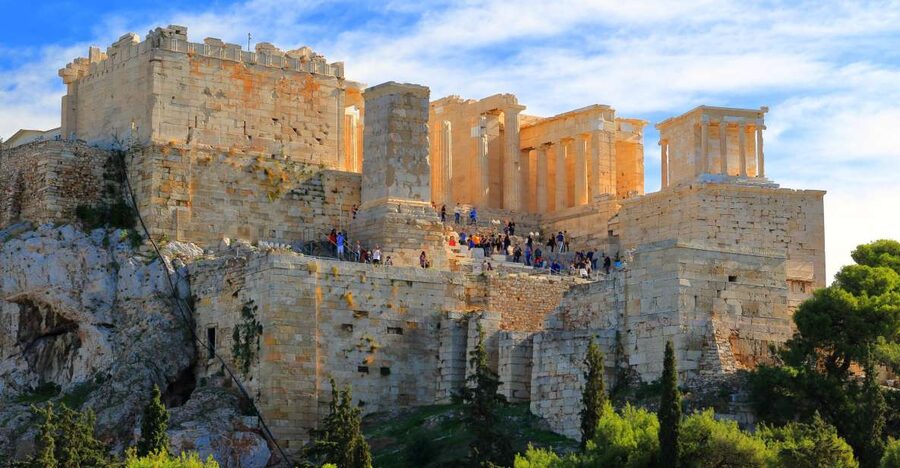
Most Acropolis visits start with a scramble of impressions. This tour starts with a structure that helps you slow down: the Propylaea, the monumental gateway into the rocky citadel.
I like this approach because the Propylaea isn’t just a photo point. It acts like a transition from modern Athens to the ancient sacred space. Once you pass through, the rest of the ruins start to make more sense as parts of one religious and civic world, rather than random buildings on a hill.
A good guide will also help you understand scale—how a gateway like this prepares you for temples and theaters that were designed to be seen and used by large crowds. Even if you’re not a “history person,” you’ll feel the difference when you know what you’re looking at and why it mattered.
Parthenon area and the Athena focus you’ll actually remember
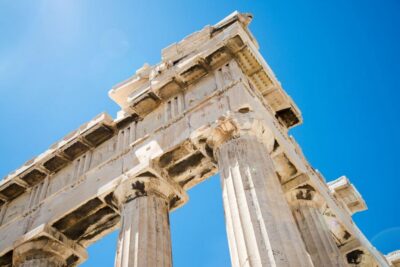
The itinerary naturally loops through the Acropolis’s core sacred theme: Athens and Athena, the goddess protector of the city. You’ll get the chance to gaze at the Parthenon and walk through the area dedicated to Athena.
Here’s what makes this valuable for your visit: the guide doesn’t treat the Acropolis like a museum display. You’re learning about the myths and religious festivals connected to the site, and that changes how you interpret details. Instead of memorizing names, you start linking stories to places.
And that matters because the Acropolis is visually “busy.” You’ll be surrounded by major structures—so the guide’s job is to help you connect them in a logical way. With a structured walking route, you don’t just see temples; you understand how people in ancient Athens used these spaces as part of life: worship, public celebration, and performance.
If you’re choosing what kind of Acropolis experience you want, this is the kind that leans toward storytelling and context. It’s a good match if you want your visit to feel coherent, not chaotic.
On foot through Plaka and beyond



Athena Nike and Caryatides: the small details that change the whole picture
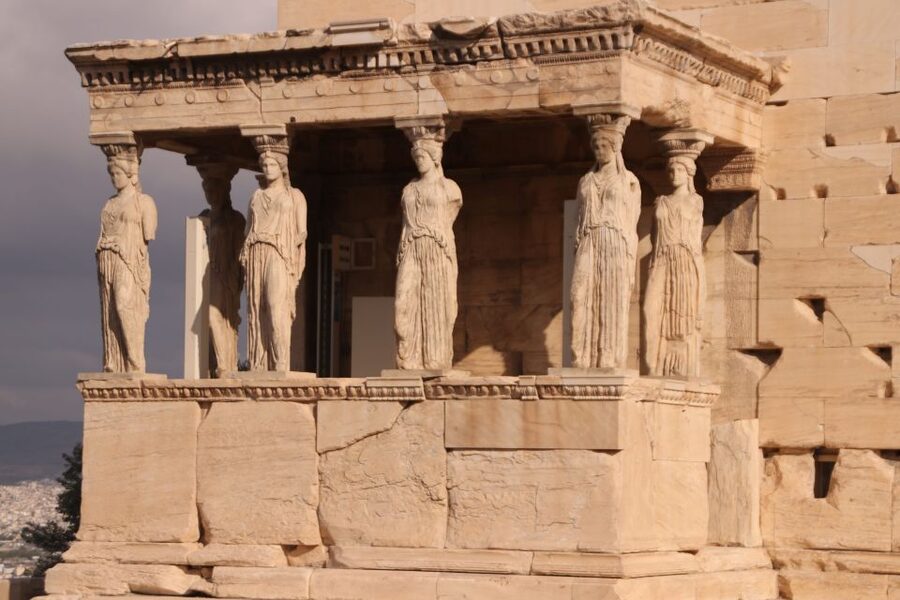
Two of the stops I’d single out for their “wow, I didn’t expect that” factor are the Temple of Athena Nike and the Caryatides.
You’ll see the Temple of Athena Nike, and the tour makes a point of calling it the smallest temple on the Acropolis. That detail is helpful because it nudges your attention. A smaller temple might not be as “loud” as the Parthenon, but it can be just as meaningful—especially when your guide ties it to Athena and the sacred identity of the city.
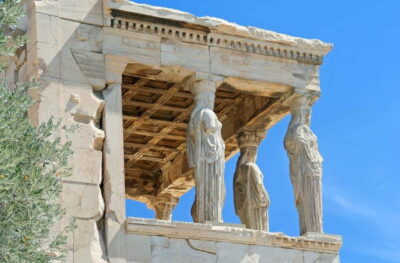
Then come the Caryatides—stone carvings that can look decorative until someone explains how they fit the bigger architectural and symbolic picture. If you’ve ever walked past something like that wondering why it’s important, a guided explanation is exactly what you need.
One practical note: places like this reward careful looking, but you’re also on a time-limited tour. So let the guide point, then use the short moments after each explanation to focus on the feature being discussed—faces, proportions, and placement on the structure.
Erechtheion and Herodes Atticus: myths and performance in the same breath
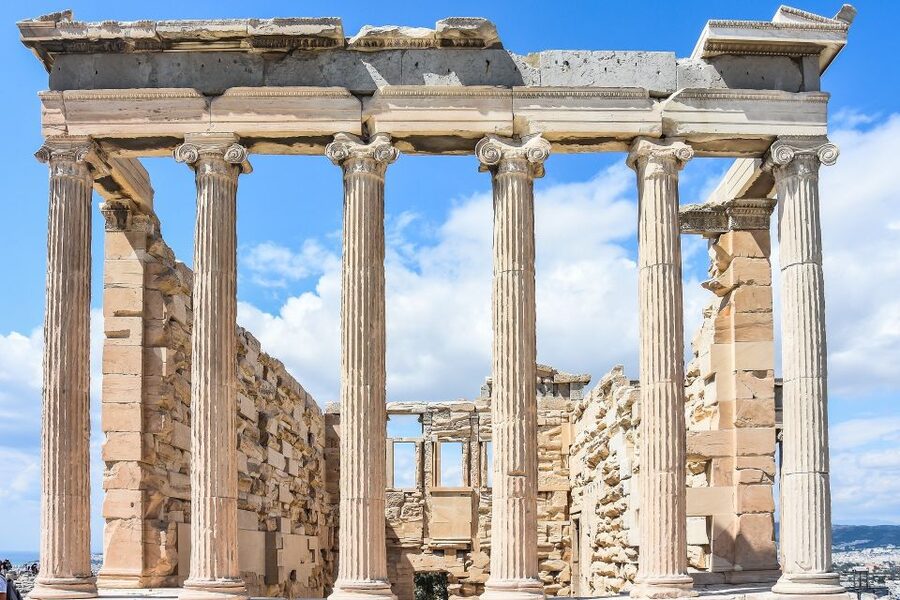
The tour doesn’t stay only on the most famous structures. It also makes room for the Erechtheion and the Odeon of Herodes Atticus.
The Erechtheion is named after Erechtheus, a demi-god, and that name connection is more than trivia. When you know the myth behind the naming, the building feels less random and more intentional—like the Acropolis was designed to preserve stories in stone.
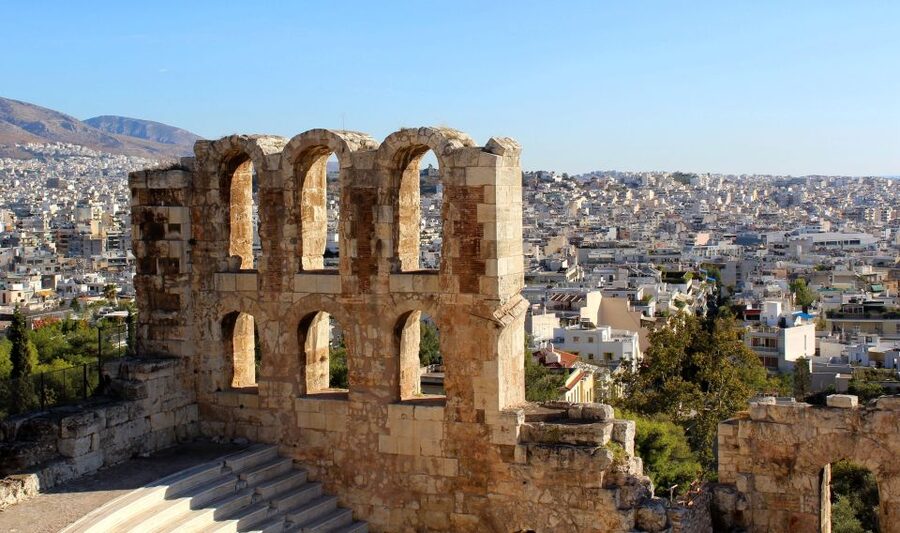
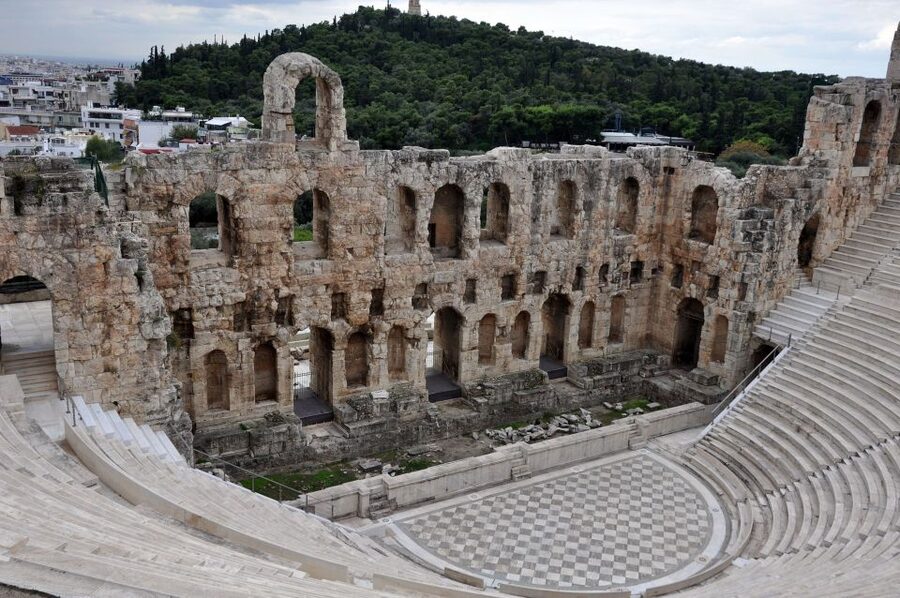
Then you’ll look at the Odeon of Herodes Atticus, described as a giant stone theater. That’s a stop that helps you remember the Acropolis wasn’t only about temples. It was also about public gatherings and performance—things people attended as part of religious and civic life.
Even if your favorite part of the day is architecture, pairing the myth-based stops (like Erechtheion) with performance spaces (like the Odeon) gives the Acropolis more emotional range. It’s easier to picture ancient Athens when temples and theaters are explained side by side.
Theater of Dionysus: the scale shock that makes the myths click
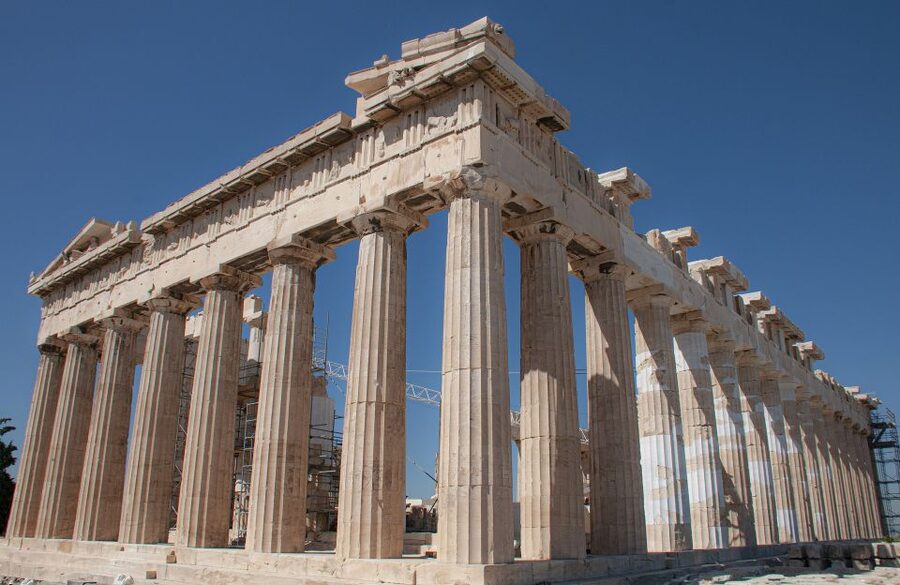
The standout “picture this” stop is the theater of Dionysus, which the tour notes could hold 17,000 spectators.
That number does something to your brain. It’s not a small venue for a niche audience; it’s a massive public stage. When you pair that scale with the fact that it hosted festivals honoring the birth of the Greek god Dionysus, the ruins stop being silent.
This is where a good guide really earns their fee. You’re not just standing in a historic shape—you’re being guided to imagine the movement: the crowd, the event, and the religious meaning. If you’ve ever visited a ruin and felt disconnected, this kind of explanation is the fix.
And because it’s part of a walking tour with stops close together, you don’t lose the thread. You keep building understanding from one structure to the next.
Caryatides, Athena Nike, and the rest: how to pace your attention
This kind of Acropolis tour works best if you treat it like a guided “reading session.” You’ll get multiple landmarks—Propylaea, Parthenon area, theater spaces, the Erechtheion, Odeon of Herodes Atticus, Caryatides, and Athena Nike—so you need to choose what to lock onto.
My advice: pick two “anchor” stops that you care most about, and let the other sites support them. For example:
- If you’re most interested in performance, focus your attention on Dionysus theater and the Odeon.
- If you’re most interested in architecture and symbolism, focus on Athena Nike and the Caryatides.
The guide’s mythology commentary ties everything together, so even if you don’t go ultra-detail on every stop, you’ll still come away with a clear mental map.
Spanish-only guidance: what it means and how to make it work
The tour is live guided in Spanish. That’s stated clearly, so you should plan for it.
If you’re comfortable with Spanish basics, you’ll likely enjoy the storytelling and the “why this matters” explanations. If your Spanish is limited, don’t panic—you’ll still see the main monuments and you’ll still benefit from the structure of the walking route. But you may find it harder to follow the mythology threads that connect specific names to specific ruins.
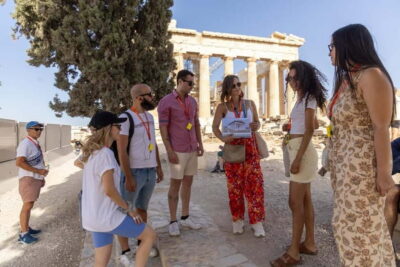
A positive angle from the experience style here: the tour is set up as a small group, and the format is built for questions. So if you’re comfortable asking short questions in Spanish (even simple ones), you can often get your key points clarified.
Also, if your guide happens to be someone named Sara, you’ll probably appreciate the delivery style highlighted in the experience: professional, with humor and a knack for explaining history, architecture, and elements you might otherwise miss. If your guide is different, you’ll still get a licensed, commentary-based tour—but the tone may vary.
After the 2-hour tour: use your free time wisely
Once the guided portion ends, you get free time to explore the outstanding site on your own pace. This is a smart design because the Acropolis is one of those places where your interest changes as you walk.
I recommend you do two things with your free time:
- Return to one stop your guide highlighted and look again without the pressure of moving on.
- Spend time near the areas you found most meaningful, whether that’s the theater views or the Athena-related corners.
It’s also a good window to take photos without feeling like you’re holding up the group. If you’re the type who likes to sit for a moment and take it in, this is your chance.
Entry ticket reality check: timing slots you should not ignore
One key logistics point: if you choose an option without the Acropolis entry ticket, you’ll have to buy the ticket previously. The tour strongly recommends buying online beforehand.
If you buy at the ticket office, the guidance is specific: you should go to the ticket office area of the South entrance around 30 minutes before the tour time. Once you get the tickets, you’ll walk to the meeting point, which is said to be less than 2 minutes away from that ticket office area.
And here’s the slot detail that can trip people up:
- Low season
- Tour at 09:30 uses ticket time slot 09:00–10:00
- Tour at 15:00 uses ticket time slot 15:00–16:00
- High season
- Tour at 08:45 uses ticket time slot 09:00–10:00
- Tour at 09:45 uses ticket time slot 10:00–11:00
- Tour at 17:00 uses ticket time slot 17:00–18:00
- Tour at 17:45 uses ticket time slot 18:00–19:00
If you’re already planning your schedule and want less stress, this is where buying online first really earns its keep. And if you can’t get the online ticket because of availability, there’s an option for help.
Accessibility and what’s not allowed
This tour doesn’t allow baby strollers, non-folding wheelchairs, or electric wheelchairs. If accessibility is a factor for you, check your exact needs before booking and consider whether your mobility matches the walking nature of an Acropolis visit.
Who this tour is best for
This experience is a great fit if you:
- Want a guided route that hits major Acropolis landmarks in a logical order.
- Enjoy mythology and festival context alongside what you see in front of you.
- Like small-group tours where you can ask questions.
- Prefer a 2-hour visit with optional extra time afterward, rather than a full-day commitment.
It may be less ideal if you:
- Strongly need an English-speaking guide, since this tour is Spanish only.
- Want a completely DIY visit with no ticket slot constraints, since you still may need to manage entry timing if you didn’t include the ticket.
Should you book the Athens Acropolis Guided Walking Tour?
If you want your Acropolis visit to feel like a story instead of a scatter of ruins, I’d book this. The licensed Spanish guidance, the small-group format, and the way the tour connects temples and theaters to myths and festivals make the time feel worthwhile. The $34 price also works out well for a guided experience, as long as you plan your entry ticket properly.
Just don’t treat the entry ticket as an afterthought. Decide early whether you’re using the option that includes it, and match your time slot to the tour time. If you do that, you’ll arrive ready to focus on the real magic: turning ancient names like Athena and Dionysus into something you can picture while you’re standing right there.
FAQ
Is the Acropolis entry ticket included in the tour price?
It depends on the option you select. The entry ticket is listed as optional, so if you don’t choose the ticket-included option, you’ll need to buy the entry ticket previously yourself.
How long is the Acropolis guided walking tour?
The tour duration is 2 hours.
What language is the live guide?
The live tour guide provides the tour in Spanish.
What are the entry ticket time-slot rules?
The ticket time slots vary by season and your tour start time. For low season: 09:30 uses 09:00–10:00, and 15:00 uses 15:00–16:00. For high season: 08:45 uses 09:00–10:00, 09:45 uses 10:00–11:00, 17:00 uses 17:00–18:00, and 17:45 uses 18:00–19:00.
Can I bring a baby stroller or a wheelchair?
Baby strollers are not allowed. Non-folding wheelchairs and electric wheelchairs are also not allowed.
What is the cancellation policy?
You can cancel up to 24 hours in advance for a full refund.
More Tour Reviews in Athens
- Athens: Acropolis & up to 5 Archaeological Sites Combo Pass★ 4.2 · 13,904 reviews
- Athens: Acropolis, Parthenon & Acropolis Museum Guided Tour★ 4.8 · 9,316 reviews
- The Acropolis, Parthenon & Acropolis Museum Guided Tour★ 4.7 · 8,493 reviews
- Athens: Cape Sounion & Poseidon Temple Sunset Half-Day Trip★ 4.8 · 8,241 reviews
- Acropolis: Premium Acropolis and Parthenon Guided Tour★ 4.8 · 5,208 reviews
- Athens: Mythology of Delphi, Museum and Arachova Guided Tour★ 4.7 · 5,102 reviews
Athens on Foot, Continued
- Acropolis and Parthenon Guided Walking Tour★ 5.0 · 4,755 reviews
- Greek Food Walking Tour in Athens★ 5.0 · 4,740 reviews
- Athens: Guided Greek Food Walking Tour with Tastings★ 4.9 · 2,859 reviews
- Acropolis monuments & Parthenon Walking Tour with Optional Acropolis Museum★ 5.0 · 2,678 reviews
- Athens Acropolis and Parthenon Walking Tour★ 4.5 · 1,355 reviews
- Acropolis, Parthenon & Athens Old City Heritage Walking Tour★ 4.5 · 876 reviews
The Acropolis, a Few More Ways Up
- Athens: Acropolis & up to 5 Archaeological Sites Combo Pass★ 4.2 · 13,904 reviews
- Athens: Acropolis, Parthenon & Acropolis Museum Guided Tour★ 4.8 · 9,316 reviews
- The Acropolis, Parthenon & Acropolis Museum Guided Tour★ 4.7 · 8,493 reviews
- Acropolis: Premium Acropolis and Parthenon Guided Tour★ 4.8 · 5,208 reviews
- Acropolis and Parthenon Guided Walking Tour★ 5.0 · 4,755 reviews
- Athens: Acropolis, Parthenon & Acropolis Museum Guided Tour★ 4.8 · 3,579 reviews
Fresh Off the Boat: New Athens Reviews





Acropolis & Parthenon Tours, compared.
 ★ 4.2Acropolis & up to 5 Archaeological Sites Combo PassFrom $4213,904 reviews
 ★ 4.8Acropolis, Parthenon & Acropolis Museum Guided TourFrom $409,316 reviews
 ★ 4.7The Acropolis, Parthenon & Acropolis Museum Guided TourFrom $408,493 reviews
 ★ 4.8Acropolis: Premium Acropolis and Parthenon Guided TourFrom $405,208 reviews
 ★ 5.0Acropolis and Parthenon Guided Walking TourFrom $414,755 reviews
★ 4.8Acropolis, Parthenon & Acropolis Museum Guided TourFrom $413,579 reviews
★ 5.0Acropolis and Parthenon Guided Walking TourFrom $414,755 reviews
★ 4.8Acropolis, Parthenon & Acropolis Museum Guided TourFrom $413,579 reviews
 ★ 4.0Acropolis Ticket with Audio GuideFrom $473,575 reviews
 ★ 5.0Athens Scenic Electric Bike Tour with optional Acropolis visitFrom $353,350 reviews
Browse the lists this tour appears in