
Reviewed · MYCENAE & NAFPLIO DAY TRIPS
Full Day Biblical Ancient Corinth Canal Mycenae Epidauvro Nafplio
Bible stories meet castle steps today. This private full-day loop strings together Ancient Corinth, Mycenae, and the postcard streets of Nafplio with stops that connect faith, power, and stone-carved legends. You start with the engineering wonder of the Corinth Canal, then move into Roman-era Corinth and the Acrocorinth fortress before heading down to Mycenae’s Lion Gate and the Treasury of Atreus.
I really like two things about this format: first, the convenience of pickup and drop-off in a modern private vehicle with WiFi, A/C, and bottled water, which saves you from rail-and-bus headaches. Second, you get an expert English-speaking driver with real historical storytelling, and people have specifically praised drivers such as Gianny, Chris, Yiannes, Ioannis, Costas, Michael, and Dimitrios for making the day feel organized, personal, and not rushed.
The one thing to plan for is that this day packs a lot into about 9–10 hours, and some stops involve uneven ground and stairs (especially later in Nafplio). Entrance fees are not included, so you’ll want to budget a bit extra for ticketed sites.
In This Review
- Key highlights at a glance
- Corinth Canal: the shipping shortcut that took forever to build
- Kenchreai and Acts 18:18: where Paul’s vow story meets the port town
- Ancient Corinth: the Bema, Gallio, and the city layers you can still read
- Apollo and the Agora: why the ruins feel oddly familiar
- Acrocorinth: the fortress that controlled the entry
- Mycenae: Lion Gate, Cyclopean walls, and the Treasury of Atreus
- Lion Gate: the iconic entrance and the surviving sculpture
- Archaeological Museum of Mycenae: quick context before the bigger tombs
- Treasury of Atreus: beehive tomb engineering on a serious scale
- Palamidi Castle and the 999 steps: the view that makes the climb worth it
- Nafplio old town: cobbled lanes, Syntagma Square, and lunch by the sea
- Lunch stop: budget it like a real meal day
- Bourtzi and Acronauplia: forts that explain the city’s job
- The Lion of the Bavarians: a memorial with local jokes built in
- The private-driver value: how this day stays organized
- Price and value: is $277.09 a good deal for 9–10 hours?
- Should you book this Corinth–Mycenae–Nafplio day trip?
- FAQ
- What’s the duration of the tour?
- Is pickup included?
- Is this a private tour?
- What language is the tour in?
- How is transportation handled?
- Are entrance fees included?
- Do we get a licensed guide inside the archaeological sites?
- Is lunch included?
- What if the weather is bad?
- What’s the cancellation policy?
Key highlights at a glance
- Corinth Canal: a 19th-century waterway fulfilling a 2,000-year shipping dream tied to ancient navigation needs
- Paul in Corinth: a Roman-era setting connected to Gallio and the Bema (plus the biblical stop at Kenchreai)
- Mycenae’s Bronze Age power: Lion Gate, Cyclopean walls, and the Treasury of Atreus with its massive lintel
- Palamidi Castle views: the famous 999-step climb over Nafplio and the Argolic Gulf
- Nafplio old town time: cobbled streets, Syntagma Square, and fortresses that explain why this place became a capital
Into the Argolid, past the Lion Gate
- From Athens: Small-Group Mycenae, Epidaurus & Nafplio Trip
★ 4.8 · 2,805 reviews - From Athens: Mycenae, Epidaurus & Nafplio Full-Day Tour
★ 4.5 · 2,530 reviews - Mycenae, Epidaurus and Nafplio Tour from Athens
★ 4.6 · 2,201 reviews - 4-Day Classical Greece Tour: Epidaurus, Mycenae, Olympia, Delphi, Meteora
★ 4.5 · 732 reviews
Corinth Canal: the shipping shortcut that took forever to build
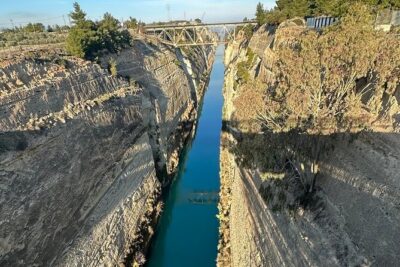
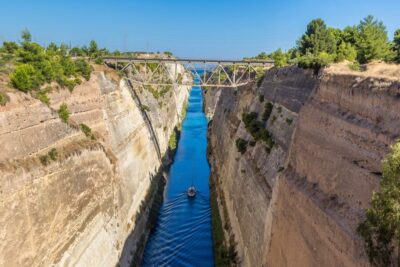
The day begins at the Corinth Canal, a narrow cut that slices across the isthmus of Corinth and links the Gulf of Corinth to the Saronic Gulf. The big idea is simple: it turns the Peloponnese into something closer to an island, saving ships a huge detour around the peninsula.
What makes this stop interesting is the time scale. The canal may have been completed in the late 19th century, but the dream stretches back around 2,000 years. Long before the canal existed, ships that wanted to cross between Aegean routes and the Adriatic would have to circle the Peloponnese, adding about 185 nautical miles of travel.
And then the story gets even more specific: tradition credits Periander, tyrant of Corinth (around 602 BC), with first conceiving the idea of digging the canal. The twist is that the technology didn’t exist yet. So Periander built the diolkos, a stone road that allowed ships to be moved overland on wheeled platforms. If you like seeing how people solved problems before modern tools, this is the kind of stop that clicks.
Practical tip: this is a quick stop, so wear comfortable shoes and get your camera ready fast. The rest of the day keeps moving.
Kenchreai and Acts 18:18: where Paul’s vow story meets the port town
Next you’ll head to the Corinth region area of Kenchreai (the ancient port of Kenchreai/Cenchreae). This is the kind of stop that’s easy to skip if you’re only looking for dramatic ruins, but it’s one of the most meaningful ones if you care about how the Bible maps onto geography.
The connection comes straight from Acts 18:18: Apostle Paul stops at Kenchreai during his second missionary journey. The description also points to the detail that he had his hair cut to fulfill a vow, likely a Nazirite vow. It also mentions the local Christian community and includes a woman named Phoebe in the local assembly.
Even if you’re not treating it as a religious pilgrimage, you still get a useful lesson in ancient travel. Ports weren’t just places to load cargo; they were social and spiritual crossroads. Kenchreai’s role as a port helps explain how ideas spread along with ships.
Consideration: the time here is brief, so if you want more context, ask your driver to connect the port story to what you’ll see later in Roman Corinth.
Ancient Corinth: the Bema, Gallio, and the city layers you can still read
Ancient Corinth is where the day’s theme locks in: a Roman-era city full of public spaces that shaped legal disputes, commerce, and religious life. One of the most compelling threads is Paul’s trial scene connected to Gallio.
During Paul’s time in Corinth, he was brought before the proconsul Lucius Junius Gallio Annaeanus (Gallio). The tradition tied to the site says that the location of the trial is the Bema, an elevated rostrum in the Roman forum where officials addressed the public. The description also notes that because of the site’s association with Saint Paul, the Bema was later transformed into a Christian church during the Byzantine period.
What I like about this part of the day is that it’s not just “big stones.” You get a sense of how a public platform could shape an entire story. The Bema wasn’t a random building; it was built for speaking, judging, and being seen.
From there, you’ll move through the Ancient Corinth area that includes:
- the Agora space, where commerce and community mixed with small temples, altars, and shops
- the Archaeological Museum of Ancient Corinth, positioned within the broader site area so it fits the same journey
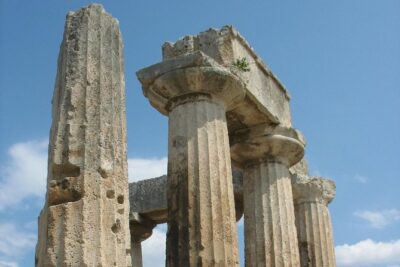
- the Temple of Apollo, an early Doric temple with rare monolithic columns
- and the fortified heights of Acrocorinth
The canal and old Corinth, a few more days
Apollo and the Agora: why the ruins feel oddly familiar
The Temple of Apollo at Corinth dates to around 550 BC and is described as one of the earlier Doric temples in both the Peloponnese and Greek Mainland. It’s noted for monolithic columns that are rare in the ancient world. Even if you’re not an architecture nerd, it’s the kind of site where your brain automatically compares it to Greek temples you’ve already seen, and that makes it easier to “read” what you’re looking at.
Then comes the Agora and Bema area. The forum-like layout helps you picture how a city worked: people gathered, officials spoke, and arguments played out in public.
Acrocorinth: the fortress that controlled the entry
Acrocorinth (“Upper Corinth”) sits on a massive rock above the city. This isn’t just a viewpoint; it’s a defensible position with a secure water supply, which the description highlights as a reason it repeatedly served as the last line of defense in southern Greece.
What makes it feel worth the effort is the strategic logic. Acrocorinth overlooks the Isthmus of Corinth, meaning whoever held the fortress had a big say in what could enter the Peloponnese by land. From a distance, it’s easy to treat it as another ruin. Up close, it feels like a control point.
Practical tip: bring a light layer if it’s windy up top, and keep an eye on your footing on uneven paths.
Mycenae: Lion Gate, Cyclopean walls, and the Treasury of Atreus
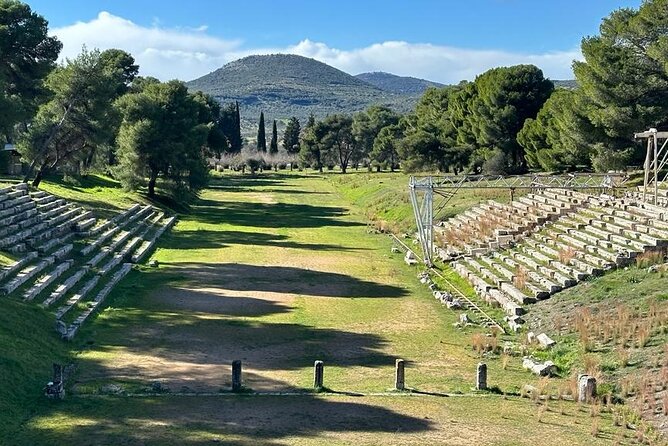
After Corinth, the day shifts into Bronze Age drama at Mycenae. This is one of those places where the ruins don’t feel like they came from a textbook. They feel like power.
Mycenae is described as the fortified citadel and the seat of the mythical King Agamemnon. The site is presented as well-preserved, with highlights such as the Tomb of Clytemnestra, the Lion’s Gate, and Cyclopean walls. The information also places Mycenae as a major center around the second millennium BC, dominating much of southern Greece and beyond.
The scale data helps ground the story: at its peak around 1350 BC, the citadel and lower town are said to have held about 30,000 people over roughly 32 hectares. It’s part of why the Mycenaean period (about 1600 BC to 1100 BC) carries Mycenae’s name.
Lion Gate: the iconic entrance and the surviving sculpture
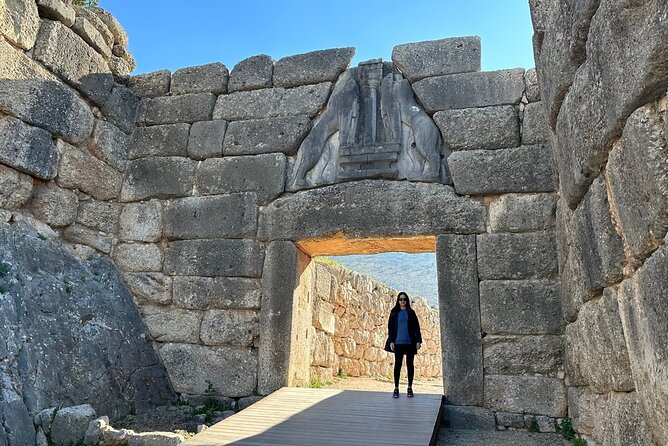
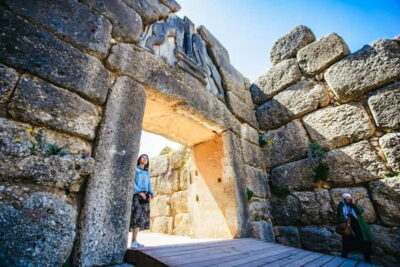
Lion Gate was the main entrance to the Bronze Age citadel, erected around the 13th century BC, about 1250 BC, and named for two lionesses (or lions) carved in relief above the entrance in a heraldic pose.
The description makes a strong claim: it’s the only surviving monumental piece of Mycenaean sculpture and the largest sculpture in the prehistoric Aegean. It’s also described as the only relief image of Bronze Age Greece that survived without being buried underground, and the only relief image described in classical antiquity literature so it was well known before modern archaeology.
That’s a lot of firsts for one gateway. When you stand in front of it, it makes the metalwork-and-stone story feel real rather than dramatic marketing.
Archaeological Museum of Mycenae: quick context before the bigger tombs
You’ll also stop at the Archaeological Museum of Ancient Mycenae, tied to the acropolis and surrounding funerary and habitation areas. The note that most visible monuments date to the peak floruit from 1350 to 1200 BC gives you a useful filter: you’re not looking at random remnants; you’re seeing the most intense period of the city’s life.
Treasury of Atreus: beehive tomb engineering on a serious scale
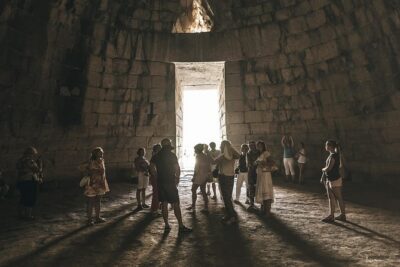
The highlight for many people here is the Treasury of Atreus, also called the Tomb of Agamemnon. It’s described as a large tholos or beehive tomb from around 1250 BC on Panagitsa Hill.
The numbers are wild in a good way: the stone lintel above the doorway weighs about 120 tons, and the doorway dimensions are given as approximately 8.3 x 5.2 x 1.2 meters. The description says it was used for an unknown period. It was mentioned by Pausanias in the 2nd century AD, was still visible in 1879, and the German archaeologist Heinrich Schliemann is credited with discovering the shaft graves under the acropolis in that era.
When you think about what 120 tons means for construction methods, you start to understand why people treat Mycenae as more than myth. It’s engineering.
Consideration: this part of the day is more walking-focused than later in Nafplio. Wear solid shoes and take short pauses so your legs don’t revolt halfway through.
Palamidi Castle and the 999 steps: the view that makes the climb worth it
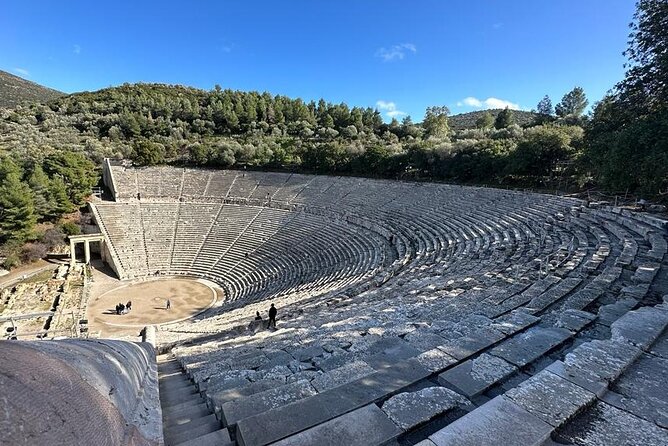
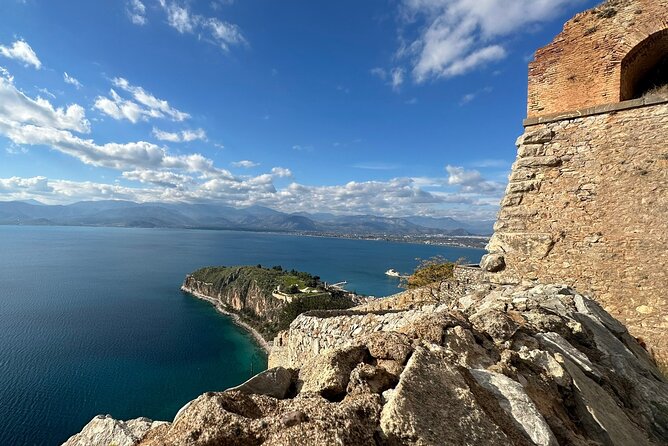
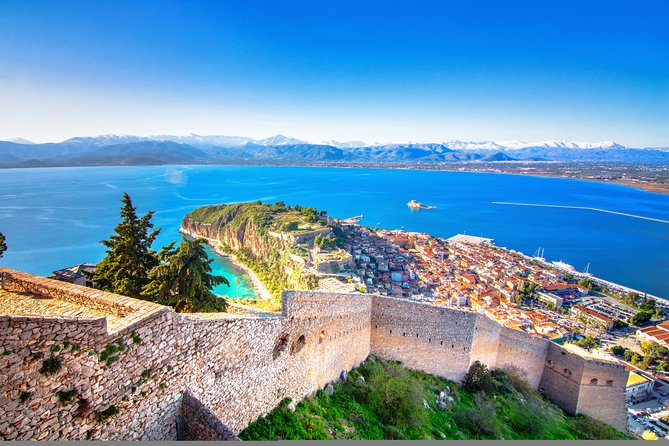
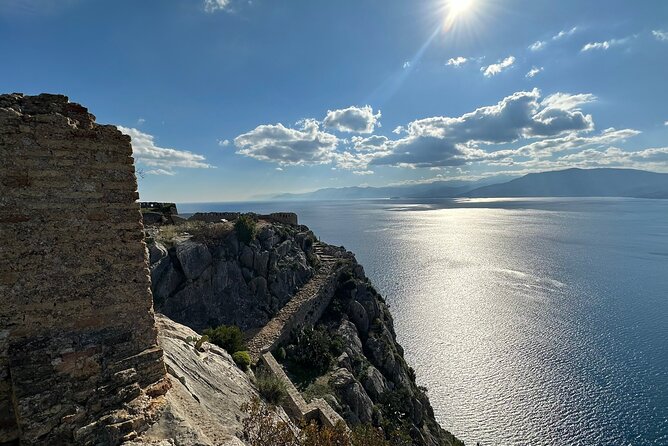
Nafplio’s Palamidi Castle is the day’s big physical moment. The fortress sits on a 216-meter-high hill east of Acronauplia and was built by the Venetians during their second occupation of the area (1686–1715).
You’ll hear a famous number: there are 913 steps up from the town to the fortress, while locals say the total to the top is over one thousand, with the classic line that it’s 999 steps. (Same idea, slightly different counting.)
What matters is the payoff: Palamidi gives sweeping views over the Argolic Gulf, Nafplio, and the surrounding country. It’s described as one of Greece’s best-preserved castles, and the routes inside connect to the fortress’s dramatic use, including the terrain linked to the Kolokotronis prison area.
Practical advice: if you’re even slightly concerned about stairs, decide early how you’ll handle it. Don’t wait until you’re already halfway up. Bring water, and pace yourself on the way down too, since the steps can feel more slippery on descent.
Nafplio old town: cobbled lanes, Syntagma Square, and lunch by the sea
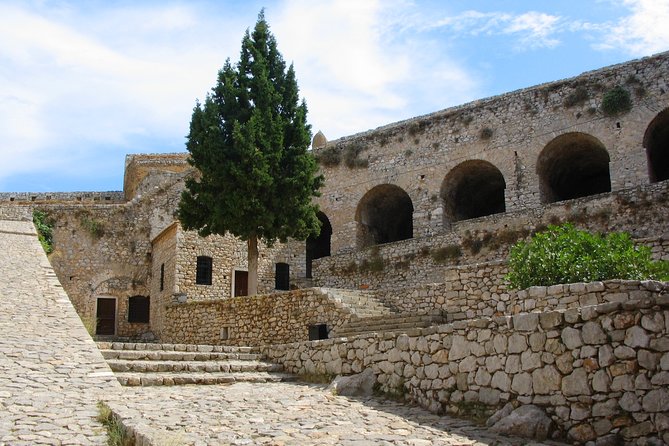
After the fortress heights, Nafplio feels like a reward for the effort. The old town is described as cobbled streets winding among mansion-like homes with flowered balconies. There are stone steps that connect neighborhoods, and the description even points out a dreamlike quiet that some visitors notice when they slow down.
Nafplio is also positioned as one of the most scenic Greek cities, and it served as the capital until 1834. That’s a useful context clue: the mix of fortresses and castles makes sense when you remember it was once a seat of government, not just a holiday town.
You’ll have time for the center around Syntagma Square, noted as the zero point of the old town. From there, you’ll travel through the city’s layers, with architecture described as revealing Venetian, neoclassical, and oriental elements.
Lunch stop: budget it like a real meal day
Lunch is scheduled at a traditional tavern by the sea, but meal costs are not included in the price. This is one of those practical details that matters: plan on treating it as part of your spending for the day, not an afterthought.
Tip: if you eat early, you’ll likely feel less rushed in the afternoon forts and viewpoints.
Bourtzi and Acronauplia: forts that explain the city’s job
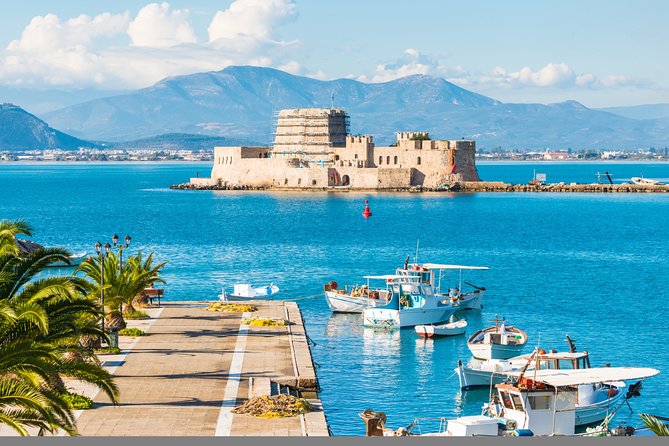
If Nafplio’s old town is the charm, Bourtzi is the postcard proof. The small fortress on the islet of Agioi Theodoroi was built by the Venetians in 1473 and was called Castello dello Soglio, meaning Castle of the Throne. Later, the Ottomans reportedly used the name Bourtzi, described simply as a fortress, and that name stuck.
The description also adds a human twist: the fortress served as a prison and later became a luxury hotel in the honored 60s. Today it’s famous as a perfect sunset setting, and you’ll reach it by boat in less than 10 minutes.
Then there’s Acronauplia (Akronafplia Fortress), described as the oldest part of the city. Until the 13th century it was a town on its own, and then the Venetians and Franks integrated it into fortifications. The description also says part of it was used as a prison until the Greek government decided the view would benefit tourism and built a hotel complex there.
When you stitch together Palamidi, Bourtzi, and Acronauplia, you get the logic of Nafplio: defend by land, watch by sea, and control access. The forts aren’t random. They’re a system.
The Lion of the Bavarians: a memorial with local jokes built in
End your Nafplio time with the Lion of the Bavarians, carved into the rock above Michael Iatrou Street with a small park under it. The description says it’s huge and the work of German sculptor Christian Ziegel.
It was commissioned by King Louis, father of Otto, as a memory for Bavarian soldiers of Otto’s dynasty who died in Nafplio in 1833 of a typhoid epidemic. Locals also have their own explanation, saying the soldiers were killed by bitter things they ate, which leads to an unofficial name for the monument.
I like stops like this because they show how cities tell stories in multiple ways: grand fortresses for power, and small public monuments for grief and identity.
The private-driver value: how this day stays organized
This is set up as a private tour, so only your group participates. That matters on a day with a lot of road time and lots of stops, because you can adjust pacing. The vehicle size also scales by your group: groups of 1–3 use a luxurious sedan, while groups of 4–7 use comfortable mini vans.
The vehicle details are practical rather than flashy: WiFi, A/C, and bottled water. On a long day that can reduce fatigue faster than you’d think, especially once you switch from roadside stops to stone-and-steps walking.
Where this experience really scores, based on the strongest praise, is the driver talent. People highlighted professionalism and strong communication from Gianny, Chris’s mix of friendliness and strong storytelling, Yiannes’s courteous care, Ioannis’s responsive planning, Costas’s ability to offer options without rushing, Michael’s patience when time ran long, and Dimitrios’s attentive pace-setting.
One note to keep expectations sane: even with a great driver, popular sites can still be crowded. If a place is busy, you’ll still feel it at the entrances. Plan to be patient and focus on the moments between the crowds.
Price and value: is $277.09 a good deal for 9–10 hours?
At $277.09 per person for roughly 9–10 hours, you’re paying for private transportation plus a driver who provides historical context in English. For many people, that’s the real value: you’re not coordinating buses or transfers, and you’re not spending time trying to match up multiple self-guided tickets across the Peloponnese.
This can make even more sense when you’re traveling as a small group. The format supports 1–3 in a sedan and 4–7 in mini vans, and there are group discounts noted.
Just budget honestly for what’s not included. Entrance fees for attractions are not included, and a licensed guide to accompany you into archaeological sites is not included either. That means your driver’s historical explanations help, but you’ll still pay for any ticketed sites directly if you choose to enter.
Also note that lunch in Nafplio is a scheduled stop, but meal costs aren’t included. And gratuities aren’t included, so plan to tip at your discretion.
In plain terms: if you want a one-day “greatest hits” of Corinth and Mycenae with Nafplio’s fortress views, private transport plus an attentive driver is often cheaper than you expect in time and stress, even before you factor in the value of not driving yourself in an unfamiliar region.
Should you book this Corinth–Mycenae–Nafplio day trip?
Book it if you want a focused Peloponnese day that connects key Bible-adjacent locations in Corinth with the big Bronze Age statement of Mycenae, then closes with Nafplio’s old town charm and Palamidi’s famous steps. It’s especially good for couples and small groups who value a smooth schedule, a driver who can explain what you’re seeing, and a trip that doesn’t force you to stitch together multiple transportation plans.
Skip it or consider another option if you hate stairs, you want lots of free time at each site, or you prefer to travel with a licensed archaeologist-style guide inside museums and excavations (since a licensed guide is not included). Also remember that entrance fees and lunch aren’t included, so your final day budget will be higher than the base price.
If your idea of a great day includes stone ruins, dramatic viewpoints, and practical convenience, this one fits the bill.
FAQ
What’s the duration of the tour?
It runs about 9 to 10 hours.
Is pickup included?
Yes. Pickup is offered from Athens hotels, Airbnb residences, or the port, and the driver will bring you back to the meeting point (or another preferred point).
Is this a private tour?
Yes. It’s described as private, with only your group participating.
What language is the tour in?
English.
How is transportation handled?
You’ll use a modern, first-class private vehicle. Vehicles have WiFi, A/C, and bottled water. Sedan vehicles are used for groups of 1–3, and mini vans for groups of 4–7.
Are entrance fees included?
No. Entrance fees for attractions are not included, though some stops are listed as free.
Do we get a licensed guide inside the archaeological sites?
No. A licensed guide to accompany you into archaeological sites is not included.
Is lunch included?
Lunch stops are scheduled, but meal costs are not included.
What if the weather is bad?
The experience requires good weather. If it’s canceled due to poor weather, you’ll be offered a different date or a full refund.
What’s the cancellation policy?
You can cancel for a full refund up to 24 hours in advance of the experience start time. After that, refunds are not guaranteed.
More Tour Reviews in Athens
- Athens: Acropolis & up to 5 Archaeological Sites Combo Pass★ 4.2 · 13,904 reviews
- Athens: Acropolis, Parthenon & Acropolis Museum Guided Tour★ 4.8 · 9,316 reviews
- The Acropolis, Parthenon & Acropolis Museum Guided Tour★ 4.7 · 8,493 reviews
- Athens: Cape Sounion & Poseidon Temple Sunset Half-Day Trip★ 4.8 · 8,241 reviews
- Acropolis: Premium Acropolis and Parthenon Guided Tour★ 4.8 · 5,208 reviews
- Athens: Mythology of Delphi, Museum and Arachova Guided Tour★ 4.7 · 5,102 reviews
Corinth and the Canal
- From Athens: Ancient Corinth Day Trip with Canal & VR Guide★ 4.6 · 1,073 reviews
- Biblical Tour Letters ToThe Corinthians St Paul’s Footsteps 6Hour★ 5.0 · 1,065 reviews
- Private Biblical Tour Ancient Corinth & Isthmus Canal from Athens★ 5.0 · 762 reviews
- Athens: Ancient Corinth & Nafplio Full Day Trip with Swim★ 4.8 · 531 reviews
- Athens: Corinth Canal, Mycenae & Nafplio Premium Guided Tour★ 4.7 · 322 reviews
- Private Tour of Apostle Paul’s Footsteps in Ancient Corinth★ 5.0 · 275 reviews
Into the Argolid: Mycenae and Nafplio
- From Athens: Small-Group Mycenae, Epidaurus & Nafplio Trip★ 4.8 · 2,805 reviews
- From Athens: Mycenae, Epidaurus & Nafplio Full-Day Tour★ 4.5 · 2,530 reviews
- Mycenae, Epidaurus and Nafplio Tour from Athens★ 4.6 · 2,201 reviews
- 4-Day Classical Greece Tour: Epidaurus, Mycenae, Olympia, Delphi, Meteora★ 4.5 · 732 reviews
- Athens: Ancient Corinth & Nafplio Full Day Trip with Swim★ 4.8 · 531 reviews
- Mycenae and Nafplion Day Trip from Athens with Official guide★ 4.5 · 501 reviews
Fresh Off the Boat: New Athens Reviews




Mycenae & Nafplio Day Trips, compared.
 ★ 4.8From Athens: Small-Group Mycenae, Epidaurus & Nafplio TripFrom $342,805 reviews
 ★ 4.5From Athens: Mycenae, Epidaurus & Nafplio Full-Day TourFrom $332,530 reviews
 ★ 4.6Mycenae, Epidaurus and Nafplio Tour from AthensFrom $332,201 reviews
 ★ 4.54-Day Classical Greece Tour: Epidaurus, Mycenae, Olympia, Delphi, MeteoraFrom $766732 reviews
 ★ 4.8Ancient Corinth & Nafplio Full Day Trip with Swim531 reviews
 ★ 4.5Mycenae and Nafplion Day Trip from Athens with Official guideFrom $78501 reviews
 ★ 4.2Argolis: Full-Day Tour in Mycenae & NafplioFrom $41350 reviews
 ★ 4.53-Day Classical Greece Tour: Epidaurus, Mycenae, Nafplion, Olympia, DelphiFrom $520342 reviews
Browse the lists this tour appears in