
Reviewed · ATHENS WALKING TOURS
Small-Group Women History in Ancient Greece Walking Tour
Women’s history in Athens starts with one street. This small-group walk through the center of the city brings you daily life, marriage, education, and myth under one theme, guided by Maelle from Culture Hunters. You’ll hear stories tied to figures like Athena, Penelope, Pandora, Sappho, Aspasia, and Agnodice, then see how those ideas played out in real spaces around Athens.
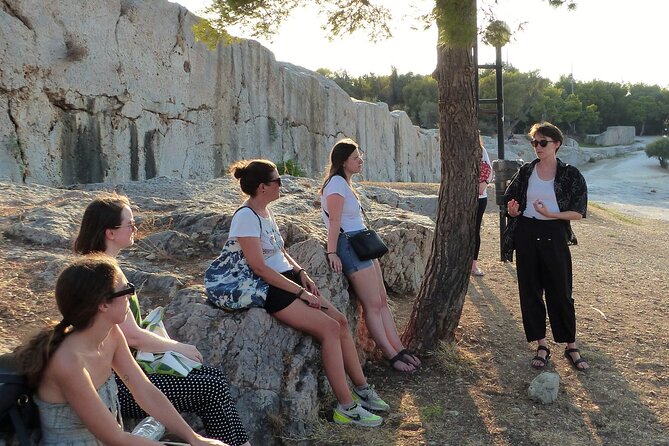
What I like most is the women-only lens. It’s not just Greek mythology as decoration; the tour links mythology to roles women were boxed into, and to the women who pushed back. The second big plus is the tight route: you pass key historic points in about two hours, so you get context without turning your day into a long slog.
One thing to consider: this is a walking tour, and it’s not recommended for travelers with mobility issues. If your pace is slow or you need frequent stops, you may find the route a bit much—especially in hot or humid weather.
In This Review
- Key Things to Know Before You Go
- Women-First Athens: What This 2-Hour Walk Really Shows
- Meeting on Monastiraki and Getting Oriented for the Stories
- Hadrian’s Library: Education for Girls and Women
- Marriage, Eros, and Athena Archegetis: Stops Where Society Shows Up
- Dioskouron and the Idea of a Festival Dedicated to Women
- Ancient Agora Views: Women in Public Space Without the Usual Crowds
- Areopagos Trials and Pnyx’s Male Democracy: When Women Break the Script
- Philopappos Hill Finish: Hill of the Muses and Acropolis Views
- Price, Group Size, and When to Book (Without the Guesswork)
- Who This Tour Suits Best (and Who Should Skip It)
- Should You Book This Women in Ancient Greece Tour?
- FAQ
- Where does the tour start and end?
- How long is the walking tour?
- How many people are in the group?
- Is the tour wheelchair or mobility friendly?
- What’s included for tickets and admissions?
- Do I need to print a ticket?
- Is the tour near public transportation?
- Are service animals allowed?
- What happens if weather is bad?
- What’s the cancellation policy?
Key Things to Know Before You Go

- Women’s daily life as the main storyline, not an add-on to a standard Athens highlights route
- Maelle’s storytelling style connects myth and society so the ideas actually make sense
- A small maximum of 12 people keeps the group feeling personal and question-friendly
- No entrance fee headaches: stops are marked free, and you won’t be entering the Agora archaeological site
- An end on Philopappos Hill gives you a strong finish with views toward the Acropolis
On foot through Plaka and beyond
- Acropolis and Parthenon Guided Walking Tour
★ 5.0 · 4,755 reviews - Greek Food Walking Tour in Athens
★ 5.0 · 4,740 reviews - Athens: Guided Greek Food Walking Tour with Tastings
★ 4.9 · 2,859 reviews - Acropolis monuments & Parthenon Walking Tour with Optional Acropolis Museum
★ 5.0 · 2,678 reviews
Women-First Athens: What This 2-Hour Walk Really Shows

This tour is basically a “missing piece” tour for Athens. You’ll still see famous landmarks in the city center, but the viewpoint changes. Instead of only asking who ruled, you ask who lived, learned, married, worked, and survived—plus which women managed to challenge the rules.
You also get the myth angle done in a useful way. Athena isn’t just a statue name; she becomes part of the conversation about identity and marriage expectations. Penelope and Pandora show up as cultural mirrors, while Sappho, Aspasia, and Agnodice help you understand how women could be known for intellect, teaching, and medicine even in a society that limited them.
If you’ve already done a classic “ancient Athens overview,” this walk helps you fill the gap. It gives you a different mental map of the city—one where women’s lives aren’t footnotes.
Meeting on Monastiraki and Getting Oriented for the Stories
You meet at Pl. Monastirakiou 2 in Athens (the Monastiraki area). It’s a central starting point, which matters because it helps you plug this tour into a normal sightseeing day instead of treating it like a separate expedition.
Monastiraki is also a good place to begin thinking about everyday life. Athens has layers—ancient foundations under modern streets—and starting here sets you up to follow the tour’s theme as you move from one historic pocket to another.
From the first moments, you’re not just collecting dates. You’re being coached to notice how each location fits into the bigger question: where did women belong, and where did they not?
Hadrian’s Library: Education for Girls and Women
One early stop is Hadrian’s Library, and the focus is education for girls and women in ancient Athens. This is a great choice because it tells you right away that ancient Greece isn’t one single story. Even within restrictive systems, there were channels for learning—and debates about what that learning meant.
Don’t expect a long lecture. You’ll get a focused segment that helps you understand education as power, not trivia. When you later hear about philosophy and medicine linked to women like Aspasia or Agnodice, this stop makes those stories feel grounded.
Practical note: since the tour keeps moving, come prepared with comfortable shoes and a mind ready for story-driven history.
Athens at walking pace, more routes
Marriage, Eros, and Athena Archegetis: Stops Where Society Shows Up

The middle of the walk leans into relationships and social rules, starting with the Holy Church of the All-Great Taxiarchs and the Virgin Mary Gregorousa. Here, the tour explores the meaning of marriage in ancient Athens and Sparta, and it connects that to Eros—the passionate kind of love. That pairing is smart. It helps you see that romance and social structure weren’t treated as separate topics.
Next comes the Gate of Athena Archegetis. This stop zeroes in on married life for women in Athens and Sparta, with myths tied to Athena. In other words, you’re learning how religious symbols and civic identity could shape personal life.
The best part of these stops is the way they translate culture into human stakes. You start recognizing patterns: where women were expected to belong, what love was allowed to mean, and how myth helped justify or critique those boundaries.
Dioskouron and the Idea of a Festival Dedicated to Women

You’ll then reach Dioskouron, tied to a mysterious ancient festival dedicated exclusively to women. A women-only festival is a powerful concept in a city where public life was generally controlled by men. Even if the details can feel “mysterious” (as this description suggests), that uncertainty still teaches you something.
It shows you that women weren’t simply absent from ritual life. They had spaces where their presence mattered, even if their power looked different than what you’d see in political institutions.
This stop also works as a mental reset. After marriage and social expectations, the festival theme broadens the story. It reminds you that women’s lives included community events, shared meaning, and cultural identity—not only restrictions.
Ancient Agora Views: Women in Public Space Without the Usual Crowds
One of the most useful stops is the Ancient Agora of Athens area. The tour frames the Agora as the marketplace and center of public life, then asks what women’s roles looked like in that kind of setting.
A key detail: there’s no entrance into the archaeological site, and you’ll see it from outside. That means you avoid extra ticketing time and you also avoid getting stuck inside when the goal is story flow.
Even from the outside, the Agora helps you understand the contrast. You hear about the role of women in public space and the lives of female slaves or courtesans in the city. That’s heavy material, but it’s also the point: if you only look at temples and speeches, you miss how most people experienced society day to day.
I like this approach because it keeps your attention on what the space represents. The city layout becomes evidence.
Areopagos Trials and Pnyx’s Male Democracy: When Women Break the Script

The tour moves to Areopago, a place associated with trials in ancient times. Here, the conversation turns to the worst sinners being judged—then shifts to an inspiring angle: the story of a woman who risked a death sentence to change women’s rights.
That pivot matters. It tells you that women’s history isn’t only about suffering and limitation. It includes resistance, advocacy, and consequences. It also prepares you for the final political lens in the next stop.
Then you reach Pnyx, the place where democracy began. The tour highlights that only male citizens voted. That’s not surprising on paper, but it’s a big deal in real understanding because it forces you to picture what “democracy” meant in practice.
Against that backdrop, the tour explains how a woman influenced politics during Athens’ Golden Age. The specific name isn’t provided in the tour description, but the message is still clear: political impact didn’t require a vote. It required influence—and women could and did have it, even when formal authority was blocked.
Philopappos Hill Finish: Hill of the Muses and Acropolis Views

The walk ends at Philopappos Hill (near Φυλής 215), described as the hill of the Muses. This is a strong way to close because it shifts from arguments and restrictions into inspiration and continuity.
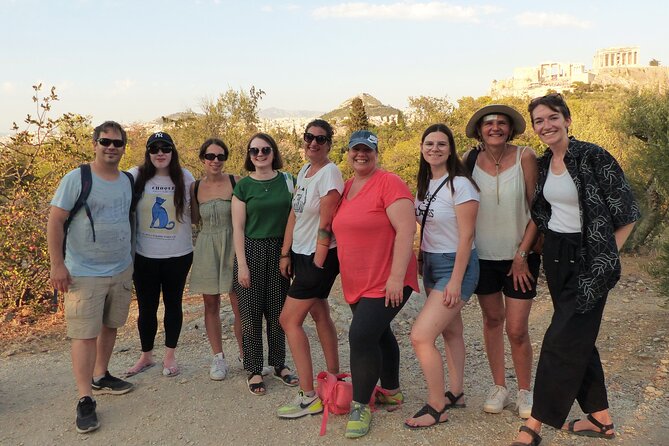
You also get the payoff view. The tour finishes with a viewpoint on the Acropolis, and reviews specifically mention that the end feels relaxed under the trees with a great view. If you want an ending that makes your photos look good without having to hunt for a separate viewpoint later, this is it.
Think of it as the “exhale” moment after a history session that could otherwise feel intense.
Price, Group Size, and When to Book (Without the Guesswork)
At $44.71 per person for about two hours, this is priced in the range where you should ask: what exactly am I buying? You’re not paying for a long checklist of sites. You’re paying for a focused theme you can’t easily replicate on your own—especially if you want the stories tied to real Athenean street locations.
The maximum of 12 travelers is part of the value. A smaller group usually means the guide can keep the pacing tight and answer questions without turning it into a tour bus lecture. That kind of attention matters even more on a topic like women’s history, where nuance and context are the whole point.
You’ll also see group discounts mentioned, and the tour uses a mobile ticket, which is convenient. Another useful detail: the tour is listed as booked about 37 days in advance on average, which suggests it often fills up in planning-friendly windows. If your Athens trip dates are fixed, it’s smart to book earlier rather than treating this as optional.
Weather also matters here. The tour requires good weather, and if conditions are poor, you’ll be offered another date or a full refund.
Who This Tour Suits Best (and Who Should Skip It)
This tour is a great fit if you want Athens history with a different center of gravity. I think you’ll enjoy it most if you like turning ideas into real places. It’s also ideal if you’ve done the classic highlights already and you want the missing layer: women’s education, marriage expectations, public roles, and the mythology that shaped social thinking.
It’s also a strong choice for anyone who likes discussion and questions. Reviews point to a guide like Maelle who keeps the tone kind, inclusive, and funny—so the content lands without feeling preachy or stiff.
Skip it if mobility is a problem. It’s not recommended for travelers with mobility issues, and it’s a walking route through central Athens. Also, if you hate “story-first” tours and only want monuments, you might find the theme heavy at times. This walk is built to make you think.
Should You Book This Women in Ancient Greece Tour?
I’d book it if you want Athens to feel more human and less one-dimensional. The women-focused lens is rare, and the route is tight enough to work even if you have limited time. If you’re the type who enjoys history when it answers questions about everyday life—who could learn, who could speak up, who could love, who could survive—this tour gives you exactly that.
I’d hesitate only if walking is difficult for you, or if you’re trying to keep your day very light and easy. For most people doing a first or second Athens trip, this is a smart use of two hours.
If your goal is to understand ancient Greece as a real society (with real limits and real people making choices), this tour is worth it.
FAQ
Where does the tour start and end?
The tour starts at Pl. Monastirakiou 2, Athina 105 55, Greece, and it ends at Philopappos Hill (Φυλής 215, Athina 117 41, Greece).
How long is the walking tour?
It lasts about 2 hours.
How many people are in the group?
The tour has a maximum of 12 travelers.
Is the tour wheelchair or mobility friendly?
It is not recommended for travelers with mobility issues.
What’s included for tickets and admissions?
Stops are listed as free admission tickets, and the Ancient Agora stop is described as no entrance to the archaeological site, with viewing from outside.
Do I need to print a ticket?
No. The tour uses a mobile ticket.
Is the tour near public transportation?
Yes, it’s near public transportation.
Are service animals allowed?
Yes, service animals are allowed.
What happens if weather is bad?
This experience requires good weather. If it’s canceled due to poor weather, you’ll be offered a different date or a full refund.
What’s the cancellation policy?
You can cancel for free up to 24 hours in advance for a full refund.
More Tours in Athens
- Athens: Acropolis, Parthenon & Acropolis Museum Guided Tour★ 4.8 · 9,316 reviews
- The Acropolis, Parthenon & Acropolis Museum Guided Tour★ 4.7 · 8,493 reviews
- Acropolis: Premium Acropolis and Parthenon Guided Tour★ 4.8 · 5,208 reviews
- Athens: Mythology of Delphi, Museum and Arachova Guided Tour★ 4.7 · 5,102 reviews
- Acropolis and Parthenon Guided Walking Tour★ 5.0 · 4,755 reviews
- Greek Food Walking Tour in Athens★ 5.0 · 4,740 reviews
More Tour Reviews in Athens
- Athens: Acropolis & up to 5 Archaeological Sites Combo Pass★ 4.2 · 13,904 reviews
- Athens: Acropolis, Parthenon & Acropolis Museum Guided Tour★ 4.8 · 9,316 reviews
- The Acropolis, Parthenon & Acropolis Museum Guided Tour★ 4.7 · 8,493 reviews
- Athens: Cape Sounion & Poseidon Temple Sunset Half-Day Trip★ 4.8 · 8,241 reviews
- Acropolis: Premium Acropolis and Parthenon Guided Tour★ 4.8 · 5,208 reviews
- Athens: Mythology of Delphi, Museum and Arachova Guided Tour★ 4.7 · 5,102 reviews
Athens on Foot, Continued
- Acropolis and Parthenon Guided Walking Tour★ 5.0 · 4,755 reviews
- Greek Food Walking Tour in Athens★ 5.0 · 4,740 reviews
- Athens: Guided Greek Food Walking Tour with Tastings★ 4.9 · 2,859 reviews
- Acropolis monuments & Parthenon Walking Tour with Optional Acropolis Museum★ 5.0 · 2,678 reviews
- Athens Acropolis and Parthenon Walking Tour★ 4.5 · 1,355 reviews
- Acropolis, Parthenon & Athens Old City Heritage Walking Tour★ 4.5 · 876 reviews
Fresh Off the Boat: New Athens Reviews





Athens Walking Tours, compared.
 ★ 5.0Acropolis and Parthenon Guided Walking TourFrom $414,755 reviews
 ★ 5.0Greek Food Walking Tour in AthensFrom $874,740 reviews
 ★ 4.9Guided Greek Food Walking Tour with TastingsFrom $812,859 reviews
 ★ 5.0Acropolis monuments & Parthenon Walking Tour with Optional Acropolis MuseumFrom $422,678 reviews
 ★ 4.5Athens Acropolis and Parthenon Walking TourFrom $411,355 reviews
 ★ 4.5Acropolis, Parthenon & Athens Old City Heritage Walking TourFrom $34876 reviews
 ★ 5.0Athens Authentic Greek Food Walking Tour (Small Group)From $83809 reviews
 ★ 4.9Ultimate Food Walking Tour with 15 TastingsFrom $93567 reviews
Browse the lists this tour appears in