
Reviewed · ANCIENT AGORA TOURS
Ancient Agora of Athens: A Self-Guided Audio Tour
GPS audio in Athens beats a rushed tour. This self-guided audio walk helps you move through the Ancient Agora’s ruins at your own pace, with stop-by-stop stories that connect everyday life to gods, philosophers, and big-name Roman connections—guided by local tour producer Christina Karantanis.
I also like the offline setup: your audio, maps, and geodata can work without roaming, and you can replay it around your dates. The only real drawback is that this is not an admission ticket—it doesn’t include entry to the Ancient Agora or other sites, so you’ll want to confirm opening hours and any fees before you go.
In This Review
- Key things to know before you start
- What you’re really buying: a guided walk, not Agora entry
- Start and finish: where the walk begins (and where you land)
- How VoiceMap works on the ground (and how to avoid app headaches)
- Stop-by-stop: how the route tells the Agora story
- Ancient Agora of Athens: the core setting where public life happened
- Panathenaic Way: a festival route honoring Athena
- Odeon: Roman-era building with an Augustan family link
- Temple of Ares: 5th-century worship context
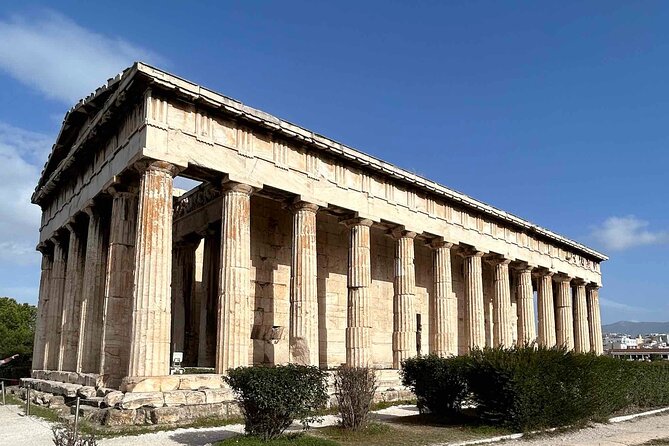
- Hephaestus: the blacksmith of the gods
- What to expect from the timing (and how to pace yourself)
- Price and value: $11.99 for a reusable Athens mini-course
- Who this is best for (and who might want something else)
- A real-world comfort tip: plan for a shaded pause
- Quick practicals you shouldn’t skip
- Should you book this audio walk?
- FAQ
- Is admission to the Ancient Agora included
- How long is the Ancient Agora audio tour
- What do I need to use the tour
- Does the tour work offline
- Where do I start and where do I finish
- Can I cancel and get a refund
Key things to know before you start
- VoiceMap GPS turn-by-turn keeps you oriented without a paper map
- Offline audio + offline maps helps when signal gets spotty
- Christina Karantanis’ local narration gives the story a lived-in Athens feel
- Lifetime access plus replays around your booking date (and even at home via virtual tour)
- No admission included means you must plan tickets separately
- Short walk, flexible pacing (about 45 minutes to 1 hour, depending on how long you linger)
Down where the old city met and traded
- Athens Half Day Tour, Acropolis, Parthenon, Temple of Olympian Zeus & Hephaistus
★ 5.0 · 609 reviews - Athens: Agora and Hephaistos Temple Entrance Ticket
★ 4.0 · 449 reviews - Athens: Ancient Agora E-Ticket and Audio Tour
★ 3.9 · 413 reviews - Athens: Roman Agora & Ancient Agora E-ticket & 2 Audio Tours
★ 4.1 · 107 reviews
What you’re really buying: a guided walk, not Agora entry
This experience is an audio walking route around Athens’s Ancient Agora area, with GPS playback through the VoiceMap app. It’s designed to be simple: you put in your code, follow the on-screen directions, and press play when you arrive.
Two things make this feel good for real travel. First, it’s self-paced, so you can pause for photos, read plaques if there are any, or just stand in the shade without feeling like you’re holding up a group. Second, the narration ties locations to stories you’ll recognize—Athena’s festival, Roman-era building, and mythic figures linked to worship and craft.
The catch is also important: this audio walk does not include admission to the Ancient Agora. If you want to go inside areas that require paid entry (and there are often ticketed sections at major archaeological sites), you’ll need to handle that separately. That means checking online for opening times and any entrance fees before you rely on the audio route.
Start and finish: where the walk begins (and where you land)
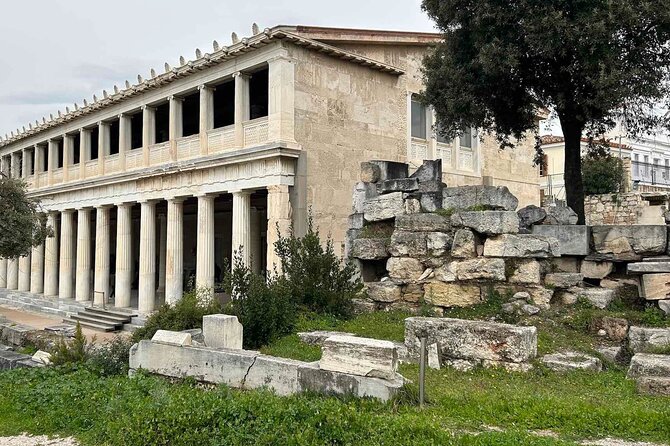
You start at Efcharis restaurant, Adrianou 49A, Athina 105 55. From there, the route guides you through the Agora-adjacent streets and key sight points until you finish at Stoa Attalou, Adrianou 24, Athina 105 55.
That start-to-finish structure is useful because it reduces backtracking. You can treat the day like a simple loop: arrive in the area, walk through with headphones on, then exit near Stoa Attalou, which is a natural hub for continuing on to other sights.
If you’re using transit, maps tend to be easier once you know your exact start address. I’d treat the meeting point as your anchor and let the app handle the tiny turns.
How VoiceMap works on the ground (and how to avoid app headaches)
Once you book, you receive a ticket with instructions and a unique code listed under Before You Go. Then you install the VoiceMap app on Android or iOS, enter the code, and use the in-app GPS directions to reach the starting point.
When you’re there, you put on your headphones and tap start. VoiceMap’s system uses automatic GPS playback, so you don’t need to manually press play at each step. It also supports offline use, which matters in Athens where you can hit dead zones between ruins, narrow streets, and stone walls.
One practical tip from a reported problem: before you commit to the walk, double-check that you received the code email and can enter it in the app. In one case, downloading failed and the traveler ended up paying twice; the response indicated an 8-digit code was emailed with instructions. If that ever happens to you, contact the provider at [email protected] or request help through your booking channel.
More days made easy with a guide


Stop-by-stop: how the route tells the Agora story
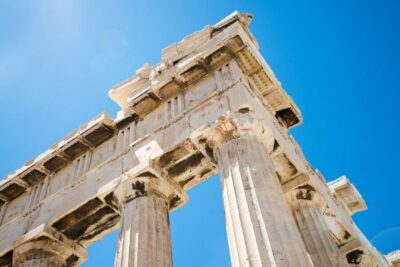
Think of this route as a chain of quick scenes. Each location is a prompt to look differently: not just at stones, but at how people gathered, traded, worshiped, and celebrated. The walk is short, so the goal is not to “cover everything,” but to give you a mental map and a few memorable story threads.
Ancient Agora of Athens: the core setting where public life happened
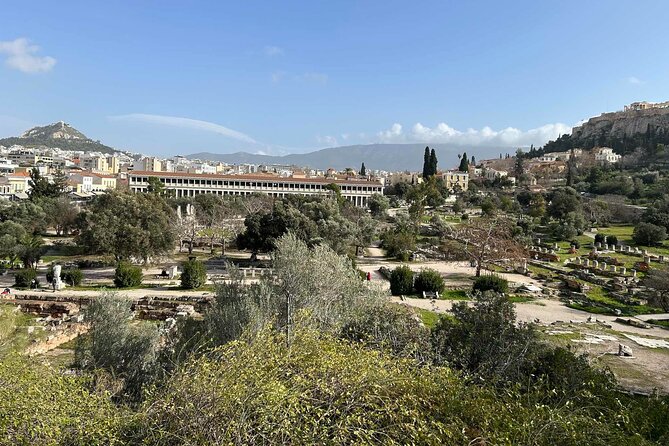
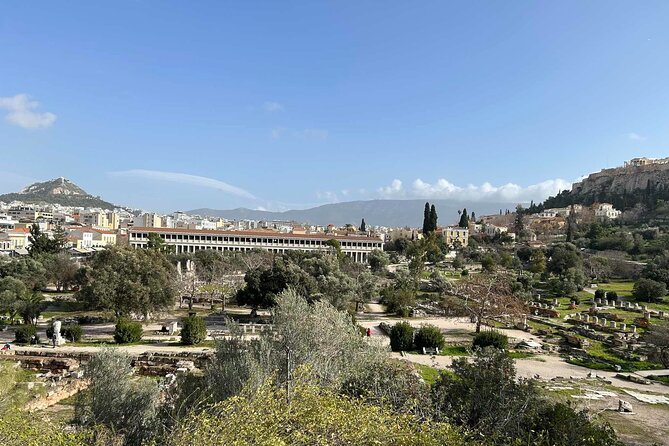
The tour begins at the Ancient Agora itself. This is where the audio frames the space as Athens’s ancient heart—something more human than a museum floor. You’ll hear about merchants, philosophers, and gods sharing the same social stage, which helps you connect what you see with what those people were doing.
A good way to use this first segment is to look for everyday patterns: sightlines, gathering spots, and how the space would have funneled people through. Even if you only catch a handful of structures clearly, the narration helps your brain place them in the bigger civic story.
Practical note: this is a walk, so plan a comfortable pace from the beginning. If you like to pause often, expect closer to an hour than 45 minutes.
Panathenaic Way: a festival route honoring Athena
As you pass along the Panathenaic Way, the audio switches from civic everyday life to ceremony. You’ll hear about the annual festival held every year in honor of Goddess Athena.
Why this matters: festivals were not just parties. They were public theater for identity—religion mixed with politics and pride. When you hear this part of the story while looking at the route, you start imagining a crowd moving through the city with a shared purpose.
If you’re a photo person, this is a good stretch to slow down. Even without a perfect viewpoint, you’ll have a better reason to frame what you’re seeing with the festival in mind.
Odeon: Roman-era building with an Augustan family link
Next, you’ll pass by the Odeon, and the narration explains how it was built by the son-in-law of Roman emperor Augustus as a gift to the Athenians.
That detail is the payoff for a short audio route. The Agora zone isn’t frozen in one era—Athens absorbed Roman influence too, and structures like these show how old civic spaces kept getting repurposed and reinterpreted.
As you listen, watch for cues in the surroundings that suggest performance or gathering spaces. The Odeon story is best used with your eyes open: think about acoustics, crowds, and how a gift could become a lasting part of public life.
Temple of Ares: 5th-century worship context
While passing the Temple of Ares, you’ll hear about worship in the 5th century. This segment leans into religious function—how sacred space shaped what people believed mattered in daily life.
A temple story works well with ruins, because you can’t always see the full building the way it once looked. The audio helps you rebuild the scene: where worship likely took place, how the temple fit civic patterns, and why people would have cared about that specific site.
I’d treat this stop as your “look longer” moment. Even a brief extra minute can make the difference between seeing stones and understanding what they were for.
Hephaestus: the blacksmith of the gods
Another temple segment focuses on Hephaestus, the blacksmith of the gods. If you’re the kind of traveler who likes myth connections you can actually remember, this is a great place to anchor one character and let the rest of the area snap into place.
Hephaestus is a smart choice for a route like this because he connects craft, work, and creation—ideas that fit naturally with the Agora as a place where people traded skills and goods. The audio helps you see how myths weren’t distant stories; they were part of how Greeks explained the world they lived in.
If you want an easy win: after this stop, try to summarize the place in your head in one sentence. Doing that once makes the next sights feel less random.
What to expect from the timing (and how to pace yourself)

The tour is designed for 45 minutes to 1 hour. That range is honest. If you walk fast through, you’ll land near the shorter end. If you stop for photos, read any on-site interpretive signs you find, or listen to certain segments twice, you’ll likely use the full hour.
Because it’s GPS-based, you don’t need to constantly check your phone screen. Still, if you’re juggling a map view and headphones, you may walk slower than you expect.
Also remember: there’s no “official guide group” to herd you along. That’s the whole point. It’s also why you should keep a light watch on where you are—especially if streets look similar. Let the app guide you, then let your eyes confirm you’re in the right zone.
Price and value: $11.99 for a reusable Athens mini-course
At $11.99 per person, this is priced like a budget-friendly add-on that turns a normal walk into something you can learn from. You’re paying for a voice narrative, GPS playback, and a built-in way to connect dots across several stops.
Here’s where the value gets real: you get lifetime access to the tour in English, plus unlimited use before your booking date and after it. That means if your first attempt gets disrupted by weather, crowds, or a late dinner, you can rerun it later without buying again.
And the offline piece is not a small detail. If your phone struggles with signal, an offline route keeps you from getting stuck with silence and a blank map. Add in the option for a virtual tour at home, and you can even preview the route before you ever step outside.
The main value tradeoff is scope. Because admission is not included, you may still spend extra time or money if you choose to enter ticketed archaeological areas. But the audio walk itself is a solid way to get context while staying flexible.
Who this is best for (and who might want something else)
This works especially well if you like structure without a tour group. You’ll probably enjoy it if you’re comfortable walking and using your phone with headphones for navigation.
It’s also a good fit if you want myth and history tied to actual places in a short window. Instead of reading a long guidebook, you can follow the story as you move.
You might want a different setup if you’re hoping for a single ticket that covers admission fees for the Agora itself. This audio walk is context first. You provide the entry ticket decisions.
A real-world comfort tip: plan for a shaded pause
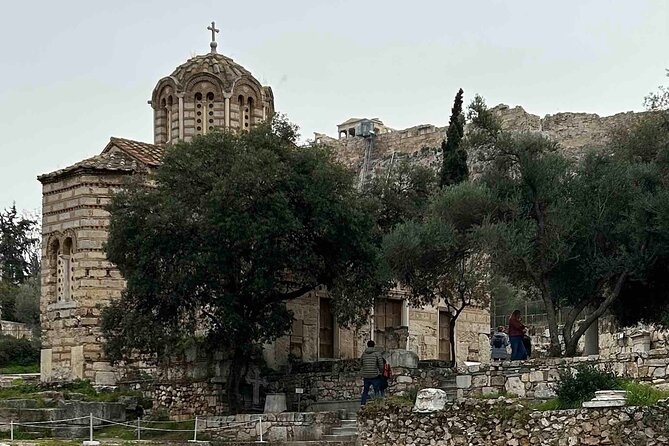
One review mentioned a little shady spot to sit down and rest between seeing statues and ruins. I’d treat that as a gentle hint rather than a promise: in this part of Athens, midday shade can be your best friend. If you can, schedule your walk for earlier in the day or be ready to slow down when the sun gets strong.
Even five minutes of rest can make the difference between rushing through ruins and actually enjoying them.
Quick practicals you shouldn’t skip
You’ll want your own smartphone and headphones. The tour does not include them.
The description also says most travelers can participate, but it’s still an outdoor walking route with an archaeological environment. Bring water if you’re out in warm weather, and wear shoes you can trust on uneven ground.
If you’re traveling with friends, note that the experience is marked as private for your group. Since it’s self-guided, that mainly affects how you think about booking, not a live guide meeting.
Should you book this audio walk?
Yes, if you want an easy, affordable way to understand the Ancient Agora area without committing to a tour group. The best reasons to book are offline audio, GPS guidance, and narration credited to local producer Christina Karantanis, which helps you turn a short walk into a set of clear mental stories.
Skip it or pair it thoughtfully if your priority is simply access and entry into ticketed spaces. This one is about learning as you walk, not buying admission.
If you do book, plan one small safety net: confirm your code email and test the app download before you head out. That one step can save you from the kind of app trouble that derailed at least one traveler’s day.
FAQ
Is admission to the Ancient Agora included
No. This self-guided audio walk does not include entry to the Agora or tickets to other attractions en route. You’ll need to check opening hours and any entry fees separately.
How long is the Ancient Agora audio tour
The route is designed for about 45 minutes to 1 hour, depending on how long you pause at stops.
What do I need to use the tour
You need the VoiceMap app on your Android or iOS device, plus your own smartphone and headphones. The audio can be used with offline access.
Does the tour work offline
Yes. Offline access is included for audio, maps, and geodata.
Where do I start and where do I finish
You start at Efcharis restaurant on Adrianou 49A, Athens, and the route ends at Stoa Attalou on Adrianou 24, Athens.
Can I cancel and get a refund
This experience is listed as non-refundable and cannot be changed for any reason.
More Tours in Athens
- Athens: Acropolis, Parthenon & Acropolis Museum Guided Tour★ 4.8 · 9,316 reviews
- The Acropolis, Parthenon & Acropolis Museum Guided Tour★ 4.7 · 8,493 reviews
- Acropolis: Premium Acropolis and Parthenon Guided Tour★ 4.8 · 5,208 reviews
- Athens: Mythology of Delphi, Museum and Arachova Guided Tour★ 4.7 · 5,102 reviews
- Acropolis and Parthenon Guided Walking Tour★ 5.0 · 4,755 reviews
- Greek Food Walking Tour in Athens★ 5.0 · 4,740 reviews
More Tour Reviews in Athens
- Athens: Acropolis & up to 5 Archaeological Sites Combo Pass★ 4.2 · 13,904 reviews
- Athens: Acropolis, Parthenon & Acropolis Museum Guided Tour★ 4.8 · 9,316 reviews
- The Acropolis, Parthenon & Acropolis Museum Guided Tour★ 4.7 · 8,493 reviews
- Athens: Cape Sounion & Poseidon Temple Sunset Half-Day Trip★ 4.8 · 8,241 reviews
- Acropolis: Premium Acropolis and Parthenon Guided Tour★ 4.8 · 5,208 reviews
- Athens: Mythology of Delphi, Museum and Arachova Guided Tour★ 4.7 · 5,102 reviews
More Hours in the Ancient Agora
- Athens Half Day Tour, Acropolis, Parthenon, Temple of Olympian Zeus & Hephaistus★ 5.0 · 609 reviews
- Athens: Agora and Hephaistos Temple Entrance Ticket★ 4.0 · 449 reviews
- Athens: Ancient Agora E-Ticket and Audio Tour★ 3.9 · 413 reviews
- Athens: Roman Agora & Ancient Agora E-ticket & 2 Audio Tours★ 4.1 · 107 reviews
- Acropolis & Ancient Agora Guided tour included all Entrances★ 4.9 · 102 reviews
- Ancient Athens Segway Tour with Agora and Kerameikos★ 5.0 · 94 reviews
Fresh Off the Boat: New Athens Reviews





Ancient Agora Tours, compared.
 ★ 5.0Athens Half Day Tour, Acropolis, Parthenon, Temple of Olympian Zeus & HephaistusFrom $314609 reviews
 ★ 4.0Agora and Hephaistos Temple Entrance TicketFrom $30449 reviews
 ★ 3.9Ancient Agora E-Ticket and Audio TourFrom $30413 reviews
 ★ 4.1Roman Agora & Ancient Agora E-ticket & 2 Audio ToursFrom $51107 reviews
 ★ 4.9Acropolis & Ancient Agora Guided tour included all EntrancesFrom $126102 reviews
 ★ 5.0Ancient Athens Segway Tour with Agora and KerameikosFrom $8394 reviews
 ★ 5.0Acropolis of Athens, Ancient Agora and the Agora Museum TourFrom $6786 reviews
 ★ 3.9Ancient Agora Self-Guided Tour with 3D & Audio (No Ticket)From $859 reviews
Browse the lists this tour appears in