

Reviewed · ANCIENT AGORA TOURS
Ancient Agora of Athens E-Ticket and Audio Tour
Democracy, minus the waiting. The time-slotted e-ticket helps you enter faster, and the visit begins at the Stoa of Attalos so you start with a clear landmark.
You’ll like that admission is included, paired with a self-guided experience that lets you control your pace instead of syncing to a group.
The real win is the offline audio tour plus an offline interactive map, built for a place where mobile signal can be weak.
You’ll also appreciate the practical prep: download the e-ticket and audio before you go to avoid roaming charges and spotty reception.
One caution: there’s no live guide, so if you get turned around by the site layout, it’s on you to follow the audio and map.
Also, the visit runs on a specific time window, and entry can still involve some waiting depending on what’s happening at the entrance.
In This Review
- Key points before you go
- Ancient Agora of Athens, in practical terms: what you’re really buying
- Fast-track entry and time slots: helpful, but plan for friction
- Starting at Stoa of Attalos: why that meeting point helps
- The offline audio tour: your best friend when signal fails
- What you’ll learn at the Agora: Socrates and Pericles, made concrete
- How to navigate the ruins without a live guide
- Time planning: 1 to 2 hours is realistic (if you don’t overthink it)
- Group size and what it feels like on the ground
- Cost and value: where $41.91 makes sense
- Who should book this Agora audio-e-ticket?
- Should you book it?
- FAQ
- What does the ticket include?
- How long does the visit take?
- Where does the visit start?
- Do I need headphones and my own phone?
- Will it work offline in the archaeological site?
- Can I cancel or change my booking?
Key points before you go
- Time-slotted e-ticket to cut down waiting, especially in peak season
- Offline audio tour + offline interactive map so you’re not stuck with roaming data
- Socrates, Pericles, and other key figures are woven into the route through the Agora
- You set the pace, since there’s no live guide walking you through each stop
- Smartphone-only experience with specific compatibility limits and an app size you must plan for
Down where the old city met and traded
- Athens Half Day Tour, Acropolis, Parthenon, Temple of Olympian Zeus & Hephaistus
★ 5.0 · 609 reviews - Athens: Agora and Hephaistos Temple Entrance Ticket
★ 4.0 · 449 reviews - Athens: Ancient Agora E-Ticket and Audio Tour
★ 3.9 · 413 reviews - Athens: Roman Agora & Ancient Agora E-ticket & 2 Audio Tours
★ 4.1 · 107 reviews
Ancient Agora of Athens, in practical terms: what you’re really buying

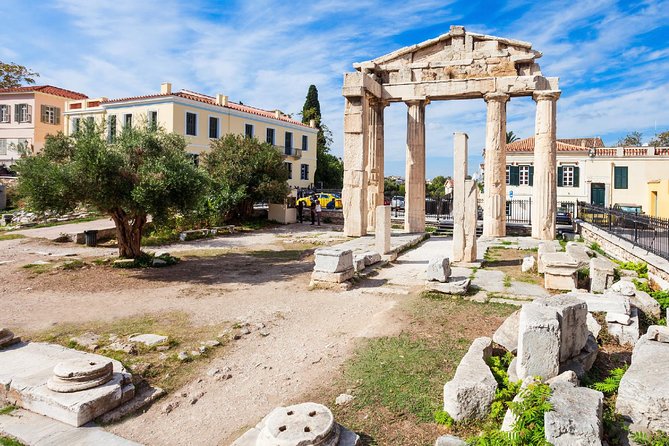
The Ancient Agora is where political Athens happened—courts, speeches, everyday commerce, and big ideas about citizenship and democracy. This ticket package is designed for one thing: getting you inside without wrestling queues, then letting you explore at your own speed while an audio guide does the talking.
You’re paying not only for admission, but for the convenience layer around it: the time slot, the pre-arranged entry flow, and the self-guided audio setup. If you like to wander, pause, and re-check what you just heard, that combo tends to feel like good value.
You should also expect a self-guided experience, not a guided lecture. The site is spread out and full of uneven ground, so comfort and navigation matter more than with a live guide.
Fast-track entry and time slots: helpful, but plan for friction
This is a skip-the-line style e-ticket with a selected time slot. In peak season, that matters. Getting inside faster means you can spend more time reading stones and less time standing still.
That said, the guidance is clear that long queues can still happen at the entrance. So think of it as “better odds of faster entry,” not instant entry no matter what.
Time windows are also not subtle. Your booking is served for the time you pick, and the experience provider notes that requests made between 5:00 pm and 8:59 am are served the next morning from 9:00 am. If you’re trying to match multiple timed sights in Athens, build in buffer time so you’re not stressed.
Practical tip: arrive a bit early for your time slot. Archaeological sites can have shifting entry points due to maintenance, security checks, and crowd flow.
Starting at Stoa of Attalos: why that meeting point helps
Your start point is Stoa of Attalos – Museum of the Ancient Agora, Adrianou 24, Athina 105 55, Greece. That’s not just an address—it’s your first anchor in an area where it’s easy to feel like you’re walking through “ruins” without a mental map.
The Stoa area is a strong orientation choice because it’s tied to the Agora complex and gives you a real reference point before you start following the audio route.
One more thing: the audio tour may begin at an entrance gate that doesn’t always match what you see day-of, especially if there’s maintenance going on. If you show up and the gate you expected looks closed, don’t panic. Use the offline map in the app to find the correct path and keep moving.
Worth comparing before you book this Athens tour:


The offline audio tour: your best friend when signal fails

This package includes a self-guided audio tour for your smartphone—Android and iOS are supported. The content is designed for offline use, with an offline interactive map, which is the right strategy in Athens where internet access might be unavailable and mobile signal may be weak inside the archaeological site.
Before you go, you’re advised to download everything ahead of time: the e-ticket, the mobile app, and the audio tour content. Doing it at home (or on hotel Wi‑Fi) is the difference between a smooth start and a frustrating dead-end when data doesn’t load.
Storage matters too. The required size for the app & tour is listed at 100–150 MB, so check your phone space before you leave. If you’re traveling with a low-storage device, download early and clear a little room.
You’ll also want your own headphones. Headphones are not included, but using them is strongly recommended so you can focus on the audio without competing with site noise.
What you’ll learn at the Agora: Socrates and Pericles, made concrete

The Agora can feel abstract if you only see stones. The audio guide is meant to turn those stones into a place where real conversations happened.
You’ll hear about:
- Socrates, tied to the area where he taught
- The rise of democracy in ancient Athens
- Pericles, mentioned as a key political figure
- Other personalities like an orator and general, connected to the Agora’s public life
Instead of just “here’s a column,” the guide tries to help you understand what the place was used for—speech-making, civic action, and public decision-making.
Also, this kind of self-paced audio is helpful because the Agora has moments that reward slowing down. You can pause, replay, or move on when you feel like it, rather than being rushed by a group schedule.
How to navigate the ruins without a live guide
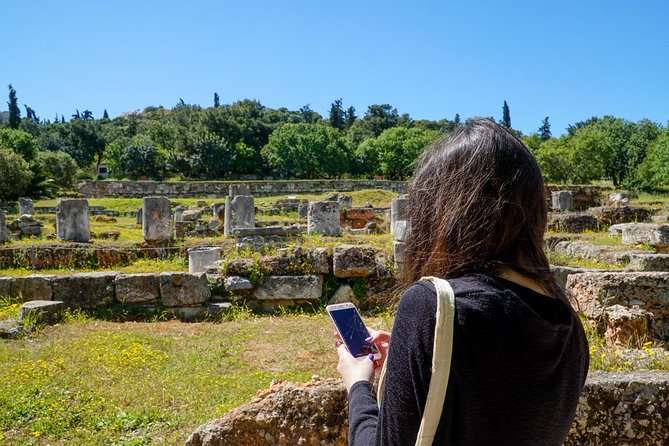
Since there’s no live guide included, your navigation method is: audio + offline map. That’s totally fine, but you should use the tool the way it’s intended.
Here’s how to set yourself up:
- Use the offline interactive map early, before you drift too far.
- Follow the audio sequence, but if something feels confusing, stop for a minute and re-orient with the map.
- If you’re short on time, focus on the main stops described in the guide instead of trying to see every fragment of wall.
A downside of self-guided sites is that ruins don’t always look “obvious.” Some structures can be hard to distinguish from each other at a glance, so the audio helps you identify what you’re looking at and why it mattered.
Also, plan for walking comfort. The visit advises comfortable shoes and hot-weather basics like sunscreen and a hat during warmer months.
Time planning: 1 to 2 hours is realistic (if you don’t overthink it)
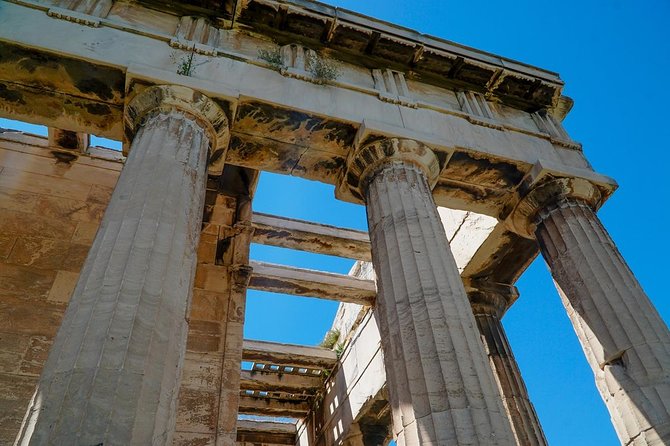
The experience duration is listed as 1 to 2 hours. For this kind of site, that’s a good window for a meaningful audio walk without turning it into a marathon.
If you like details, you might stretch toward 2 hours, especially if you replay sections or stop to read surrounding signage. If you want the highlights and you’re good at moving, 1 hour can still cover the key ideas the audio is aiming to deliver.
Just remember the strictness of time slots. It’s not a “wander in whenever” situation, so treat your start time like an appointment.
Group size and what it feels like on the ground
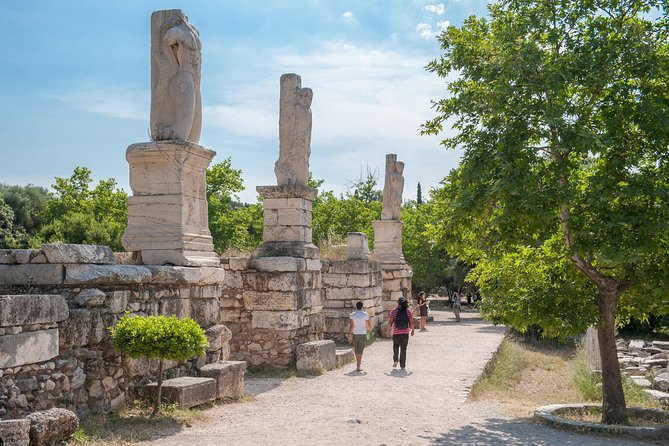
This activity has a maximum of 15 travelers. That limit matters because it supports a smoother check-in and less crowding around the starting area.
But your experience is still self-guided. Even with a small group limit, you won’t have someone leading you from stop to stop. Think of it as: you get the door opened smoothly, then you explore independently.
If you prefer a human explanation—stories, context, and quick answers—this might feel thinner than a live tour. If you’re the type who enjoys learning in your own rhythm, it’s a strong format.
Cost and value: where $41.91 makes sense
At $41.91 per person, you’re paying for three things bundled together:
- the entrance fee/adult ticket
- a time-slotted ticket service
- the self-guided offline audio tour with an offline interactive map
If you were buying admission anyway, the question becomes: is the offline audio and streamlined entry worth the difference versus doing admission on your own? For many visitors, it is—especially if you want fewer delays and better phone-friendly navigation in a site where signal can be unreliable.
If you already know the Agora well, don’t want audio, and can tolerate queues, this may feel less cost-efficient. But if you want structure without a live guide—and you’re bringing a smartphone—you’re paying for convenience and learning support.
Who should book this Agora audio-e-ticket?
I think this setup fits best if you:
- want skip-the-line entry with a time slot
- prefer to explore at your own pace
- like audio learning and planning to use offline maps
- don’t want to pay for a live guide
It may be less ideal if you:
- strongly prefer a live guide to explain layout and answer questions on the spot
- need an accessibility-friendly human-led navigation system (this option is smartphone-driven)
- are traveling with an unsupported device (Windows Phone and several older Apple models are not compatible)
Should you book it?
I’d book it if you’re the kind of visitor who likes structure but not crowds—arrive, enter, put on your headphones, and let the audio help you connect Socrates, Pericles, and democracy to the stones in front of you.
Skip it and choose a live guide instead if you know you’ll struggle without someone physically pointing out what matters. Also consider skipping if you’re traveling with a device that won’t work with the audio tour, because the whole experience depends on downloading and offline playback.
If you do book, the smartest move is preparation: download the audio and map at home, carry headphones, and give yourself time to get oriented at the Stoa of Attalos.
FAQ
What does the ticket include?
It includes the entrance fee/adult ticket for the Ancient Agora, a time-slotted ticket service, and a self-guided audio tour for your smartphone (Android & iOS). The tour also comes with offline content and an offline interactive map.
How long does the visit take?
The experience duration is listed as 1 to 2 hours (approx.).
Where does the visit start?
You start at Stoa of Attalos – Museum of the Ancient Agora, Adrianou 24, Athina 105 55, Greece. The activity ends back at the meeting point.
Do I need headphones and my own phone?
You need an Android or iOS smartphone. Headphones are not included, so plan to bring your own.
Will it work offline in the archaeological site?
Yes. You’re advised to download your e-ticket, the app, and the audio tour before your visit. The tour provides offline content plus an offline interactive map, since internet access might be unavailable and mobile signal can be weak on site.
Can I cancel or change my booking?
No. The experience is non-refundable and cannot be changed for any reason.
If you tell me your travel month and what phones you’ll have, I can help you sanity-check the download timing and storage needs before you go.
More Tours in Athens
- Athens: Acropolis, Parthenon & Acropolis Museum Guided Tour★ 4.8 · 9,316 reviews
- The Acropolis, Parthenon & Acropolis Museum Guided Tour★ 4.7 · 8,493 reviews
- Acropolis: Premium Acropolis and Parthenon Guided Tour★ 4.8 · 5,208 reviews
- Athens: Mythology of Delphi, Museum and Arachova Guided Tour★ 4.7 · 5,102 reviews
- Acropolis and Parthenon Guided Walking Tour★ 5.0 · 4,755 reviews
- Greek Food Walking Tour in Athens★ 5.0 · 4,740 reviews
More Tour Reviews in Athens
- Athens: Acropolis & up to 5 Archaeological Sites Combo Pass★ 4.2 · 13,904 reviews
- Athens: Acropolis, Parthenon & Acropolis Museum Guided Tour★ 4.8 · 9,316 reviews
- The Acropolis, Parthenon & Acropolis Museum Guided Tour★ 4.7 · 8,493 reviews
- Athens: Cape Sounion & Poseidon Temple Sunset Half-Day Trip★ 4.8 · 8,241 reviews
- Acropolis: Premium Acropolis and Parthenon Guided Tour★ 4.8 · 5,208 reviews
- Athens: Mythology of Delphi, Museum and Arachova Guided Tour★ 4.7 · 5,102 reviews
More Hours in the Ancient Agora
- Athens Half Day Tour, Acropolis, Parthenon, Temple of Olympian Zeus & Hephaistus★ 5.0 · 609 reviews
- Athens: Agora and Hephaistos Temple Entrance Ticket★ 4.0 · 449 reviews
- Athens: Ancient Agora E-Ticket and Audio Tour★ 3.9 · 413 reviews
- Athens: Roman Agora & Ancient Agora E-ticket & 2 Audio Tours★ 4.1 · 107 reviews
- Acropolis & Ancient Agora Guided tour included all Entrances★ 4.9 · 102 reviews
- Ancient Athens Segway Tour with Agora and Kerameikos★ 5.0 · 94 reviews
Fresh Off the Boat: New Athens Reviews





Ancient Agora Tours, compared.
 ★ 5.0Athens Half Day Tour, Acropolis, Parthenon, Temple of Olympian Zeus & HephaistusFrom $314609 reviews
 ★ 4.0Agora and Hephaistos Temple Entrance TicketFrom $30449 reviews
 ★ 3.9Ancient Agora E-Ticket and Audio TourFrom $30413 reviews
 ★ 4.1Roman Agora & Ancient Agora E-ticket & 2 Audio ToursFrom $51107 reviews
 ★ 4.9Acropolis & Ancient Agora Guided tour included all EntrancesFrom $126102 reviews
 ★ 5.0Ancient Athens Segway Tour with Agora and KerameikosFrom $8394 reviews
 ★ 5.0Acropolis of Athens, Ancient Agora and the Agora Museum TourFrom $6786 reviews
 ★ 3.9Ancient Agora Self-Guided Tour with 3D & Audio (No Ticket)From $859 reviews
Browse the lists this tour appears in