
Reviewed · CORINTH DAY TRIPS
Ancient Corinth Half Day Tour
Corinth in one breath beats rushing. This private half-day plan strings together the big wow moments: the Corinth Canal, the ruins of Ancient Corinth, the medieval fortress at Acrocorinth, and a quick look at Kechries. It’s a smart fit if you want classic Peloponnese history without giving up your whole day.
I especially like the door-to-door air-conditioned transportation and the fact that your driver keeps the story going on the road. Guides such as Planos (noted for weaving myths into the drive) and owner Frank Kotsiopoulos (praised for being on time and helpful with practical requests) set a friendly, hands-on tone from the moment you meet them.
One thing to consider: the sites aren’t all fully covered by the tour price. Entrance fees apply (Ancient Corinth is listed at 15.00 Euros per adult), and if you want a licensed guide inside the archaeological areas, that’s an extra cost.
In This Review
- Key Things I’d Prioritize on This Ancient Corinth Half Day Tour
- How This Half-Day Ancient Corinth Tour Fits Your Athens Time
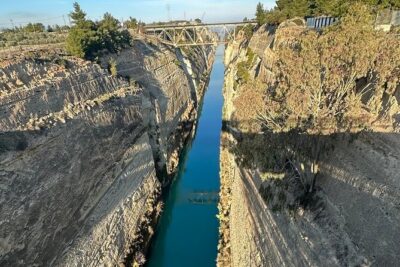
- Corinth Canal: A Short Stop With a Big Geographic Point
- Ancient Corinth (Archaia Korinthos): Apollo, Agora, and Lechaion Street
- Temple of Apollo and the scale of the site
- The agora and the rostrum/bèma area
- Lechaion Street and the Roman “shopping mile”
- Roman buildings you may catch around the edges
- Acrocorinth: The Medieval Castle on the Rock Overlooking Everything
- Kechries Port Remains: A Quick Look at Corinth’s Trading Side
- Price and Value: What $363.71 Covers for Up to Two
- Your Driver and Site Reality: How Much Guidance You Actually Get
- Who This Ancient Corinth Half Day Tour Is Best For
- Should You Book This Ancient Corinth Half Day Tour?
- FAQ
- What is the duration of the Ancient Corinth half day tour?
- How many people are in the group?
- What’s included in the price?
- Are entrance fees included?
- Does the tour include a licensed English guide inside the sites?
- Is there pickup from places besides Athens hotels?
- Where does the airport pickup happen?
- How does pickup work at Piraeus Port?
- Is the tour offered in English?
- What is the cancellation policy?
Key Things I’d Prioritize on This Ancient Corinth Half Day Tour
- Four stops, five hours: canal views, major ruins, a fortress rock, and the port at Kechries.
- Corinth Canal story stops: the idea goes back to Periander and later work attempted by Nero.
- Ancient Corinth layout that makes sense: Apollo Temple, agora landmarks, and the impressive Lechaion Street.
- Acrocorinth is the payoff: a monolithic rock that’s been occupied for centuries and used as a medieval castle site.
- Private pickup from Athens or Piraeus: no random passengers, just your group.
- Driver explanations vs. inside access: your driver can talk history, but may not enter the sites with you.
The canal and old Corinth, a few more days
- From Athens: Ancient Corinth Day Trip with Canal & VR Guide
★ 4.6 · 1,073 reviews - Biblical Tour Letters ToThe Corinthians St Paul’s Footsteps 6Hour
★ 5.0 · 1,065 reviews - Private Biblical Tour Ancient Corinth & Isthmus Canal from Athens
★ 5.0 · 762 reviews - Athens: Ancient Corinth & Nafplio Full Day Trip with Swim
★ 4.8 · 531 reviews
How This Half-Day Ancient Corinth Tour Fits Your Athens Time
If you’re basing yourself in Athens, the biggest challenge is always time. Ancient Corinth is worth more than a quick glance, but doing it under your own steam can mean waiting for buses and figuring out parking. This tour solves the logistics with round-trip, air-conditioned transportation and a tight schedule that still hits the headline sights.
The tour is also built for clarity. You don’t spend half your time doing paperwork. You get a mobile ticket and you’re picked up with a clear sign at the meeting point (or at the airport/customs exit, if you’re arriving that way). Once you’re rolling, the driver explains what you’re seeing and why it matters—helpful if this is your first time in the Corinth story.
The pacing is what you need to know before booking: it’s not a slow, all-day archaeology day. It’s a focused sampler. That’s great if you want momentum and you like walking through the main spaces without getting stuck in one spot too long.
Corinth Canal: A Short Stop With a Big Geographic Point
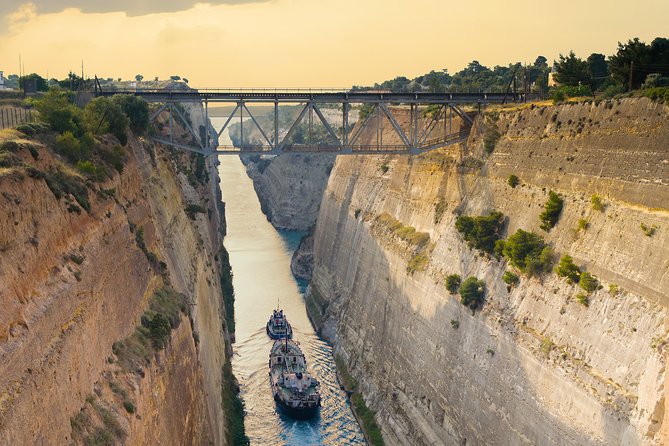
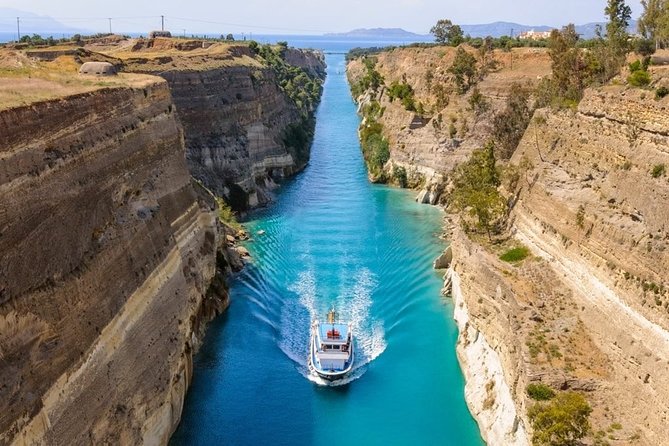
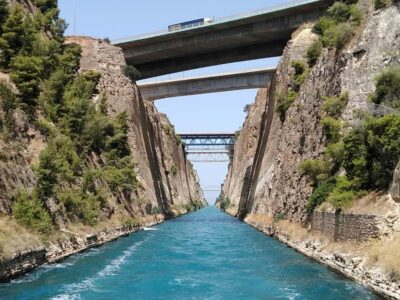
Your day starts with a drive along the National highway to the Corinth Canal. You’re going out specifically for the geography—this canal is the connection between the Saronic Sea and the Corinthian Sea, and it cuts a long nautical detour that ships used to make around the Peloponnese.
Even though the canal’s construction is modern (completed at the end of the 19th century), the “idea” is ancient. The plan described here traces the dream back to Periander, the tyrant of Corinth, who is linked with conceiving the idea of cutting through. Since the tech wasn’t there, the earlier workaround was the diolkós, a stone road used to move ships on wheeled platforms.
Then history gets darker and more dramatic. The canal construction attempt attributed here to Emperor Nero involves a massive workforce of 6,000 slaves—followed by his murder and the project being left unfinished. The takeaway for you: when you look at the canal, you’re not just seeing an engineering feature. You’re seeing a centuries-long ambition to control movement through Greek waters.
Logistically, the stop is short—about 20 minutes. That’s enough to get your bearings and get a few good photos, but not enough to linger if you’re hoping for a long, guided deep read. If you’re the type who wants more time, plan to pair this with later independent exploration (or choose an all-day option elsewhere).
Ancient Corinth (Archaia Korinthos): Apollo, Agora, and Lechaion Street
This is the core stop, with about one hour at the archaeological site. And yes, Ancient Corinth can feel huge. The good news is this tour puts you in the zone of the most meaningful fragments: temple remains, civic spaces, and the Roman-era street-life that helped make Corinth famous across the Mediterranean.
The big Athens hits in one go
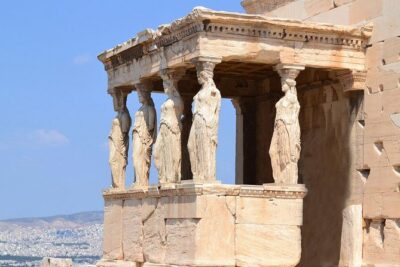

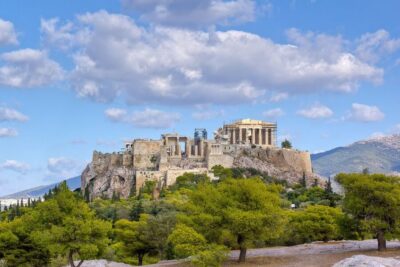
Temple of Apollo and the scale of the site
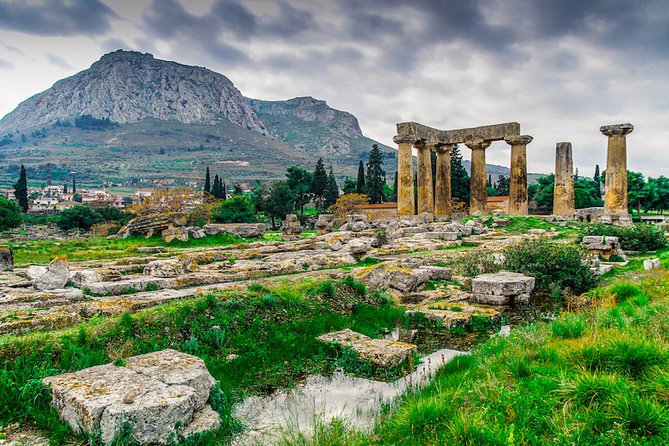
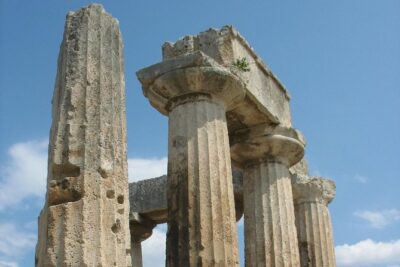
The standout structure associated with the city is the Temple of Apollo (mid-6th century BC). What catches your eye here is the column work—monolithic columns instead of built-up column drums. Seven columns still remain standing, and even though only part of the site has been excavated and wars left scars, the footprint still communicates power and wealth.
A practical note: with a one-hour stop, you’ll want to move with intention. Aim for the major anchor pieces first (the temple area and main civic spaces), then circle back for smaller details like inscriptions or architectural fragments if time allows.
The agora and the rostrum/bèma area
In the city’s public heart is the agora, likely dating to the 4th century BC. It’s surrounded by layers of later Roman development, which is why Corinth is such a useful site for understanding how Greek cities adapted over time.
The tour information also highlights the bèma (rostrum)—a platform where important announcements and decisions were made. There’s a popular connection to Paul and Gallio, but the data here emphasizes that this specific identification isn’t supported strongly by archaeological and historical research, and that the place was later overbuilt by a church. In plain terms: it’s still a meaningful civic spot, just don’t build your whole mental story around one disputed biblical landmark.
Lechaion Street and the Roman “shopping mile”
One of my favorite parts of the Corinth experience is the shift from monumental ruins to daily life. That’s where the Lechaion Street comes in. It begins at an arched gateway and runs along a preserved paved route that once lined up shops with goods moving across the empire. Even with time and weather, it’s impressive to walk this kind of street and picture commerce and public life happening in a steady flow.
There’s also mention of a well-preserved latrine, which is one of those details that helps you feel how real city life was. In a one-hour visit, it’s the kind of thing you might not hunt for unless you’re told where to look—so if you like human-sized realism, this is a win.
Roman buildings you may catch around the edges
The site description includes other notable structures: the Basilica Iulia (courthouse) and an Odeion (concert hall) with later enlargement. There’s also a theatre area that was replaced in the Roman period by an arena-style setup capable of naval-battle recreations (naumachiai). With a tight schedule, you won’t get to fully process all of it, but knowing what you’re looking at helps you read the ruins faster.
Also, remember: entrance fees are not included for this stop. Ancient Corinth is listed as 15.00 Euros per adult. Build that into your budget early so you’re not surprised at the site.
Acrocorinth: The Medieval Castle on the Rock Overlooking Everything
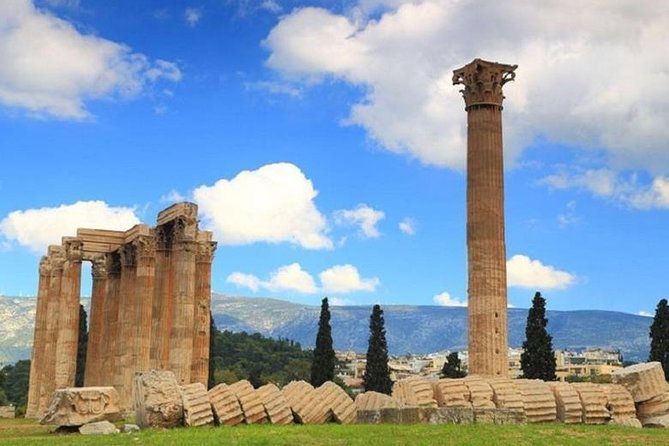
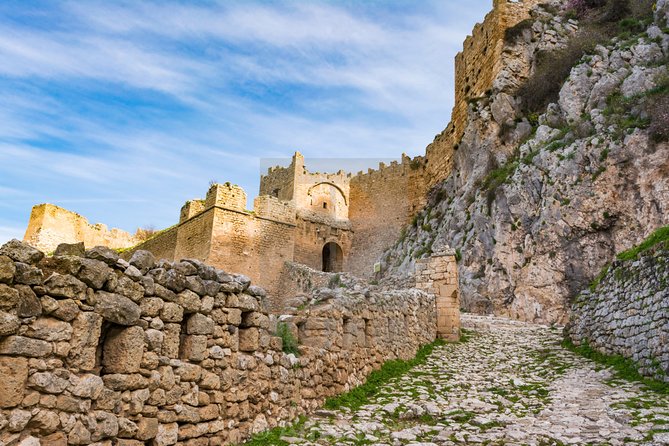
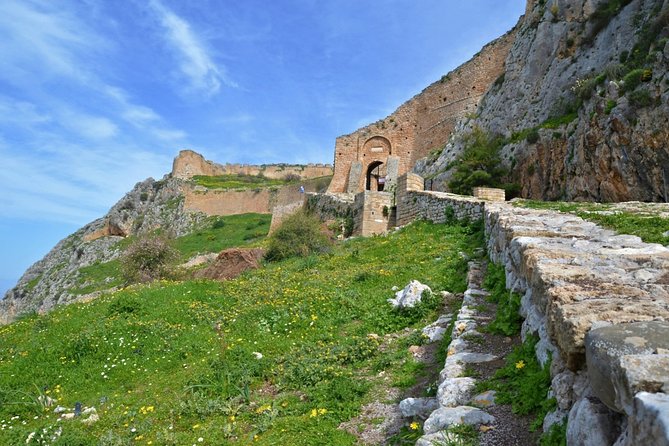
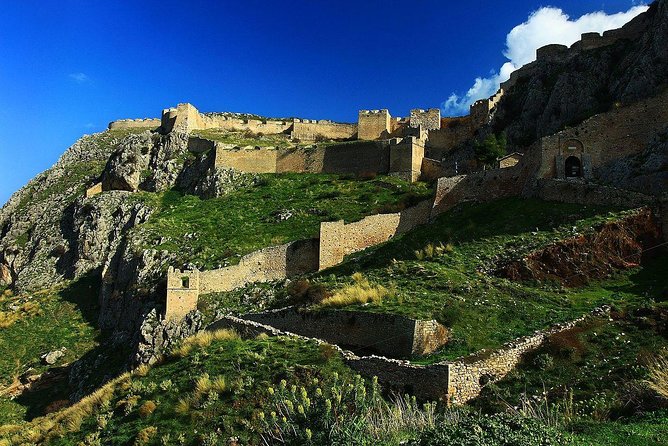
After Ancient Corinth, you head up to Acrocorinth, the upper fortress rock dominating the area. This stop is about one hour, and it’s different from the ruins below. Instead of fragmented temples and streets, you’re dealing with a massive presence—rock, walls, and viewpoints.
Acrocorinth is described as continuously occupied from archaic times to the early 19th century, and today it’s one of Greece’s important medieval castle sites. That timeline matters for you because it explains why the site feels layered. You’re not seeing one single era fossilized in place. You’re seeing how strategic geography keeps getting reused.
Because the tour doesn’t include the admission ticket for Acrocorinth (it’s listed as not included), plan on paying whatever entrance fee applies on the day. The other practical factor: this is a place where you’ll want sturdy footwear. Even if the exact routes aren’t specified, castle terrain tends to be uneven and exposed in ways that reward good shoes and a hat.
If you want your “wow” moment for the day, Acrocorinth usually does it. From up here, Corinth makes more sense: you can imagine control over land routes, and you can visualize how the ancient city connected to the ports and canal ambitions that framed its power.
Kechries Port Remains: A Quick Look at Corinth’s Trading Side
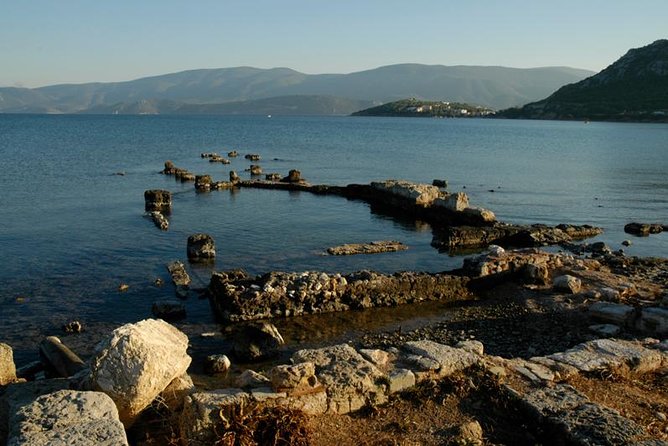
To close out the day, you have a chance to visit Kechries, an ancient port area tied to eastern trade routes via the Saronic Gulf. This stop is short—about 15 minutes—and it’s one of those add-ons that works well because it changes your viewpoint. Instead of temples and fortifications, you get the sense of movement and shipping.
The information tied to Kechries also mentions Apostle Paul arriving there during his second missionary. Even if you’re not traveling for religious landmarks, the historical association helps anchor the port into the broader Corinth story, where trade, politics, and cultural exchange were always tangled together.
Since the stop is brief and marked as free, it’s a low-cost way to add context. The drawback is obvious: you won’t be able to read everything or wander extensively. Treat it like a signpost for where Corinth’s ships would have connected to the wider world.
Price and Value: What $363.71 Covers for Up to Two
The price listed is $363.71 per group (up to 2), for about five hours. That sounds high until you unpack what’s included and who it’s really for.
You’re paying for:
- Private round-trip transport from Athens hotel or Piraeus port (pickup/drop-off included)
- Air-conditioned vehicle, plus bottled water
- WiFi on board
- A driver who can explain the monuments and story behind them (while professional drivers are noted as not licensed to accompany you inside the sites)
For a couple, this can be straightforward value: you’re essentially buying convenience plus comfort plus a pre-planned route. For a solo traveler, it’s more expensive per person, but it can still be worth it when you factor in the difficulty of piecing together a reliable day trip to multiple Corinth sites from Athens.
What’s not included is just as important:
- Ancient Corinth entrance fee (15.00 Euros per adult)
- Acrocorinth admission is not included (and the exact fee isn’t stated)
- Optional licensed guide to enter sites is listed at 260 Euros payable in cash (subject to availability)
- Snacks are not included
My advice for budgeting: treat the base price as transportation plus guided narration on the road, then add entrance fees and optional guide costs on top.
Your Driver and Site Reality: How Much Guidance You Actually Get
This tour leans on a smart division of labor. Your driver can explain history and monuments before you enter and while you’re getting from place to place. But the tour data also states that professional drivers are not licensed to accompany you into the sites.
So the experience breaks down like this:
- On the bus: you get the narrative, the myths, the historical connections, and the practical orientation. This is where a driver like Planos was praised for myth storytelling.
- Inside the sites: you’ll be mostly self-guided unless you arrange an optional licensed tour guide.
If you’re traveling with a deep interest in archaeology or specific religious history, the licensed guide option may be worth considering. If you’re more interested in seeing the main highlights and moving at a good pace, self-guided with the driver’s orientation can be enough.
Also, the tour is private, meaning only your group participates. That matters because it keeps your day from getting slowed down by other people’s pace, questions, or confusion.
Who This Ancient Corinth Half Day Tour Is Best For
I think this tour fits best if you:
- Want to see Corinth Canal + Ancient Corinth + Acrocorinth in one tight time window
- Prefer a private vehicle over public transit juggling
- Like road-trip storytelling that helps you understand what you’re standing in front of
- Travel as a couple (since pricing is per group up to two)
It’s less ideal if you:
- Want to spend hours in one museum-like environment
- Need a licensed guide in every site to explain details inside
- Are hoping entrance fees are fully covered
Should You Book This Ancient Corinth Half Day Tour?
If your goal is to check off the key Corinth sights with minimal planning headache, this is a good bet. The biggest strength is how efficiently it packs multiple eras into one manageable day: ancient engineering dreams at the canal, monumental city spaces in Ancient Corinth, and the commanding medieval fortress feeling of Acrocorinth.
Book it if you value private, air-conditioned transportation and you’re okay with self-guided time inside the archaeological areas. Pass or consider a longer option if you want slow, detailed interpretation in every corner or you dislike adding entrance fees and optional guide costs at the last moment.
FAQ
What is the duration of the Ancient Corinth half day tour?
It runs for about 5 hours (approx.).
How many people are in the group?
The tour is private and listed as up to 2 people per group.
What’s included in the price?
The tour includes private transportation with round-trip pickup/drop-off (Athens hotel/Piraeus port), an air-conditioned vehicle, bottled water, and WiFi on board.
Are entrance fees included?
Entrance fees are not included. Ancient Corinth is listed as 15.00 Euros per adult.
Does the tour include a licensed English guide inside the sites?
Not automatically. The tour notes that the English-speaking driver explains about the monuments, but they are not allowed by law to accompany you into the sites. A licensed guide can be arranged for an extra cost of 260 Euros payable in cash (subject to availability).
Is there pickup from places besides Athens hotels?
Yes. Private transportation is also offered from the Piraeus Port cruise ship terminal. Airport pickup is mentioned as available on request.
Where does the airport pickup happen?
The driver meets you at Athens International Airport, Eleftherios Venizelos, at the customs exit, holding an H.P. Tours sign with your name.
How does pickup work at Piraeus Port?
Piraeus has terminals A, B, and C. The driver waits at the corresponding exit for the terminal your ship docks at. If the gate for your terminal is closed, you may need the shuttle to Terminal A (about 3 minutes).
Is the tour offered in English?
The tour is offered in English.
What is the cancellation policy?
Free cancellation is available. You can cancel up to 24 hours in advance for a full refund.
More Tour Reviews in Athens
- Athens: Acropolis & up to 5 Archaeological Sites Combo Pass★ 4.2 · 13,904 reviews
- Athens: Acropolis, Parthenon & Acropolis Museum Guided Tour★ 4.8 · 9,316 reviews
- The Acropolis, Parthenon & Acropolis Museum Guided Tour★ 4.7 · 8,493 reviews
- Athens: Cape Sounion & Poseidon Temple Sunset Half-Day Trip★ 4.8 · 8,241 reviews
- Acropolis: Premium Acropolis and Parthenon Guided Tour★ 4.8 · 5,208 reviews
- Athens: Mythology of Delphi, Museum and Arachova Guided Tour★ 4.7 · 5,102 reviews
All of Athens in a Day
- Athens: City Sightseeing Hop-On Hop-Off Bus Tour★ 4.3 · 4,520 reviews
- Best of Athens Half Day Private Tour★ 5.0 · 3,714 reviews
- Athens & Acropolis Highlights: Greek Mythology Small-Group Tour★ 5.0 · 2,370 reviews
- Athens: Acropolis and Mythology Highlights Small Group Tour★ 4.8 · 2,275 reviews
- City Sightseeing Athens, Piraeus & Beach Riviera Hop-On Hop-Off Bus Tours★ 4.0 · 1,887 reviews
- Athens Half-Day Sightseeing Tour with Tickets of Acropolis★ 4.0 · 1,402 reviews
Corinth and the Canal
- From Athens: Ancient Corinth Day Trip with Canal & VR Guide★ 4.6 · 1,073 reviews
- Biblical Tour Letters ToThe Corinthians St Paul’s Footsteps 6Hour★ 5.0 · 1,065 reviews
- Private Biblical Tour Ancient Corinth & Isthmus Canal from Athens★ 5.0 · 762 reviews
- Athens: Ancient Corinth & Nafplio Full Day Trip with Swim★ 4.8 · 531 reviews
- Athens: Corinth Canal, Mycenae & Nafplio Premium Guided Tour★ 4.7 · 322 reviews
- Private Tour of Apostle Paul’s Footsteps in Ancient Corinth★ 5.0 · 275 reviews
Fresh Off the Boat: New Athens Reviews





Corinth Day Trips, compared.
 ★ 4.6From Athens: Ancient Corinth Day Trip with Canal & VR GuideFrom $411,073 reviews
 ★ 5.0Biblical Tour Letters ToThe Corinthians St Paul’s Footsteps 6HourFrom $1701,065 reviews
 ★ 5.0Private Biblical Tour Ancient Corinth & Isthmus Canal from AthensFrom $301762 reviews
 ★ 4.8Ancient Corinth & Nafplio Full Day Trip with Swim531 reviews
 ★ 4.7Corinth Canal, Mycenae & Nafplio Premium Guided TourFrom $32322 reviews
 ★ 5.0Private Tour of Apostle Paul’s Footsteps in Ancient CorinthFrom $169275 reviews
 ★ 4.3Corinth Canal, Mycenae and Nafplio Day TourFrom $129252 reviews
 ★ 4.5Corinth Half-Day Trip from Athens with Entrance TicketsFrom $91242 reviews
Browse the lists this tour appears in