
Reviewed · ANCIENT AGORA TOURS
Athens: Roman Agora E-Ticket and Audio Guide
The Roman Agora feels small, but it packs serious stories. With a pre-booked e-ticket and a downloadable audio tour, you can move through two thousand years of Athens at your own pace. I like that the experience is built for real-world timing: a visit that fits in about 45 minutes to 1 hour without the stress of finding the right line or a meeting place.
Two standouts are the offline audio guide (so you can roam without data anxiety) and the chance to line up major sights in one compact route. You’ll pass the Gate of Athena Archegetis, the Tower of the Winds, and the Mosque, plus spots like the fountain house, the Vespasianae, and the shops. One possible drawback: because it’s self-guided, the tour works best if you’re comfortable using your phone to keep your bearings as you go.
In This Review
- Key things to know before you go
- Roman Agora in one pocket-sized visit
- E-ticket entry: less waiting, more time in the ruins
- Before you arrive: download the audio like a pro
- How the audio tour is meant to work in the field
- Your route through the Roman Agora’s top sights
- Gate of Athena Archegetis: start by reading the entrance
- Tower of the Winds: the stop that feels like a mini science exhibit
- Mosque of the Conqueror: layers of history in one glance
- Fountain house and the everyday city rhythm
- Vespasianae and the shops: where daily needs meet public space
- Where you land visually: the Acropolis view payoff
- Timing: how to fit it into a real Athens day
- Price and value: is $18 worth it for this format?
- Who this Roman Agora audio tour is best for
- Quick practical checklist for a smoother visit
- Should you book the Roman Agora E-ticket and audio guide?
- FAQ
- How long does the Roman Agora audio tour take?
- Do I need a live guide?
- Can I download the audio guide before I arrive?
- Is the audio guide available in languages other than English?
- Are headphones included?
- Does it work on Windows phones?
Key things to know before you go
- Skip-the-line entry with an e-ticket sent by email, so you can focus on walking, not paperwork
- Offline audio on your phone (text, narration, and maps), designed to avoid roaming charges
- A tight circuit that hits the Roman Agora’s core features in under an hour
- Major landmarks close together, including the Gate of Athena Archegetis and the Tower of the Winds
- Multiple language options, including English plus several European languages and Greek
- Self-guided means self-paced, with no live guide on site
Down where the old city met and traded
- Athens Half Day Tour, Acropolis, Parthenon, Temple of Olympian Zeus & Hephaistus
★ 5.0 · 609 reviews - Athens: Agora and Hephaistos Temple Entrance Ticket
★ 4.0 · 449 reviews - Athens: Ancient Agora E-Ticket and Audio Tour
★ 3.9 · 413 reviews - Athens: Roman Agora & Ancient Agora E-ticket & 2 Audio Tours
★ 4.1 · 107 reviews
Roman Agora in one pocket-sized visit

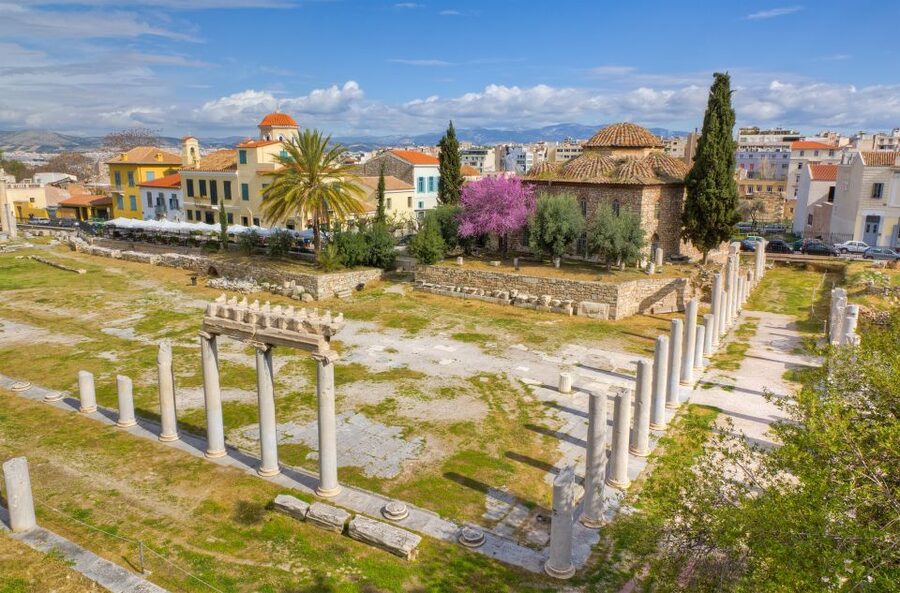
The Roman Agora is one of those Athens stops that stays manageable even when the city feels huge. The site is famous for how much it preserves in a relatively small area, so you get the feeling of classical city life without needing a half-day plan. If you’re short on time, this is the kind of stop that lets you see key structures and still have energy for the rest of your day.
What makes this specific experience practical is that it bundles entry with a smartphone story package. Instead of standing around reading whatever you can find on the spot, you get a structured audio tour that takes you place to place. You can listen while you walk, then repeat the audio later anytime you want to refresh the details.
Also, you get that classic Athens payoff: views. The Roman Agora offers a splendid look up toward the Acropolis, so you’re not just looking at ruins in isolation. You’re seeing how the ancient city layered itself over time, with the hills and skyline always nearby.
E-ticket entry: less waiting, more time in the ruins
The ticket side is straightforward. After you book, you receive an email with instructions to access the Roman Agora e-ticket and to download the audio portion. The entry ticket is meant to help you avoid the ticket line, which matters in Athens when crowds can swing quickly.
This is also one reason the timing works well. The visit is listed as 45 minutes to 1 hour, and the flow is designed to match that window. You’re not paying for a tour that drags on with group logistics. You’re paying for a direct entry and a guided-by-audio route.
Do note two small realities. First, the activity is non-refundable, so be sure your day plan is solid. Second, free or reduced admission tickets do not include skip-the-line privileges and have to be acquired at the ticket booth on site.
Before you arrive: download the audio like a pro
The setup is one of the smartest parts of this ticket. You activate and download the audio tour to your smartphone ahead of time, and the content is designed for offline use. That means you won’t get stuck hunting for signal while you’re standing in front of a monument.
A few practical tips will save you time. Check your email for the activation link and instructions, and also scan your spam folder. Then download everything before you head out—plan for about 100–150 MB of storage on your phone.
You also need your own gear on the day. Headphones are not included, and the listing specifically notes that the audio tour is incompatible with Windows phones. It’s also not compatible with older Apple devices listed in the constraints, including iPhone 5/5C or older and older iPads or iPod Touch models.
Worth comparing before you book this Athens tour:


How the audio tour is meant to work in the field
This is a self-guided audio tour delivered through an app on Android and iOS. The tour content is described as offline text, narration, and maps, and the app includes maps to help you track where you are. The narration is presented as brief, original stories created from in-depth research.
Here’s how to make it work smoothly in real life: treat it like a walking script, not a podcast you can pause and forget. When the audio tells you to look at a feature—like a gate structure or a specific element of the fountain house—don’t just keep listening while you wander. Stop, look, and match the story to what’s in front of you.
One caution based on feedback style you’ll want to keep in mind: the experience depends on orientation. If you prefer lots of obvious signage and you hate switching attention between ruins and your phone, you might find navigation a bit challenging. The maps are meant to help, but your comfort level with self-direction matters.
Your route through the Roman Agora’s top sights
Think of this as a compact circuit of Roman-era Athens. You’re not moving far across the city; you’re absorbing the site in sequence, with the audio guiding you toward the most important features.
Gate of Athena Archegetis: start by reading the entrance
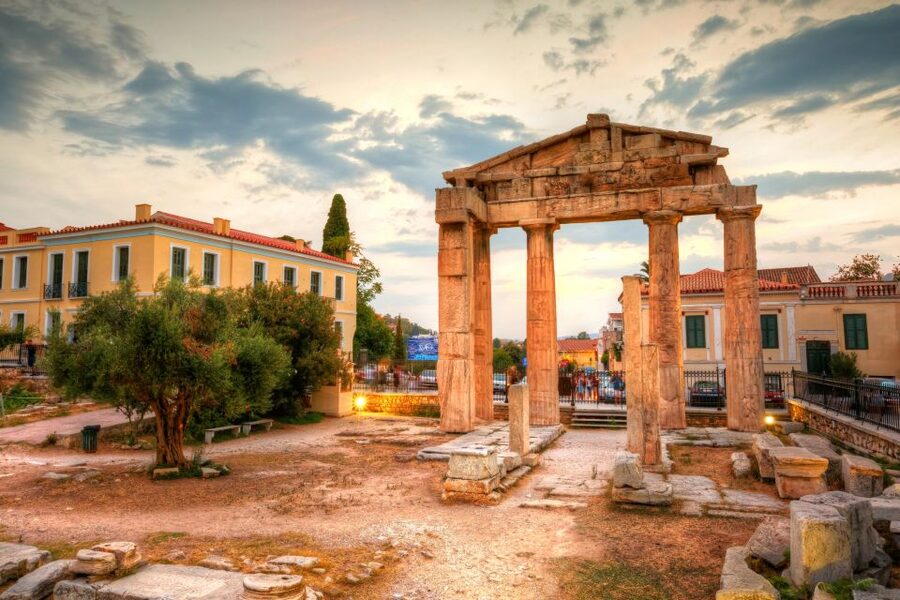
The tour kicks off with the Gate of Athena Archegetis. This is the kind of structure that benefits from context, because a visitor can walk past an architectural remnant without fully grasping why it mattered. In the audio, the gate is framed as part of the daily rhythm of the Agora and the larger story of Athens under shifting powers.
As you look at it, pay attention to how gates work in a city. They’re not just stone frames; they control movement, mark transitions, and signal identity. With the audio narration, you get a reason to stand still here instead of just passing through.
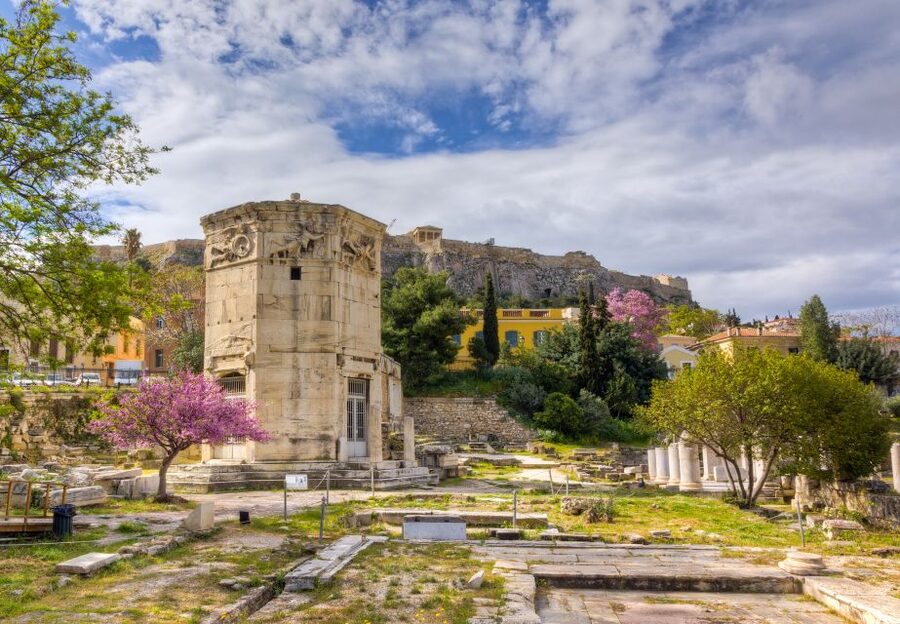
Tower of the Winds: the stop that feels like a mini science exhibit
Next comes the Tower of the Winds. This is one of those places where the structure itself invites questions: what was it for, and how did people use it in daily life? The audio tour is designed to connect you to that question by telling stories around how the site functioned, including a chance to meet the Winds as the tour describes.
If you like practical details—how people measured time and weather before modern tech—this stop is likely a highlight. It’s also a great moment to take a break from pure architecture and focus on everyday intelligence.
Mosque of the Conqueror: layers of history in one glance
Then the route brings you to the Mosque (described in the tour as the Mosque of the Conqueror). This is where Athens history shows its layered nature. You’re not only looking at the Roman Agora as a Roman scene. You’re seeing how later eras used, adapted, or built around existing spaces.
This is also a good place to slow down. When a site includes different periods of use, it helps to understand that ruins don’t stay frozen. They become stages that later history steps onto.
Fountain house and the everyday city rhythm
After the big names, you’ll move into the more day-to-day parts of the Agora experience. The audio includes the fountain house, which is exactly the kind of element people often overlook if they only focus on the most photogenic structures.
A fountain house isn’t only about water. It’s about routine: where people gathered, refreshed, met, and moved on. When the narration connects it to habits of the city, you start to see the Agora less like a museum layout and more like an active neighborhood.
Vespasianae and the shops: where daily needs meet public space
The tour highlights the Vespasianae and the shops. This is a smart choice for an audio-guided visit because it shifts your attention from monuments to human needs. Public facilities and marketplaces are where the feel of everyday life lives on, even when the physical details are worn down.
If classical history feels too grand to picture, these are the stops that bring it down to earth. The stories aim to make these areas feel like places people used—not only places people photographed.
Where you land visually: the Acropolis view payoff
Throughout the route, keep an eye on sightlines, because the Roman Agora is positioned to give you that classic Athens contrast: the visible structure under your feet and the Acropolis rising beyond. The audio tour also frames the experience as a way to appreciate classical Athens and Roman ingenuity in one view.
Even a brief pause here can change how you remember the site. You stop thinking of the Agora as isolated fragments, and you start seeing it as part of a living city landscape.
Timing: how to fit it into a real Athens day
The visit window is 45 minutes to 1 hour. That’s perfect if you’re doing Athens in chunks—Acropolis area in the morning, museums or neighborhoods later, and this kind of compact archaeological stop in between.
If you’re a slower walker or you like to stop for photos, aim for the high end of the time. If you’re strict about schedules, you can still get the full story package without racing, as long as you download beforehand and start listening right away.
Also, since there’s no live guide, you control your pace. You can linger at the Gate of Athena Archegetis or Tower of the Winds without worrying about a group waiting behind you.
Price and value: is $18 worth it for this format?
At $18 per person, this is not a budget activity—but it is priced like a guided experience. You’re paying for two things: skip-the-line entry and the smartphone audio tour with offline content.
For value, think about what you’re avoiding. Without the e-ticket, you can spend time in lines. Without a guide, you might spend that same time trying to piece together what you’re seeing from scattered information. This ticket aims to replace both with one setup: entry + structured storytelling you can reuse.
What pushes it toward good value for many people is repeatability. The audio tours can be used repeatedly and at any time, before or after your visit. That turns the price from a one-time fee into an Athens memory tool you can revisit.
Still, the value depends on your comfort with self-guided audio. If you want constant human interpretation, you’ll miss the live guidance that would answer questions on the spot. And if you struggle with smartphone navigation outdoors, the experience might feel less smooth.
Who this Roman Agora audio tour is best for
This works especially well if:
- You want a self-paced visit and like learning through short stories
- You’re history-minded but don’t want a long guided tour
- You prefer offline use because Athens days often mean unpredictable data access
- You like bundling smart “must-see” stops into one compact route
It may be less ideal if:
- You dislike smartphone-based navigation and would rather have a person direct you
- You’re planning to use very limited phone storage or you forgot to download offline content
- You need a live Q&A or prefer tours that handle accessibility accommodations with a staff member present (this listing notes partial accessibility, but it does not say a dedicated helper is provided)
Quick practical checklist for a smoother visit

Before you go, pack:
- Comfortable shoes (this is walk-and-stand archaeology)
- Headphones (not included)
- A charged smartphone with the downloaded app content
On arrival, do:
- Open the app and confirm the tour is ready
- Start with the first major stop so the audio context kicks in early
- Use the maps when you feel you’re drifting
This will help you get the most from the story structure, instead of treating it like background noise.
Should you book the Roman Agora E-ticket and audio guide?
If your goal is an easy Athens “history hit” that fits into a busy day, I’d lean yes. The combination of skip-the-line entry, offline audio, and a route that highlights the Gate of Athena Archegetis, Tower of the Winds, Mosque, fountain house, Vespasianae, and shops makes this a strong option for solo travelers and couples.
Book it if you like learning on your own schedule and you’re comfortable using your phone outdoors. Skip it or consider a different format if you need a live guide for orientation or if you know you get frustrated when you can’t easily track where you are.
At its best, this is the kind of ticket that turns a short stop into a memorable walk through how an Agora worked—less as a pile of ruins, more as a daily stage of the Roman world.
FAQ
How long does the Roman Agora audio tour take?
The listed duration is 45 minutes to 1 hour, depending on availability and starting times.
Do I need a live guide?
No. This is a self-guided audio tour on your smartphone, with no live guide provided.
Can I download the audio guide before I arrive?
Yes. After booking, you’ll receive an email with instructions and an activation link to access and download the audio tour on your phone before your visit. The content is also available offline.
Is the audio guide available in languages other than English?
Yes. Audio is available in English, Spanish, German, French, Italian, and Greek.
Are headphones included?
No. The listing notes that a smartphone is required and that headphones are not included.
Does it work on Windows phones?
No. The app is not compatible with Windows phones, and it also has restrictions for older iPhone and iPad models listed in the requirements.
More Tickets in Athens
- Athens: Acropolis Ticket with Audio Guide★ 4.0 · 3,575 reviews
- Athens All Included: Acropolis and Museum Guided Tour with Ticket★ 4.5 · 2,673 reviews
- Athens: Acropolis Museum Ticket with optional Audio Guide★ 4.4 · 2,652 reviews
- Athens: Guided Tour of Acropolis & Parthenon with Tickets★ 4.7 · 2,049 reviews
- Athens Half-Day Sightseeing Tour with Tickets of Acropolis★ 4.0 · 1,402 reviews
- Athens: Acropolis Museum Ticket with Audio Guide★ 4.1 · 835 reviews
More Tour Reviews in Athens
- Athens: Acropolis & up to 5 Archaeological Sites Combo Pass★ 4.2 · 13,904 reviews
- Athens: Acropolis, Parthenon & Acropolis Museum Guided Tour★ 4.8 · 9,316 reviews
- The Acropolis, Parthenon & Acropolis Museum Guided Tour★ 4.7 · 8,493 reviews
- Athens: Cape Sounion & Poseidon Temple Sunset Half-Day Trip★ 4.8 · 8,241 reviews
- Acropolis: Premium Acropolis and Parthenon Guided Tour★ 4.8 · 5,208 reviews
- Athens: Mythology of Delphi, Museum and Arachova Guided Tour★ 4.7 · 5,102 reviews
More Hours in the Ancient Agora
- Athens Half Day Tour, Acropolis, Parthenon, Temple of Olympian Zeus & Hephaistus★ 5.0 · 609 reviews
- Athens: Agora and Hephaistos Temple Entrance Ticket★ 4.0 · 449 reviews
- Athens: Ancient Agora E-Ticket and Audio Tour★ 3.9 · 413 reviews
- Athens: Roman Agora & Ancient Agora E-ticket & 2 Audio Tours★ 4.1 · 107 reviews
- Acropolis & Ancient Agora Guided tour included all Entrances★ 4.9 · 102 reviews
- Ancient Athens Segway Tour with Agora and Kerameikos★ 5.0 · 94 reviews
Fresh Off the Boat: New Athens Reviews





Ancient Agora Tours, compared.
 ★ 5.0Athens Half Day Tour, Acropolis, Parthenon, Temple of Olympian Zeus & HephaistusFrom $314609 reviews
 ★ 4.0Agora and Hephaistos Temple Entrance TicketFrom $30449 reviews
 ★ 3.9Ancient Agora E-Ticket and Audio TourFrom $30413 reviews
 ★ 4.1Roman Agora & Ancient Agora E-ticket & 2 Audio ToursFrom $51107 reviews
 ★ 4.9Acropolis & Ancient Agora Guided tour included all EntrancesFrom $126102 reviews
 ★ 5.0Ancient Athens Segway Tour with Agora and KerameikosFrom $8394 reviews
 ★ 5.0Acropolis of Athens, Ancient Agora and the Agora Museum TourFrom $6786 reviews
 ★ 3.9Ancient Agora Self-Guided Tour with 3D & Audio (No Ticket)From $859 reviews
Browse the lists this tour appears in