
Reviewed · ATHENS MYTHOLOGY TOURS
Mythology, Philosophy and Democracy Tour
Mythology and democracy in one Athens walk? That’s what makes this tour fun and unusually smart. You move from Athens’ stories and belief systems toward the habits of thinking that shaped philosophy and democratic politics—all while standing in the actual places where ideas were argued out.
I especially love the way the guide turns famous names into real people and real debates. I also like the mix of famous landmarks and quieter spots, including Kerameikos and the Roman Agora, so you don’t feel like you’re just ticking boxes. Along the way, you get standout Acropolis-area views from two viewpoints that feel made for photos.
One thing to consider: it’s a walking tour that ends on hilltop terrain, and it can be hot. If the weather turns poor, the tour can be rescheduled or refunded, so plan to be flexible.
In This Review
- Key highlights to look for
- From Kerameikos to Pnyx: what this Athens tour really connects
- Kerameikos: the cemetery where Pericles framed democracy
- The Ancient Agora: where Athens practiced conversation
- Monastiraki and the Roman Agora: Athens beyond the Greeks you memorized
- The Tower of the Winds and Hadrian’s Library: time, weather, and power
- Plaka streets: your scenic pause before the big viewpoints
- Pnyx Hill: the first parliament and a real sunset outlook
- Philopappos Hill: Acropolis views after dark, with philosophy in the air
- Price and value: what you’re paying for at $50.69
- Who should book this tour (and who might skip it)
- Should you book the Mythology, Philosophy and Democracy Tour?
- FAQ
- FAQ
- Where does the tour start and end?
- How long is the tour?
- What language is the tour offered in?
- How big is the group?
- How much does it cost?
- What kind of ticket do I get?
- Are the sites on the route free to enter?
- Is there public transportation nearby?
- Do I need good weather?
- What is the cancellation policy?
- Is there a minimum number of travelers?
Key highlights to look for
- Pericles at Kerameikos: the setting for his Epitaph speech honoring the first casualties of the Peloponnesian War
- Socrates-style debate in the Agora: philosophers, politicians, poets, and everyday Athenians all using the same public space
- Practical Athens texture: an easy-paced walk through Monastiraki’s flea market area
- The Tower of the Winds: a 1st-century BC weather station that acted like Athens’ “Big Ben,” including a sound on the hour
- Pnyx Hill viewpoints: the first parliament of the world with a sunset-friendly outlook
- Philopappos Hill at night: strong views of the Acropolis after dark
The old gods retold, a few more walks
- Athens: Mythology of Delphi, Museum and Arachova Guided Tour
★ 4.7 · 5,102 reviews - Athens & Acropolis Highlights: Greek Mythology Small-Group Tour
★ 5.0 · 2,370 reviews - Athens: Acropolis and Mythology Highlights Small Group Tour
★ 4.8 · 2,275 reviews - Philosophy and Democracy tour of Athens
★ 5.0 · 285 reviews
From Kerameikos to Pnyx: what this Athens tour really connects
This is the kind of Athens experience that helps your brain organize what you’re seeing. You start with the myth-and-meaning side of the Greek world, then follow the thread into why people began questioning, arguing, measuring, and reasoning.
The tour’s big promise isn’t just history facts. It’s the idea that the same city that told stories also learned to test them—moving from blind faith toward the start of science, and from power-by-tradition toward political talk that looked a lot like democracy.
What makes it work is the pacing and the route. In a short window—about 3 hours—you hit major civic spaces, science-adjacent landmarks, and two viewpoints over Athens.
Kerameikos: the cemetery where Pericles framed democracy
Kerameikos is one of those Athens stops that feels underused by typical sightseeing plans. It’s meaning-filled in a way that surprises you: the name links to ceramics, because workshops once clustered here, but the area later became Athens’ cemetery for many centuries.
This is also where the guide places Pericles’ Epitaph speech for the first casualties of the Peloponnesian War. Standing in a former cemetery while talking about public virtue changes the tone. It’s harder to treat democracy like an abstract concept when it’s tied to sacrifice and collective values.
If you care about the “why” behind political systems, this stop is a strong anchor. It gives you a starting point for the tour’s central theme: democracy wasn’t only about voting; it was about a shared story of what citizens owed each other.
Practical note: the stop time is short (around 25 minutes), so you’ll want to listen actively instead of trying to read every surface detail.
The Ancient Agora: where Athens practiced conversation
Next comes the Ancient Agora, which the tour frames as the heart of Athens. This is where the public life of the city happens—philosophers, politicians, poets, and everyday people walking the same paths and debating ideas.
The guide names and connects key figures tied to this space: Socrates, Plato, Solon, Themistocles, Pericles, Thucydides, Sophocles, Aristophanes. Even if you only recognize a few of those names, the message lands fast: Athens wasn’t just producing thinkers. It was producing social conditions for thinking.
This is where the tour starts to feel like more than sightseeing. You begin to understand democracy as a culture of speech—arguments, persuasion, disagreements—and not just a system of government. The Agora becomes the stage for that idea.
One more plus: the stop is brief (about 10 minutes), so it keeps the walk moving. You don’t get stuck in “museum-mode,” which helps if you’ve got limited time in Athens.


Monastiraki and the Roman Agora: Athens beyond the Greeks you memorized
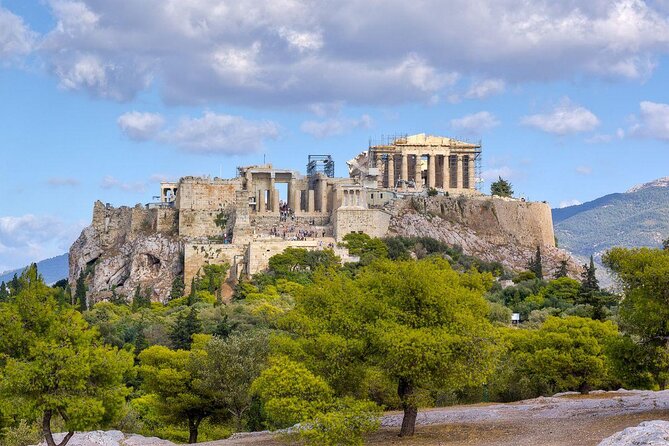
After the philosophical civic core, you shift into a more everyday Athens moment with Monastiraki Square. The pace stays easy as you pass through the flea market area, which is a useful reset for your feet and your attention.
You’re not there to shop hard—you’re there to feel the city continuing to live on top of its past. It helps you remember that Athens isn’t a closed-in theme park. It’s a working city, and that matters when you’re learning about how public spaces evolve.
Then comes the Roman Agora, located north of the Acropolis and east of the Ancient Agora. It’s a quick stop (around 10 minutes), but it gives you a reminder that Athens’ public spaces didn’t stop working when the Romans arrived. Layers of governance and culture kept reusing and reshaping the same general idea of a civic center.
The trade-off here is time. You’ll get direction and context, but it’s not a long “stay and explore everything” segment. If you love independent wandering, plan to add extra free time later for whichever area hits you hardest.
The Tower of the Winds and Hadrian’s Library: time, weather, and power

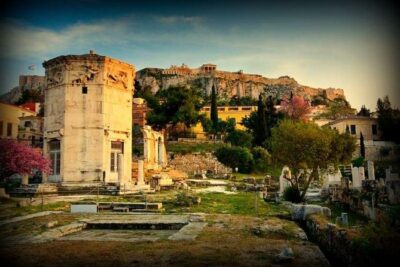
This tour gets nerdy in a good way at the Tower of the Winds. The octagonal building, built in the 1st century BC, served as an indicator of wind and also a clock. It’s described as a kind of Athens-era “Big Ben,” and it even had a way to keep time and make hourly sound in cloudy conditions using a hydraulic mechanism.
That mix—astronomy, engineering, and daily life—is exactly where the tour’s “from belief to thinking” idea becomes concrete. This wasn’t just myth on stone. People built tools to measure the world.
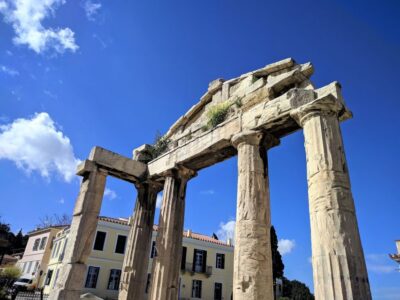
Just after that, you move to Hadrian’s Library, commissioned by Emperor Hadrian in AD 132 on the north side of the Acropolis. The tour frames it as a major scholarly space and notes it was the second largest in the world at the time.
Even if you only skim stone remnants, the connection is clear: empires may change, but the desire to collect knowledge and organize learning keeps showing up.
Both stops are short (about 10 minutes each), so your best move is to focus on the “what it was for” story the guide tells while you still have momentum for the rest of the walk.
Plaka streets: your scenic pause before the big viewpoints
Plaka is next, and it’s the kind of neighborhood you’ll enjoy even if you’re tired. Small houses and narrow, picturesque streets give you a gentle break between major archaeological stops.
This segment also works as a mental transition. You’ve been dealing with civic ideals, measurement, and timekeeping. Here, you can reset and take in the human scale of the city—then prepare for the hilltop sections that end the tour.
Plaka is listed for about 10 minutes, which is enough for atmosphere without dragging. If you want more, you can always come back later, but during the tour it keeps things snappy and realistic.
Pnyx Hill: the first parliament and a real sunset outlook

Then you reach Pnyx Hill, described as the first parliament of the world. The tour treats this as a climax point, and it makes sense: you’re finally at a place tied directly to how citizens gathered to argue and decide.
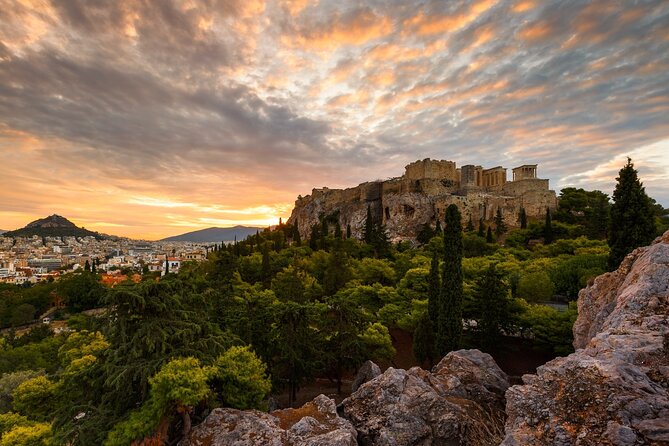
Pnyx is also a great viewpoint. The tour highlights it as an excellent spot for sunset views, which is smart timing for your attention. When the light gets softer, the talk about democracy stops feeling like a lecture and starts feeling like a lived scene.
Plan for about 25 minutes here. That’s enough time to take in the view and let the guide connect the dots between the earlier Agora conversation culture and the political role of the Pnyx.
If your group has different interests—some history lovers, some people who just want great photos—Pnyx is one of those rare places that can satisfy both.
Philopappos Hill: Acropolis views after dark, with philosophy in the air

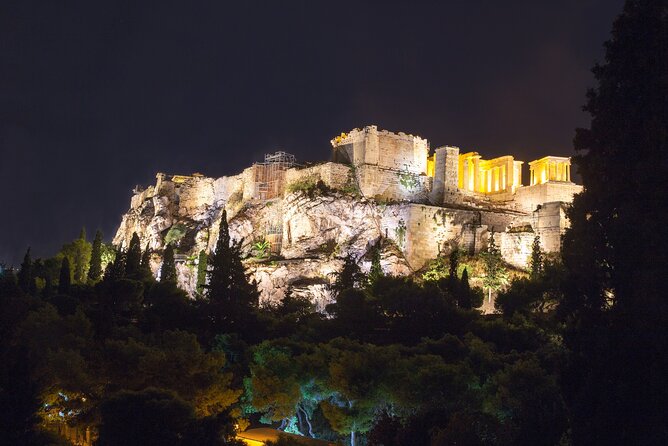
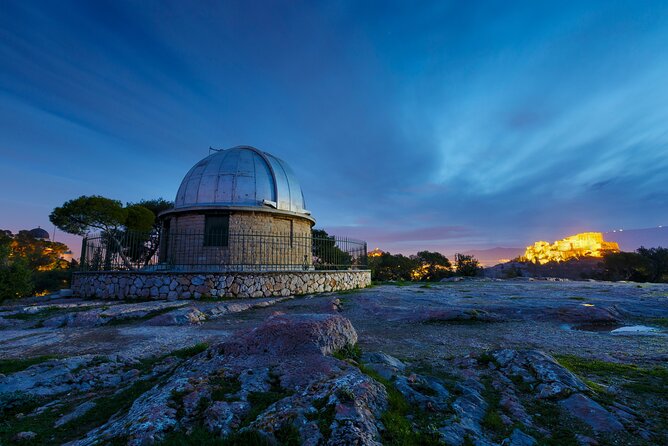
The tour ends at Philopappos Hill, also called the Hill of the Muses. The main payoff is the view: the tour notes it offers some of the best panoramas of the Acropolis and Athens by night.
The timing of this finish is practical. You’re not starting your evening at a viewpoint, you’re walking toward it. That makes the final payoff feel earned, not rushed.
You’re on the clock, though, so don’t spend all your energy hunting photos. Instead, take a minute to look and then listen. This is the point where the tour’s theme—myth, philosophy, and democracy—often lands most emotionally. Athens becomes less like a list of sites and more like a set of linked ideas.
The stop time is listed around 45 minutes, which is generous compared with many other walking tours. You’ll likely have time to settle into the view and get the final framing before you head off on your own.
Price and value: what you’re paying for at $50.69
At $50.69 per person for about 3 hours, you’re paying mainly for two things: expert storytelling and access to a carefully chosen sequence of meaningful places.
All the listed stops show admission ticket: free, which matters. You’re not stacking up separate ticket costs to feel like you got value. Instead, the price goes toward a guide-led interpretation of the places you’re walking through.
You also get a small group size: maximum 12 travelers. That usually translates into a tour where questions and back-and-forth feel possible, and where you’re less likely to be lost in a crowd at key stops.
You’ll also get a mobile ticket, plus group discounts are offered. And since it’s near public transportation, you can build it into a longer Athens day without needing a taxi plan.
One small reality check: this is not a sit-down lecture. It’s a walking route, so you’ll get the best experience if you wear comfortable shoes and keep your phone battery charged for the viewpoint moments.
Who should book this tour (and who might skip it)
Book it if you want Athens to make sense as a thinking machine, not just a place with great photos. It fits well if you like ideas—especially how Greek philosophy and democratic politics grew out of public debate.
It’s also a good choice for mixed groups. The walk includes practical city texture (Monastiraki) and major civic sites (Agora and Pnyx). That gives different interests a chance to latch on.
If you hate walking, or you want a slow, self-paced tour where you linger at every stone, you may want a different format. Hilltop endings can be tiring, and the stops are short by design.
Families can often do well, especially older teens. Several write-ups stress that the content works when you’re willing to think, not when you only want facts on walls.
Should you book the Mythology, Philosophy and Democracy Tour?
If you have limited time in Athens and you want more than a highlight reel, yes—this is a smart use of a half-day. The route connects Pericles, the culture of debate in the Agora, and the political role of Pnyx, then finishes with strong views from Philopappos Hill.
I’d especially recommend it if you’re the kind of traveler who likes being asked to connect the past to bigger questions. The tour’s best moments are when those connections stop being abstract and you feel them standing in place.
Book this one early in your trip if you can. Knowing how the city’s ideas fit together makes everything you see afterward—Acropolis visits included—click faster.
FAQ
FAQ
Where does the tour start and end?
The tour starts at Statue of Theseus, Athens (Athens 105 55, Greece) and ends at Philopappos Hill (Φυλής 215, Athina 117 41, Greece).
How long is the tour?
It runs for approximately 3 hours.
What language is the tour offered in?
The tour is offered in English.
How big is the group?
The tour has a maximum group size of 12 travelers.
How much does it cost?
The price is $50.69 per person.
What kind of ticket do I get?
You receive a mobile ticket.
Are the sites on the route free to enter?
The tour notes that admission tickets for the listed stops are free.
Is there public transportation nearby?
Yes, it’s near public transportation.
Do I need good weather?
The experience requires good weather. If it’s canceled due to poor weather, you’ll be offered a different date or a full refund.
What is the cancellation policy?
You can cancel for a full refund up to 24 hours in advance of the experience’s start time.
Is there a minimum number of travelers?
Yes. If it’s canceled because the minimum isn’t met, you’ll be offered a different date/experience or a full refund.
More Tours in Athens
- Athens: Acropolis, Parthenon & Acropolis Museum Guided Tour★ 4.8 · 9,316 reviews
- The Acropolis, Parthenon & Acropolis Museum Guided Tour★ 4.7 · 8,493 reviews
- Acropolis: Premium Acropolis and Parthenon Guided Tour★ 4.8 · 5,208 reviews
- Athens: Mythology of Delphi, Museum and Arachova Guided Tour★ 4.7 · 5,102 reviews
- Acropolis and Parthenon Guided Walking Tour★ 5.0 · 4,755 reviews
- Greek Food Walking Tour in Athens★ 5.0 · 4,740 reviews
More Tour Reviews in Athens
- Athens: Acropolis & up to 5 Archaeological Sites Combo Pass★ 4.2 · 13,904 reviews
- Athens: Acropolis, Parthenon & Acropolis Museum Guided Tour★ 4.8 · 9,316 reviews
- The Acropolis, Parthenon & Acropolis Museum Guided Tour★ 4.7 · 8,493 reviews
- Athens: Cape Sounion & Poseidon Temple Sunset Half-Day Trip★ 4.8 · 8,241 reviews
- Acropolis: Premium Acropolis and Parthenon Guided Tour★ 4.8 · 5,208 reviews
- Athens: Mythology of Delphi, Museum and Arachova Guided Tour★ 4.7 · 5,102 reviews
Myth and Legend, Retold
- Athens: Mythology of Delphi, Museum and Arachova Guided Tour★ 4.7 · 5,102 reviews
- Athens & Acropolis Highlights: Greek Mythology Small-Group Tour★ 5.0 · 2,370 reviews
- Athens: Acropolis and Mythology Highlights Small Group Tour★ 4.8 · 2,275 reviews
- Philosophy and Democracy tour of Athens★ 5.0 · 285 reviews
- Athens: Mythology Tour for Families★ 4.8 · 173 reviews
- The History of Athens: Greek Mythology Private Tour★ 5.0 · 138 reviews
Fresh Off the Boat: New Athens Reviews





Athens Mythology Tours, compared.
 ★ 4.7Mythology of Delphi, Museum and Arachova Guided TourFrom $305,102 reviews
 ★ 5.0Athens & Acropolis Highlights: Greek Mythology Small-Group TourFrom $542,370 reviews
 ★ 4.8Acropolis and Mythology Highlights Small Group TourFrom $532,275 reviews
 ★ 5.0Philosophy and Democracy tour of AthensFrom $50285 reviews
 ★ 4.8Mythology Tour for FamiliesFrom $79173 reviews
 ★ 5.0The History of Athens: Greek Mythology Private TourFrom $199138 reviews
 ★ 4.9Guided Mythological Walking TourFrom $47125 reviews
Philosophy and Democracy Walking TourFrom $4991 reviews
★ 4.9Guided Mythological Walking TourFrom $47125 reviews
Philosophy and Democracy Walking TourFrom $4991 reviews
Browse the lists this tour appears in