
Ancient Athens gets political and personal. This small-group walk turns key sites like the Ancient Agora and Pnyx Hill into a guided story about how ideas about democracy and philosophy took shape. I especially like the way the guide connects big concepts to real street corners, and how Panos Fotiadis keeps the discussion moving at a smart pace.
One main consideration: it’s a walking tour with some steps at the end, and it’s not suitable for people over 70. If you’re sensitive to heat, uneven sidewalks, or long stretches on foot, plan your day accordingly.
In This Review
- Key things to know before you go
- Meeting Athens at street level: Kerameikos and the Pericles moment
- Monastiraki Flea Market: a detour that keeps Athens human
- Hadrian’s Library and the Roman Agora: how the city organized its life
- Tower of the Winds: a real-world science stop on a marble clock
- Plaka pass-by and the Ancient Agora: where daily life met political argument
- Pnyx Hill: the democracy hillside with views worth the walk
- Acropolis pass-by: why this tour can help before you do the big one
- Price, group size, and value: why $49 can feel fair
- Who should book this Athens philosophy and democracy walk
- Before you go: what to bring and how to pace yourself
- Should you book this tour?
- FAQ
- How long is the Athens Philosophy and Democracy Walking Tour?
- Where does the tour meet?
- Is the tour guided and in English?
- Are site admissions included?
- Can children join the tour?
- Does the tour run in bad weather?
Key things to know before you go
- Start at Kerameikos Archaeological Site for a strong launch point tied to important Athenian figures, including a famous Pericles speech.
- Monastiraki stop mixes ancient Athens with a very practical taste of today’s antiques and flea-market energy.
- Hadrian’s Library + Roman Agora put you close to the institutional Athens that came after the classics.
- Tower of the Winds explains an octagonal marble structure that worked as both a wind indicator and clock, tied to early weather forecasting.
- Pnyx Hill and Philopappos Hill deliver the democracy theme and then reward you with panoramic views of the city.
- Group size is capped at max 15, and children up to 14 can join for free.
The old gods retold, a few more walks
- Athens: Mythology of Delphi, Museum and Arachova Guided Tour
★ 4.7 · 5,102 reviews - Athens & Acropolis Highlights: Greek Mythology Small-Group Tour
★ 5.0 · 2,370 reviews - Athens: Acropolis and Mythology Highlights Small Group Tour
★ 4.8 · 2,275 reviews - Philosophy and Democracy tour of Athens
★ 5.0 · 285 reviews
Meeting Athens at street level: Kerameikos and the Pericles moment
You meet in front of the statue of Theseus, opposite the train station, across the road. From there, you’re set up for the first real payoff: Kerameikos Archaeological Site, where ancient Athens feels less like a postcard and more like a lived-in civic landscape.
Kerameikos is described as an important place where many prominent Athenians were buried for centuries. That burial history matters, because it changes how you read the ground beneath you. You’re not just looking at stones; you’re standing in a zone that helps explain how serious Athenians were about memory, status, and civic identity.
Just as important, this is connected to Pericles and his famous speech. That detail gives you a head start on what the rest of the tour is really doing: making democracy and public life feel less abstract. When the guide moves from politics to ideas, you’re already tuned into the stakes—public speaking, civic values, and who gets heard.
Practical tip: since this is the start of the walk, it’s worth showing up with your comfortable shoes already on and tied tight. You’ll be glad later, when the route keeps moving.
Monastiraki Flea Market: a detour that keeps Athens human
After Kerameikos, you head to Monastiraki, with a walk around the area tied to the flea market scene. The point here isn’t to shop like a mission. It’s to get your bearings in a neighborhood where antiques stores and everyday commerce sit right beside the larger ancient narrative.
This stop helps you make a connection: the Ancient Agora wasn’t just politics and speeches. It was also a place where people traded goods, compared ideas, and built community. Monastiraki gives you a modern echo of that daily rhythm, with the bonus of being easy to look at while you keep walking.
If you like your sightseeing with texture—small streets, shopfronts, lots of movement—Monastiraki does that work fast. If you prefer a quieter experience and can’t handle crowds, just treat it as a short visual pause, not a shopping event.
Hadrian’s Library and the Roman Agora: how the city organized its life
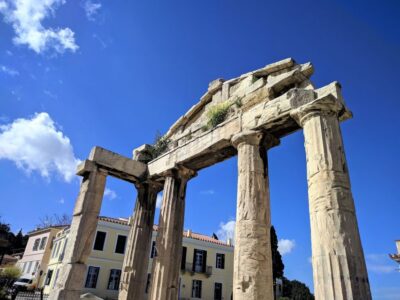
Next comes Hadrian’s Library, followed by the Roman Agora. This is a smart choice for a “philosophy and democracy” tour, because it reminds you that Athens didn’t stop at the classical period. City life kept changing, building, and reorganizing—often in ways that still influenced how people learned, governed, and used public space.
Hadrian’s Library is one of those landmarks that can look straightforward from far away, but gains meaning when the guide places it in the story of education and institutions. Even if you don’t go inside (admissions aren’t included), the stop is still useful. It becomes a setting for understanding how public knowledge and civic culture connected.
Then the tour shifts to the Roman Agora area, where you start to see the layering of Athens: Greek civic ideals on one level, then later Roman structures that reflect new kinds of public life. This isn’t just sightseeing variation. It changes your mindset from asking what Athens was, to understanding how it evolved.
On foot through Plaka and beyond


Tower of the Winds: a real-world science stop on a marble clock
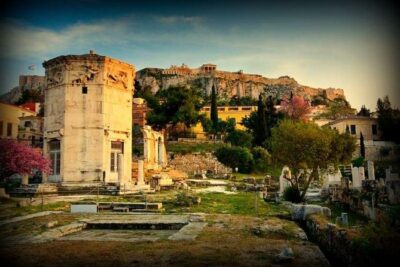
In the Roman Agora area, you reach the Tower of the Winds, an octagonal marble structure that served as a wind indicator and also as a clock. That’s a rare combination, and it’s exactly why this stop works: it puts science and observation into the same frame as public life.
The tour explains it as an early meteorological station, used to forecast weather. Even if you only remember one thing from the tour, remember this: Athens wasn’t only philosophers arguing in the abstract. People measured patterns, tracked conditions, and used that information in daily decisions.
This is also where the tour’s style shows up most clearly. Panos Fotiadis is praised for turning complex ideas into something you can actually picture while walking. With the Tower of the Winds, you’re not just hearing theory—you’re seeing a built object designed for practical thinking.
Short consideration: the tower is best enjoyed if you can slow down for a few minutes at a time. If you rush past monuments, you’ll miss the meaning the guide builds around it.
Plaka pass-by and the Ancient Agora: where daily life met political argument
As you continue, you pass by Plaka, the historic neighborhood known for small scenic houses and narrow streets. Think of this as a visual reset before you hit the heavier sites. Plaka helps you shift from “monument mode” into “walking neighborhood mode,” where Athens feels more like a city you could live in than a museum you must conquer.
Then you reach the Ancient Agora of Athens, described as the best-known example of an ancient Greek agora. This is the core civic stage: an area that once focused political, commercial, administrative, and social activity. That set of categories is the key, because it frames philosophy and democracy as parts of public life, not separate worlds.
When the guide ties philosophical theories to the places around the agora, you start to see why this route is called philosophy and democracy. The Ancient Agora is where citizens gathered, debated, and handled daily business. In other words, it’s where rational argument and civic process become normal habits.
If you’ve ever struggled to understand how democracy could grow beyond slogans, this part gives you a physical sense of what it relied on: space for meeting, rules for participation, and an environment where public reasoning mattered.
Pnyx Hill: the democracy hillside with views worth the walk
Now you climb to Pnyx Hill, a historic location for democracy. This is one of the emotional highlights of the tour because it connects a concept you may have heard in textbooks to a specific place built for civic participation.
Pnyx is also paired with the Philopappos Monument, described as an ancient Greek mausoleum. The tour encourages you to admire the view from the hilltop location. That matters because Athens’ “big idea” becomes easier to understand when you can see the city layout. From high ground, you grasp why certain gatherings mattered and why leaders and citizens would care about presence and proximity.
This is also where you’ll feel the payoff of the guide’s storytelling style. In the reviews, Panos is repeatedly praised for being fun, funny at moments, and able to explain philosophy so it doesn’t feel like a locked-door lecture. On Pnyx Hill, those explanations stick because the setting reinforces them.
Practical tip: on sunny days, bring water and pace yourself. Even an easy walk can feel longer under Greek heat. The route keeps a smooth tempo, but you’ll still be outdoors for a good portion of the 3.5 hours.
Acropolis pass-by: why this tour can help before you do the big one
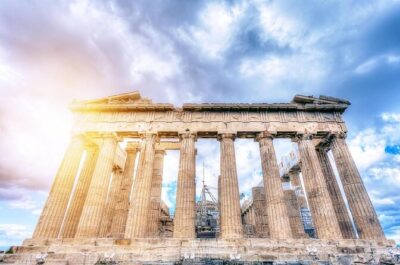
You finish with an Acropolis pass-by, described as an ancient citadel on a rocky outcrop above Athens. You’re not spending your entire time in the Acropolis complex on this route, so it won’t replace a dedicated Acropolis visit if you want maximum time on the main ruins.
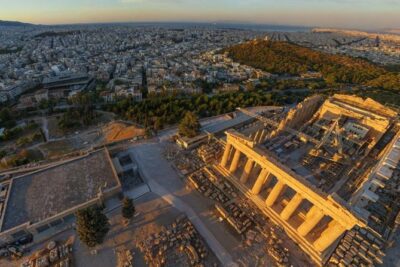
What it does instead is help you do something useful on your first day: get context. After seeing the democratic settings at Pnyx and the civic machinery around the agora, the Acropolis becomes more than a view. It becomes part of a political and cultural system.
So if you’re planning your itinerary, I like this approach: do this walk early for the framework, then return later (if you choose) with a clearer sense of what you’re looking at.
Price, group size, and value: why $49 can feel fair
The price is $49 per person for a 3.5-hour guided experience. Value here isn’t just the duration; it’s the fact that you’re covering multiple major areas tied together by a single storyline about how Athens thought and governed.
A few practical value points:
- Small groups (max 15) mean you’ll usually be able to hear the guide and ask questions without feeling lost in the crowd.
- Children up to 14 join for free, which makes the tour unusually good value for families.
- The route visits major landmarks like Kerameikos, Hadrian’s Library, Roman Agora, Tower of the Winds, and the Pnyx area, with admissions noted as not included.
About admissions: the tour lists admissions for several sites as not included, so you may still pay for entry to whatever parts you choose to go into on your own later. That said, the tour is built around stops where you can still learn a lot from the outside and from the viewpoints the walk gives you.
In plain terms: if you want a guided framework that helps you connect sites to ideas, the price makes sense. If you want all-day ruin time inside buildings, you’ll likely want a different type of ticketed tour too.
Who should book this Athens philosophy and democracy walk
This is a great fit if you:
- Want an Athens introduction that explains the logic behind democracy and philosophy, not just dates and names.
- Enjoy walking with a guide who tells stories and keeps moving through a narrative.
- Like having a plan for the first half of your day without committing to a huge, ticket-heavy schedule.
It may be less ideal if:
- You’re over 70 or need a very low-impact option, since it’s not suitable for people over 70 and includes some steps at the end.
- Your priority is maximum time in the Acropolis complex rather than the civic Athens that sits below and around it.
- You’re traveling with very small kids who may struggle with the learning-heavy pacing.
Before you go: what to bring and how to pace yourself
Bring comfortable shoes. The tour is described as easy, with a few steps at the end, but you’ll still be on foot for much of the 3.5 hours.
The tour runs rain or shine, so it’s smart to plan for weather changes. If it’s hot, take advantage of shaded stops when you can and don’t be shy about asking the guide questions as you pause.
Also, the tour is English and led live by your guide. In the reviews, Panos is singled out for being warm, humorous, and open to questions. That means the tour works best when you treat it like a conversation—ask what you want to understand.
Should you book this tour?
Yes, if you want a fast, smart Athens orientation that connects major landmarks to the ideas that shaped public life. For the price, you’re paying for a narrative engine: Panos Fotiadis helps you read the sites through the lens of philosophy, education, and democracy, and you’ll walk away with a clearer sense of how the city thought.
No, if you’re mainly chasing ticketed interior time inside the biggest monuments, or if walking won’t be comfortable for you. In that case, you’d be better served by a shorter, more accessible option focused on a single area.
If this matches your style, book it early in your trip. It’ll make your later Athens stops feel less like scattered ruins and more like connected arguments written into stone.
FAQ
How long is the Athens Philosophy and Democracy Walking Tour?
The tour lasts 3.5 hours.
Where does the tour meet?
You meet in front of the statue of Theseus, opposite the train station across the road.
Is the tour guided and in English?
Yes. It’s a live tour with an English-speaking guide.
Are site admissions included?
No. Admissions for Athens sites, Hadrian’s Library, the Roman Agora, the Tower of the Winds, and the Ancient Agora of Athens are not included.
Can children join the tour?
Children up to 14 years old join for free.
Does the tour run in bad weather?
Yes, the tour takes place rain or shine.
More Tour Reviews in Athens
- Athens: Acropolis & up to 5 Archaeological Sites Combo Pass★ 4.2 · 13,904 reviews
- Athens: Acropolis, Parthenon & Acropolis Museum Guided Tour★ 4.8 · 9,316 reviews
- The Acropolis, Parthenon & Acropolis Museum Guided Tour★ 4.7 · 8,493 reviews
- Athens: Cape Sounion & Poseidon Temple Sunset Half-Day Trip★ 4.8 · 8,241 reviews
- Acropolis: Premium Acropolis and Parthenon Guided Tour★ 4.8 · 5,208 reviews
- Athens: Mythology of Delphi, Museum and Arachova Guided Tour★ 4.7 · 5,102 reviews
Athens on Foot, Continued
- Acropolis and Parthenon Guided Walking Tour★ 5.0 · 4,755 reviews
- Greek Food Walking Tour in Athens★ 5.0 · 4,740 reviews
- Athens: Guided Greek Food Walking Tour with Tastings★ 4.9 · 2,859 reviews
- Acropolis monuments & Parthenon Walking Tour with Optional Acropolis Museum★ 5.0 · 2,678 reviews
- Athens Acropolis and Parthenon Walking Tour★ 4.5 · 1,355 reviews
- Acropolis, Parthenon & Athens Old City Heritage Walking Tour★ 4.5 · 876 reviews
Myth and Legend, Retold
- Athens: Mythology of Delphi, Museum and Arachova Guided Tour★ 4.7 · 5,102 reviews
- Athens & Acropolis Highlights: Greek Mythology Small-Group Tour★ 5.0 · 2,370 reviews
- Athens: Acropolis and Mythology Highlights Small Group Tour★ 4.8 · 2,275 reviews
- Philosophy and Democracy tour of Athens★ 5.0 · 285 reviews
- Athens: Mythology Tour for Families★ 4.8 · 173 reviews
- The History of Athens: Greek Mythology Private Tour★ 5.0 · 138 reviews
Fresh Off the Boat: New Athens Reviews





Athens Mythology Tours, compared.
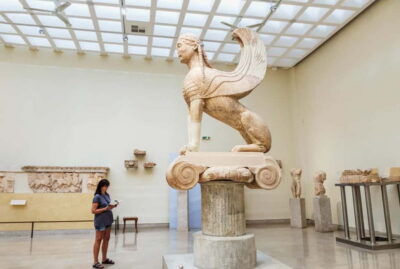 ★ 4.7Mythology of Delphi, Museum and Arachova Guided TourFrom $305,102 reviews
 ★ 5.0Athens & Acropolis Highlights: Greek Mythology Small-Group TourFrom $542,370 reviews
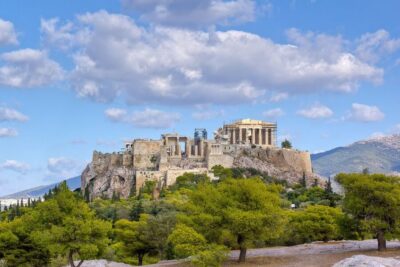 ★ 4.8Acropolis and Mythology Highlights Small Group TourFrom $532,275 reviews
 ★ 5.0Philosophy and Democracy tour of AthensFrom $50285 reviews
 ★ 4.8Mythology Tour for FamiliesFrom $79173 reviews
 ★ 5.0The History of Athens: Greek Mythology Private TourFrom $199138 reviews
 ★ 4.9Guided Mythological Walking TourFrom $47125 reviews
 ★ 5.0Greek Mythology Treasure Hunt for Kids – Athens Private TourFrom $17477 reviews
Browse the lists this tour appears in