

Reviewed · ACROPOLIS & PARTHENON TOURS
Athens: Guided Mythology Walking Tour Acropolis View
Myths start on modern street corners. I love how this walk ties mythology storytelling to places you can actually see today, and I like the fast orientation it gives you across central Athens. With only about 2 hours on the clock, you’ll cover a lot of ground and you may want extra time later for your favorite stop.
I also really liked the human touch from the guide—Rena keeps the stories fun, including details about the first kings of Greece and who created the Royal Gardens, then adding lighter, modern Greece facts. With a maximum group size of 30 and a mobile ticket, the tour feels organized without feeling stiff.
For the price of $42.14 per person, it’s a good “structured overview” deal, especially if you don’t want to plan a hop-by-hop route yourself. One consideration: the tour starts at Syntagma Square and finishes near the Statue of Theseus, so think about where you’ll eat next.
In This Review
- Key highlights to look for
- Why This Athens Mythology Walk Works as Your First-Day Plan
- Syntagma Square: Changing of the Guards and the Route Setup
- National Garden Break: A Calm Reset Between Big Monuments
- Panathenaic Stadium: Marble, Myths, and Ancient Sports Energy
- Temple of Olympian Zeus Ruins and Hadrian’s Arch: Seeing Roman Athens Next to Greek Sacred Space
- The Oldest Neighborhood, Roman Agora Ruins, and Hadrian’s Library
- Monastiraki Square: A Real Athens Break Between Ancient Stones
- Ancient Agora and the Temple of Hephaestus: Ending on a High-Meaning Landmark
- The Promised Acropolis View: How to Make It Count
- Price and Group Size: Is $42.14 Good Value?
- Who This Tour Suits Best (and Who Might Want More Time)
- Should You Book This Athens Guided Mythology Walking Tour?
- FAQ
- How long is the Athens guided mythology walking tour?
- What is the price per person?
- Where does the tour start?
- Where does the tour end?
- How many people are in the group?
- What language is the tour offered in?
- Do I need to print a ticket?
- Is there free cancellation?
- Where is it located in relation to transit?
Key highlights to look for
- Changing guards at Syntagma Square: a quick, free stop that sets the mood for the day.
- National Garden pause: a quieter break before the big monuments start stacking up.
- Panathenaic Stadium: the only stadium described as built entirely of marble in this route.
- Olympian Zeus + Hadrian’s Arch: Greek sacred space meeting the Roman layer right beside it.
- Hadrian’s Library and Roman Agora: ruins you can connect to the stories you hear on the walk.
- Ends by the Statue of Theseus: easy transition into the Theseio area after the tour.
More ways up the sacred rock, set side by side
- Athens: Acropolis & up to 5 Archaeological Sites Combo Pass
★ 4.2 · 13,904 reviews - Athens: Acropolis, Parthenon & Acropolis Museum Guided Tour
★ 4.8 · 9,316 reviews - The Acropolis, Parthenon & Acropolis Museum Guided Tour
★ 4.7 · 8,493 reviews - Acropolis: Premium Acropolis and Parthenon Guided Tour
★ 4.8 · 5,208 reviews
Why This Athens Mythology Walk Works as Your First-Day Plan
Athens can feel huge when you land—lots of neighborhoods, lots of ruins, and a lot of names. This tour gives you a guided thread from Syntagma Square out through major landmarks, so your brain starts making sense of where things are.
The biggest value is that the guide doesn’t treat the sites like museum exhibits behind glass. Instead, you connect the dots between the myths and the real streets, and you pick up context as you walk. By the end, you’re not just seeing famous stops—you’re understanding how different eras overlap in the same city blocks.
At 2 hours (approx.), it’s also realistic. You get a meaningful hit of Athens without blowing your entire day. The trade-off is time: you’ll get highlights, not deep study at every single spot.
Syntagma Square: Changing of the Guards and the Route Setup
You start at Syntagma Square (Plateia Syntagmatos), which is about as central as Athens gets. The first stop is the changing of the guards, held for around 10 minutes, and it’s listed as ticket free, so it’s a low-stress way to begin.
This opening works for two reasons. First, it’s visual and easy to join in with even if you’re still shaking off jet lag. Second, it gets you oriented right away in the city’s modern center before you head into historical layers.
Practical tip: come ready to stand and watch for a short window. If you arrive late, you’ll still catch something, but you’ll have less of the best sightlines for that 10-minute slice.
National Garden Break: A Calm Reset Between Big Monuments
After the guard ceremony energy, the walk shifts to the National Garden, described as a peaceful oasis in the heart of the city. Even if you’re not a garden person, this is a smart pacing move on a mythology walk—your feet keep moving, but your eyes finally get a breather.
This stop also matters because it connects to the guide’s storytelling. Rena is credited with bringing in details about the first kings of Greece and who created the Royal Gardens, which makes the garden feel like more than a green patch. You’ll likely find yourself listening differently here, since the setting encourages slower attention.
The main drawback? A garden stop isn’t the place for marathon sightseeing. It’s meant to reset you before you start seeing larger ruins and stone structures again, so if you expect a long linger, you might feel a little rushed. The good news is that the tour’s overall structure keeps those transitions smooth.
The old gods retold, a few more walks


Panathenaic Stadium: Marble, Myths, and Ancient Sports Energy
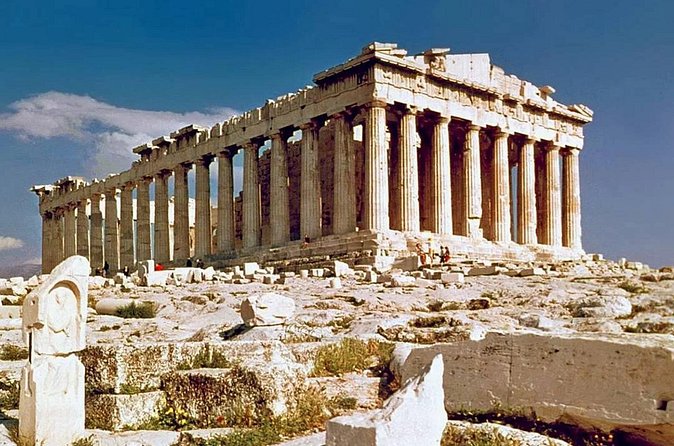
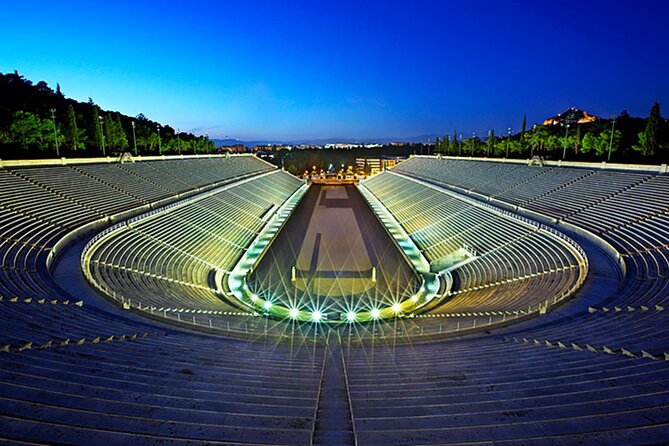
Next up is the Panathenaic Stadium, noted as the only stadium built entirely of marble. That detail alone is worth the stop, because it’s unusual and instantly gives you a concrete image—Athens didn’t only build temples and ruins, it also built sporting stages out of the same kind of material used for monumental culture.
For a mythology walking tour, this spot is a helpful bridge. Myths often involve people, contests, games, and public life, not just gods floating in the clouds. When you see a real arena, the stories stop being abstract and start feeling grounded in how ancient Athenians might have experienced public rituals and athletic events.
One thing to plan for: this is still a walking tour. You’ll see what you came for, but you won’t have endless time to wander every corner of the stadium area. If you love sports architecture, you might want to return later on your own—still, as a guided stop, it’s a strong use of time.
Temple of Olympian Zeus Ruins and Hadrian’s Arch: Seeing Roman Athens Next to Greek Sacred Space

Then the tour hits a major visual: the Temple of Olympian Zeus, described as a colossal ruin. It’s positioned next to the Arch of Hadrian, and that pairing is one of the smartest parts of the route.
Why? Because it helps you understand Athens as a layered city. You’re not only looking at Greek-era sacred space; you’re also seeing how later power left its mark right beside it. When you hear the myth framing and then look at stone remains, you start to feel the continuity—different eras speaking in the same urban language.
The Arch of Hadrian stop matters because it’s literally a marker of that overlap. In other cities, those eras are spread out across long distances. Here, they’re close enough that you can connect them while your feet are still on the same streets.
I also like that this segment doesn’t ask you to know everything already. Even if you’re starting from scratch, the guide can give you enough story context so the ruins don’t feel like random piles of stone.
The Oldest Neighborhood, Roman Agora Ruins, and Hadrian’s Library
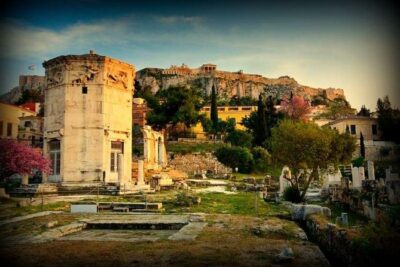
After the grand monuments, the route turns more street-level. The itinerary includes the oldest neighbourhood in Athens, then moves on to the ancient ruins of the Roman Agora and the library of Hadrian.
This is where the walk becomes practical. Ruins can look confusing if you just pass them at walking speed. But when your guide frames what you’re looking at, you start to spot relationships—where civic life happened, how different sites connect, and how the Roman presence reshaped everyday Athens.
If you enjoy “story geography,” you’ll probably like this part the most. Rena’s role (as described in the experience feedback) includes weaving myth and early Greek stories into the real places you’re standing in. With sites like the Roman Agora and Hadrian’s library, that approach works well because you can literally see civic and cultural functions in stone remnants.
The only consideration here is attention span. By the time you reach this part of the route, you’ve already seen several major highlights. So it helps to listen actively rather than just stare. If you take the guide’s cues, you’ll get more out of the ruins than you would on a self-walk.
Monastiraki Square: A Real Athens Break Between Ancient Stones

You’ll also reach Monastiraki square, one of the livelier hubs in central Athens. It’s a useful contrast stop: after ruins and monuments, you step into a place where today’s city rhythm is visible.
I like this type of stop on a guided walk because it lets your brain switch gears. You’re not only collecting historical images—you’re also mapping where you can actually spend time after the tour. If you plan to explore on your own later, Monastiraki is a convenient anchor point.
Try to use it strategically. Don’t treat it like a long lunch stop during the guided portion; instead, treat it like a moment to reorient and decide where you want to return once you’ve got your bearings. If your feet are tired, this is also a good moment to slow down for a minute and just watch the square.
Ancient Agora and the Temple of Hephaestus: Ending on a High-Meaning Landmark
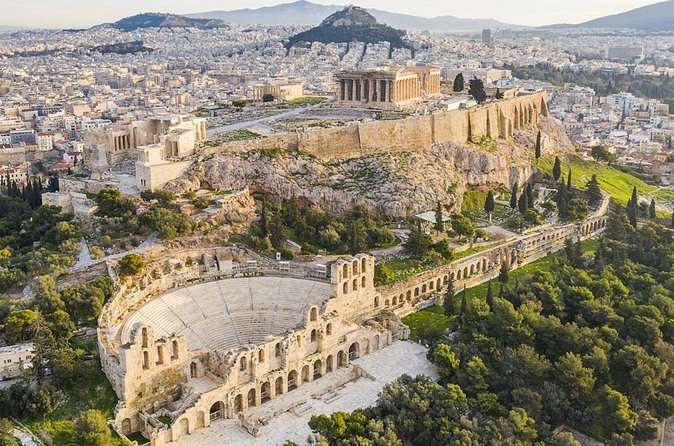
The final stretch includes the ancient agora and the temple of Hephaestus. For me, this ending works because it caps the walk with a classic Athens power center: the agora is the idea of public life, and Hephaestus gives you a clear, standout structure to focus on.
It’s also a logical capstone for a mythology tour. Agora spaces are where stories become public—where people gather, debate, perform, and honor. You’ve heard myth and early royal stories earlier; here the tour wraps those ideas around a place connected to the public heart of the city.
The tour ends at the Statue of Theseus, described as nearby to Thiseio Metro station. That matters because you’re not stuck far from transport when the tour ends. You can easily continue with your day—either by going back toward your base or by planning a nearby meal and follow-up exploring.
The Promised Acropolis View: How to Make It Count
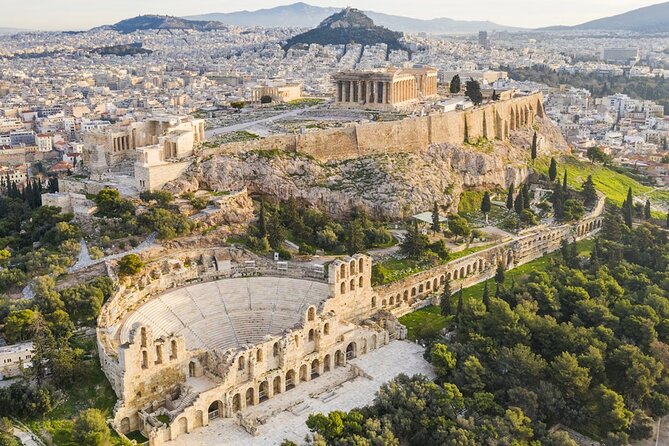
The tour title includes an Acropolis view, but the detailed stop list you have focuses on central Athens landmarks. That means the viewpoint component may be brief or folded into one of the walk segments.
So here’s how to make it work for you: when you book, confirm where the Acropolis view moment happens and how long you’ll have to look. During the walk, keep an eye out for guide cues that signal a viewpoint window, since 2 hours goes fast and it’s easy to miss a short sightline opportunity.
If the Acropolis view is a top priority for your trip, I’d treat this tour as a great add-on for orientation, not a replacement for a longer Acropolis visit later. You’ll likely get enough to connect the dots, then want a fuller look with more time.
Price and Group Size: Is $42.14 Good Value?
At $42.14 per person for about 2 hours, this sits in the “structured tour without a huge time commitment” category. You’re paying for three things: a guided route linking myth stories to real landmarks, a tight itinerary that prevents decision fatigue, and the fact that you’re walking between several major stops rather than just doing one or two.
A max group size of 30 is also a value point. It’s big enough for a lively atmosphere, but small enough that a guide can keep the group together and explain what you’re seeing without losing everyone.
Also, it’s offered in English, and you get a mobile ticket. If you don’t want to fuss with printed passes while you’re traveling, that’s a real comfort feature, not just a detail.
Timing note from the booking pattern: it’s commonly booked about 41 days in advance on average. That suggests demand stays steady. If you have fixed dates, book early so you don’t end up with only the least convenient time slots.
Who This Tour Suits Best (and Who Might Want More Time)
This tour is a great fit if you want a guided way to connect Athens landmarks quickly, especially your first day or first full day in the city. You’ll likely enjoy it if you like hearing myth and then seeing the physical places tied to culture and civic life.
I also think it suits couples, solo travelers, and small friend groups who want structure but still want freedom afterward. The end point near Thiseio Metro helps you keep moving without extra stress.
If you’re the type who loves lingering at ruins for long periods, you might find the “high points” format a little fast. In that case, you can still book it for orientation, then plan longer independent visits to the sites that really grab you—especially if the Temple of Olympian Zeus ruins, the Panathenaic Stadium, or the Ancient Agora area are your top interests.
Should You Book This Athens Guided Mythology Walking Tour?
I’d book it if you want a myth-told, practical route through central Athens that doesn’t eat your whole day. The price is reasonable for the number of major landmarks in the 2-hour window, and the guide storytelling—especially details credited to Rena—makes the stops feel connected instead of random.
Skip it only if you already have a very detailed plan for central Athens and you’re planning to spend long hours at each monument. This tour shines as a “get your bearings fast” experience, and it’s best used as a foundation for the rest of your trip.
If you care about the Acropolis view specifically, double-check when and where that moment happens before you commit. Then you can decide if it’s enough for your priorities—or if you’ll also schedule a longer Acropolis outing.
FAQ
How long is the Athens guided mythology walking tour?
It lasts about 2 hours (approx.).
What is the price per person?
The price is $42.14 per person.
Where does the tour start?
The meeting point is Syntagma Square, Plateia Syntagmatos, Athens, Greece.
Where does the tour end?
The tour ends at the Statue of Theseus, Athens 105 55, Greece (near Thiseio Metro station).
How many people are in the group?
The tour has a maximum of 30 travelers.
What language is the tour offered in?
The tour is offered in English.
Do I need to print a ticket?
No. It includes a mobile ticket.
Is there free cancellation?
Yes. You can cancel for a full refund if you cancel at least 24 hours before the experience start time.
Where is it located in relation to transit?
It is near public transportation.
Athens on Foot, Continued
- Acropolis and Parthenon Guided Walking Tour★ 5.0 · 4,755 reviews
- Greek Food Walking Tour in Athens★ 5.0 · 4,740 reviews
- Athens: Guided Greek Food Walking Tour with Tastings★ 4.9 · 2,859 reviews
- Acropolis monuments & Parthenon Walking Tour with Optional Acropolis Museum★ 5.0 · 2,678 reviews
- Athens Acropolis and Parthenon Walking Tour★ 4.5 · 1,355 reviews
- Acropolis, Parthenon & Athens Old City Heritage Walking Tour★ 4.5 · 876 reviews
Myth and Legend, Retold
- Athens: Mythology of Delphi, Museum and Arachova Guided Tour★ 4.7 · 5,102 reviews
- Athens & Acropolis Highlights: Greek Mythology Small-Group Tour★ 5.0 · 2,370 reviews
- Athens: Acropolis and Mythology Highlights Small Group Tour★ 4.8 · 2,275 reviews
- Philosophy and Democracy tour of Athens★ 5.0 · 285 reviews
- Athens: Mythology Tour for Families★ 4.8 · 173 reviews
- The History of Athens: Greek Mythology Private Tour★ 5.0 · 138 reviews
The Acropolis, a Few More Ways Up
- Athens: Acropolis & up to 5 Archaeological Sites Combo Pass★ 4.2 · 13,904 reviews
- Athens: Acropolis, Parthenon & Acropolis Museum Guided Tour★ 4.8 · 9,316 reviews
- The Acropolis, Parthenon & Acropolis Museum Guided Tour★ 4.7 · 8,493 reviews
- Acropolis: Premium Acropolis and Parthenon Guided Tour★ 4.8 · 5,208 reviews
- Acropolis and Parthenon Guided Walking Tour★ 5.0 · 4,755 reviews
- Athens: Acropolis, Parthenon & Acropolis Museum Guided Tour★ 4.8 · 3,579 reviews
Fresh Off the Boat: New Athens Reviews





Acropolis & Parthenon Tours, compared.
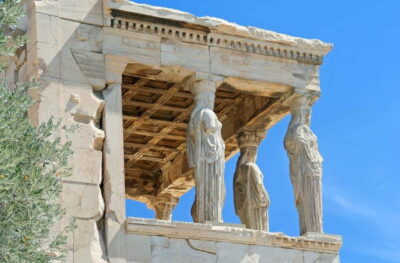 ★ 4.2Acropolis & up to 5 Archaeological Sites Combo PassFrom $4213,904 reviews
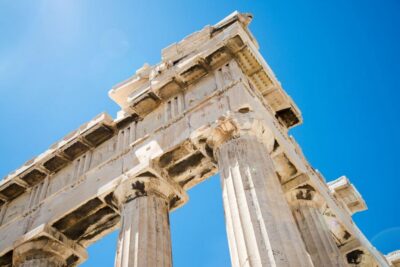 ★ 4.8Acropolis, Parthenon & Acropolis Museum Guided TourFrom $409,316 reviews
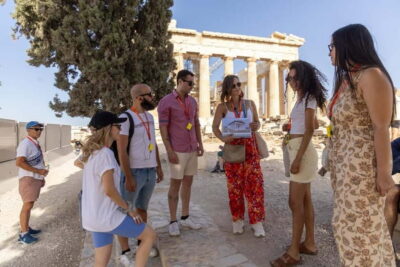 ★ 4.7The Acropolis, Parthenon & Acropolis Museum Guided TourFrom $408,493 reviews
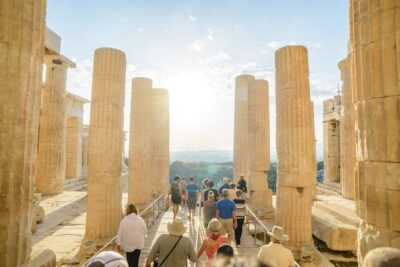 ★ 4.8Acropolis: Premium Acropolis and Parthenon Guided TourFrom $405,208 reviews
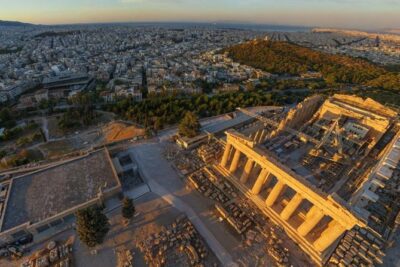 ★ 5.0Acropolis and Parthenon Guided Walking TourFrom $414,755 reviews
★ 4.8Acropolis, Parthenon & Acropolis Museum Guided TourFrom $413,579 reviews
★ 5.0Acropolis and Parthenon Guided Walking TourFrom $414,755 reviews
★ 4.8Acropolis, Parthenon & Acropolis Museum Guided TourFrom $413,579 reviews
 ★ 4.0Acropolis Ticket with Audio GuideFrom $473,575 reviews
 ★ 5.0Athens Scenic Electric Bike Tour with optional Acropolis visitFrom $353,350 reviews
Browse the lists this tour appears in